

 العربية

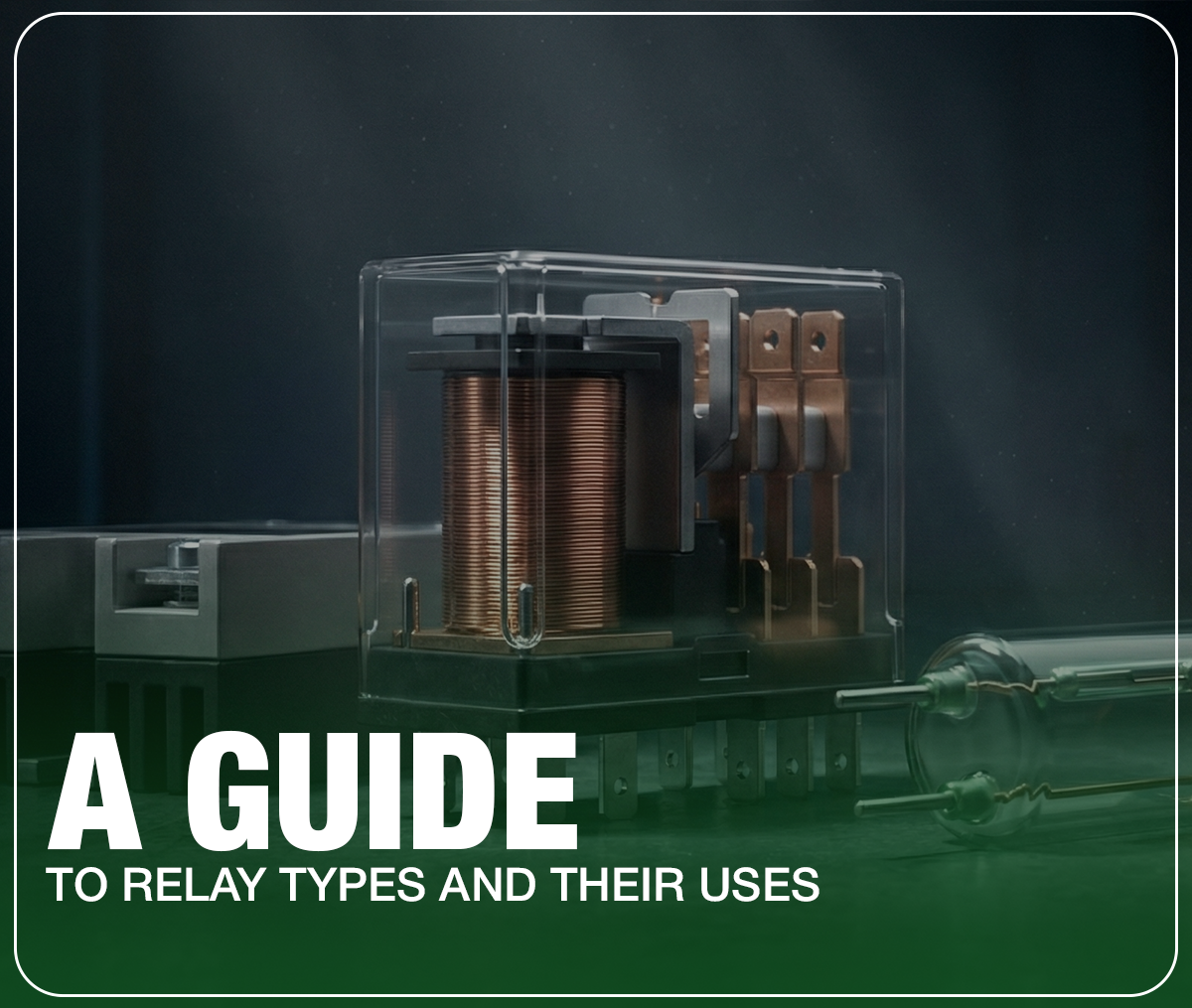

A Guide to Relay Types and Their Uses
Introduction
Are you confused by the seemingly unlimited variety of relays? You are not alone! To make things easier, we’ve divided six popular relay types commonly used in a low current panel to help you understand their different functions and pick which one is best for your application.
Before we get started, let me clarify: a relay is an electrically operated switch. A mechanical switch is operated manually, whereas an electrical relay serves the same purpose. Although all relays follow the same underlying idea, their unique characteristics and uses differ. Continue reading to learn more about the differences and how to choose the best relay for your project.
Change-Over Relays
A Change-Over Relay is one of the most common relay types, with five pins and two contacts coupled to a single terminal. These relays can function as either:
NO/NC Changeover Relay
- Normally Open (NO): The circuit remains disconnected (open) until the relay coil is activated. When powered, the circuit closes.
- Normally Closed (NC): The circuit remains linked (closed) until the relay coil is energized, at which point it opens.
The Change-Over relay may regulate two different circuits, one NO and one NC, and switch between them as needed. However, both circuits cannot be operational at the same time.
Regular maintenance and inspections are essential for maintaining your electrical panel in good condition. A well-maintained panel not only guarantees that your electrical system runs smoothly, but it also reduces the danger of safety issues such as electrical fires or power surges.
If you see flickering lights, tripped breakers, or burning odors, these could be early indications of problems with your panel.
Time Delay Relays
A Time Delay Relay (XT2N) acts similarly to a regular relay but contains a timing component. Even when the power source is turned off, this relay maintains a power supply for a set amount of time, which can range from a few seconds to many minutes.
Time Delay Relay:
- On-Delay: Starts timing when the voltage is applied. After the delay, the contacts close.
- Off-Delay: Starts timing only once the control input is gone. The contacts remain closed during the time before opening.
Understanding the timing specification (on-delay or off-delay) is critical for use in applications that require precise control over time.
Latching Relays
Even when the power is turned off, a latching relay keeps its position (set or rest). This memory-like feature makes it excellent for applications such as controlling a light with many switches.
For example, in a multi-way switch configuration, the relay remembers whether the light is turned on or off, providing proper performance independent of the previous switch state.
Solid State Relays
A Solid State Relay (SSR) differs from regular relays in that it contains no moving parts. Instead, it transfers current through semiconductor components, resulting in:
Mechanical relays are slower and less durable.
The absence of moving parts makes it resistant to wear and strain.
It comes with ignition prevention, making it suited for explosive situations or hard climates.
SSRs are ideal for high-frequency operations and situations where reliability is critical.
Potted Relays
A Potted Relay is specially built for harsh situations. These relays are sealed with materials like thermosetting polymers or silicone rubber to prevent:
- Dust and dampness.
- Shock and vibrations.
This makes them perfect for marine, industrial, and other demanding applications that require high reliability.
Hi-Amp Relays
In addition to the relay types listed above, Hi-Amp Relays are employed in high-power applications such as engine control, glow plugs, heated screens, and preheating systems.
Final Thoughts
With so many options, selecting the proper relay might be difficult. Hopefully, this guide has simplified the procedure! Do you still have questions? Learn more about how relays work or Contact us and we will help you choose the right ABB relay for you.
FAQs
What factors should I consider when selecting a relay?
Consider load current, voltage, switching frequency, timing needs, and environmental conditions to choose the right relay.
When should I use a solid state relay instead of a mechanical relay?
Use a solid state relay for high-speed switching, frequent operations, or harsh and explosive environments.