

 العربية

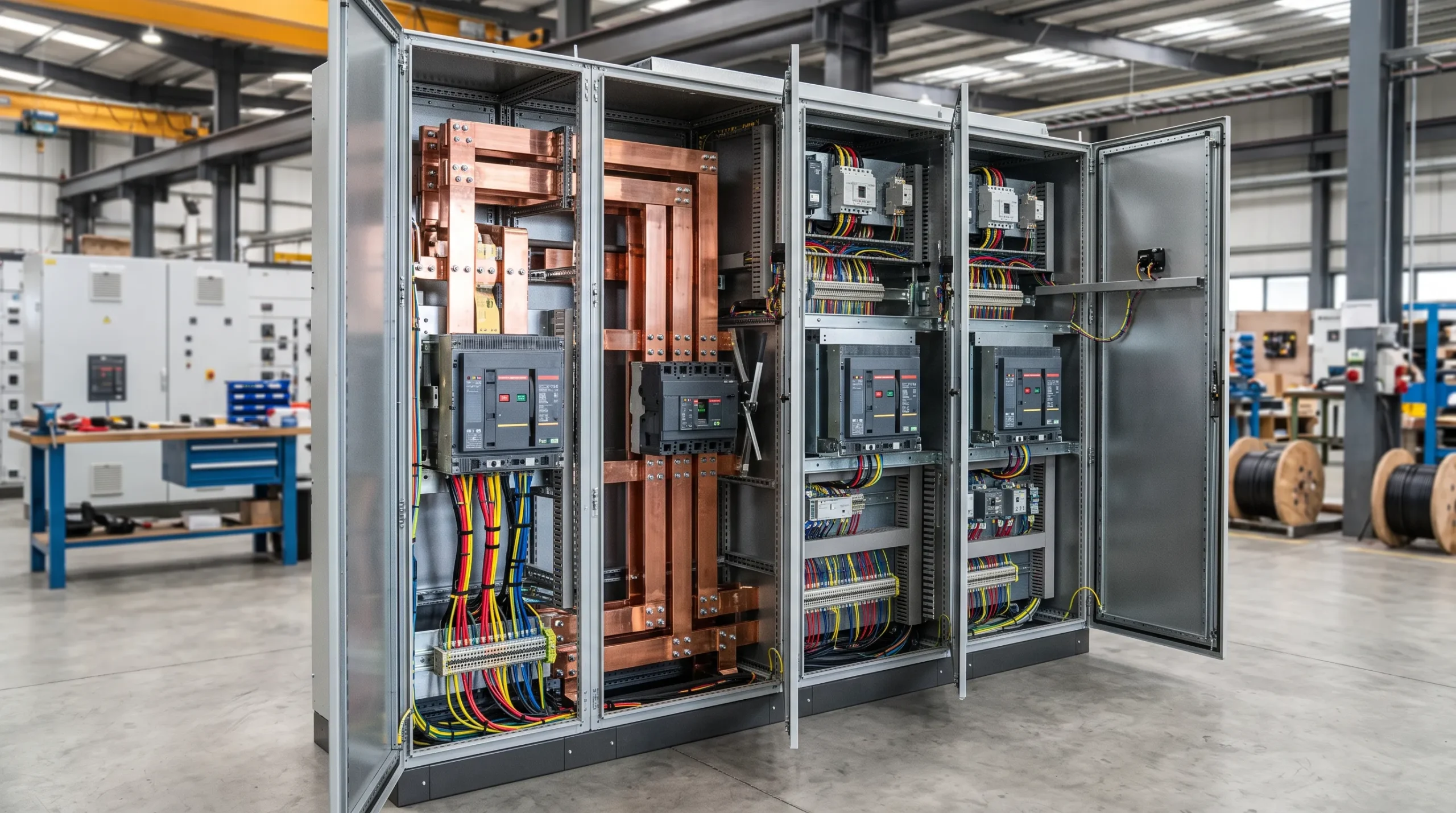
A quotation arrives with a single line that reads “type-tested panel, built to IEC 61439.” It sounds reassuring, and it is hard to argue with. But what exactly was tested, by whom, and does it cover the panel you are about to pay for?
That question is worth asking, because the phrase is used loosely. IEC 61439 is a family of standards with specific rules about how a low voltage assembly is designed, verified, and delivered. A buyer who knows the structure can read a quotation, a datasheet, and a nameplate with far more confidence.
ARC Technologies is an official ABB partner and official ABB panel manufacturer. Low voltage assemblies are at the heart of our Low Voltage Panel Builder offering, so these are questions we meet from buyers every week.
What is IEC 61439?
IEC 61439 is the international standard series for low voltage switchgear and controlgear assemblies, meaning the panels, boards, and enclosures that combine breakers, busbars, contactors, and control gear into one working unit. The series covers assemblies rated up to 1,000 V AC or 1,500 V DC.
The structure is simple once you see it. Part 1 sets the general rules. IEC 61439-1 lays down the general definitions, service conditions, construction requirements, technical characteristics, and verification requirements. The later parts apply those rules to particular types of assembly, and Part 2 covers power switchgear and controlgear assemblies, which is what most industrial buyers mean by a panel.
The first edition of the series arrived in 2009 and replaced the older IEC 60439-1. The current third edition of Part 1 was published in 2020, and it cancels and replaces the 2011 edition. If a supplier cites an edition, check that it is the one you intend to specify.
What does "type-tested" mean under IEC 61439?
The old standard divided assemblies into two groups: type-tested assemblies and partially type-tested assemblies. IEC 61439 removed that distinction. In its place, the standard asks for design verification, a proof that the design meets every requirement, whichever route was used to prove it.
Three routes are allowed, and the standard treats them as equivalent:
Verification Method | What It Means |
Testing | A representative assembly is physically tested in a laboratory environment. |
Calculation or measurement | The result is derived by mathematical calculation or calibrated physical measurements. |
Design rules | The design is proven to follow strict rules based on an already verified reference design. |
So when someone says “type-tested panel,” the accurate reading is “a panel whose design has been verified.” Testing is one way to get there, not the only one. The useful question for a buyer is which method was used for each characteristic and where the evidence sits.
What does design verification cover?
Design verification checks that the overall design of the assembly, not just each unit, is sound. Among the characteristics it covers are
- Strength of materials and parts
- Degree of protection provided by the enclosure (IP rating)
- Clearances and creepage distances
- Protection against electric shock and integrity of protective circuits
- Incorporation of switching devices and components
- Internal electrical circuits and connections
- Terminals for external conductors
- Dielectric properties
- Temperature rise limits
- Short-circuit withstand strength
- Electromagnetic compatibility (EMC)
- Mechanical operation
Two of those deserve a closer look:
- Temperature rise decides how much current the assembly can carry continuously. The 2020 edition of Part 1 introduced a group-rated current for circuits within a loaded assembly, refocusing temperature-rise verification on realistic operating conditions.
- Short-circuit withstand decides whether the busbars and mechanical supports survive the violent electromagnetic forces of a fault until the protective device clears it.
IEC 61439-2 adds further detail for power assemblies, including temperature-rise verification routes for large currents and for actively cooled assemblies.
What is routine verification, and why does every panel need it?
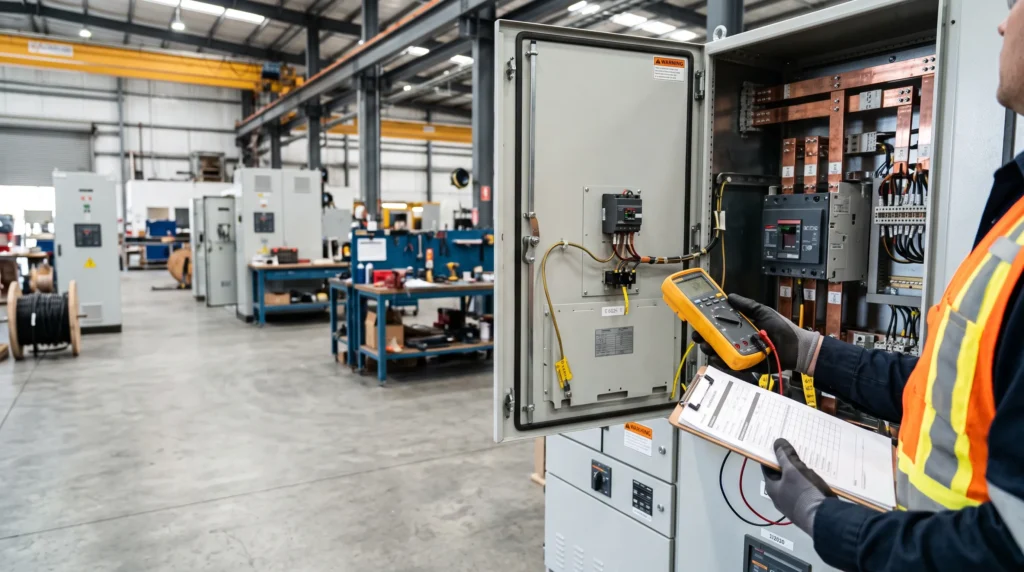
Design verification proves the design. Routine verification proves that this particular panel was built correctly. It applies to every assembly that leaves the workshop, replacing what older standards called routine tests.
A routine verification panel check typically inspects:
- Degree of protection of the enclosure
- Clearances and creepage distances
- Protection against electric shock and continuity of protective circuits
- Correct incorporation of built-in components
- Internal wiring and connections
- Terminal fit for external conductors
- Mechanical operation
- Dielectric properties
- Wiring, operation, and electrical function
Think of it this way: Design verification is the crash test of a car model. Routine verification is the final quality inspection of the individual car before it leaves the factory. You need both, and a formal record of routine verification is part of what you are paying for.
Attribute | Design Verification | Routine Verification |
Question Answered | Is the overall engineering design compliant? | Was this specific assembly built and wired correctly? |
Applies To | The design family (performed once) | Every single assembly before dispatch |
Typical Evidence | Type test report, calculation, or verification certificate. | Routine test report/verification certificate for the panel |
Who is the original manufacturer, and who is the assembly manufacturer?
The standard separates two roles that are sometimes the same company and sometimes not:
- The Original Manufacturer: The organization that carried out the original design and its complete verification (such as ABB providing the verified system architecture).
- The Assembly Manufacturer: The organization that builds the finished assembly and takes full commercial and technical responsibility for it (such as ARC Technologies assembling the panel).
This split explains why a panel builder can legitimately use a verified design from a system provider, as long as the assembly is built strictly within the limits of that verified design. Once a builder departs from those limits with different component brands, altered busbar layouts, or higher ratings, the original verification no longer applies. New verification is required by test, calculation, or design rules.
For a buyer, the takeaway is simple: ask which verified design the panel is based on, and ask the builder to confirm in writing that the build sits entirely within its tested limits.
What are forms of separation in IEC 61439?
Forms of separation describe how the inside of an assembly is divided into compartments using barriers or partitions. The purpose is to limit contact with live parts of neighboring units, reduce the spread of an internal arc or fault, and allow maintenance on one section while others stay energized. Part 2 of the series defines the forms:
Form | Internal Separation Description |
Form 1 | No internal separation between busbars, functional units, or terminals. |
Form 2 | Busbars separated from functional units. • Form 2a: Terminals not separated from busbars. • Form 2b: Terminals separated from busbars. |
Form 3 | Busbars separated from functional units, and functional units separated from each other. • Form 3a: Terminals not separated from busbars. • Form 3b: Terminals separated from busbars and other units. |
Form 4 | Busbars separated from functional units, functional units separated from each other, and complete separation of external terminals. • Form 4a: Terminals in the same compartment as the functional unit. • Form 4b: Terminals in separate, dedicated compartments. |
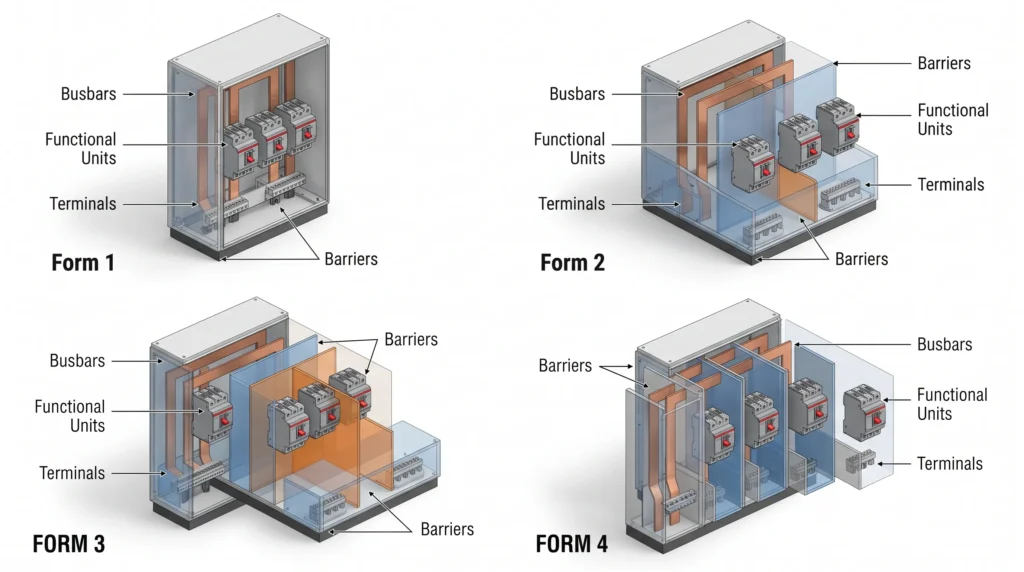
Higher forms offer superior operator safety and easier maintenance, but they require a larger physical footprint and carry higher cost. Choosing the form of separation must reflect plant operations: if a production line cannot shut down to service a feeder breaker, Form 4 is worth the investment. For a simple distribution board that can be fully isolated during servicing, Form 1 or Form 2 is often sufficient.
Always state the required form of internal separation in your tender specification. If left unspecified, suppliers will default to the lowest-cost configuration.
How is IEC 61439 different from the older IEC 60439?
The change is one of philosophy:
- Under IEC 60439, categories like “TTA” (Type-Tested Assembly) and “PTTA” (Partially Type-Tested Assembly) made compliance look like a static badge.
- Under IEC 61439, compliance is an unbroken chain of verifiable evidence: every design characteristic has an approved verification route, every calculation or test has documented records, and every panel undergoes routine verification before delivery.
The newer standard also clarified critical practical criteria:
- Temperature-Rise Limits: Clarified rated diversity factors (RDF) and realistic circuit load grouping.
- Empty Enclosures: Integrated standards for empty enclosures into the verification framework.
- Integration of Power Electronics: The 2020 third edition confirmed that while VFDs, soft starters, and UPS units comply with their own product standards, their installation within the enclosure must be verified under IEC 61439 assembly rules.
- Shock Protection: Introduced Class I and Class II classifications for protective circuit integrity.
If a tender response still quotes “TTA” or “PTTA,” the vendor is using obsolete terminology from a standard withdrawn years ago.
Which ratings and documents should come with the panel?
A compliant assembly must carry an indelible nameplate and comprehensive documentation:
- Name or trademark of the assembly manufacturer
- Type designation or unique serial/identification number
- Date of manufacture
- Governing standard (e.g., IEC 61439-2)
- Rated operational voltage (Ue) and rated current (In) of the assembly and individual circuits
- Short-circuit withstand ratings (Icw and Ipk or conditional rating Icc)
- Degree of protection (IP rating)
- Form of internal separation
- Rated Diversity Factor (RDF)
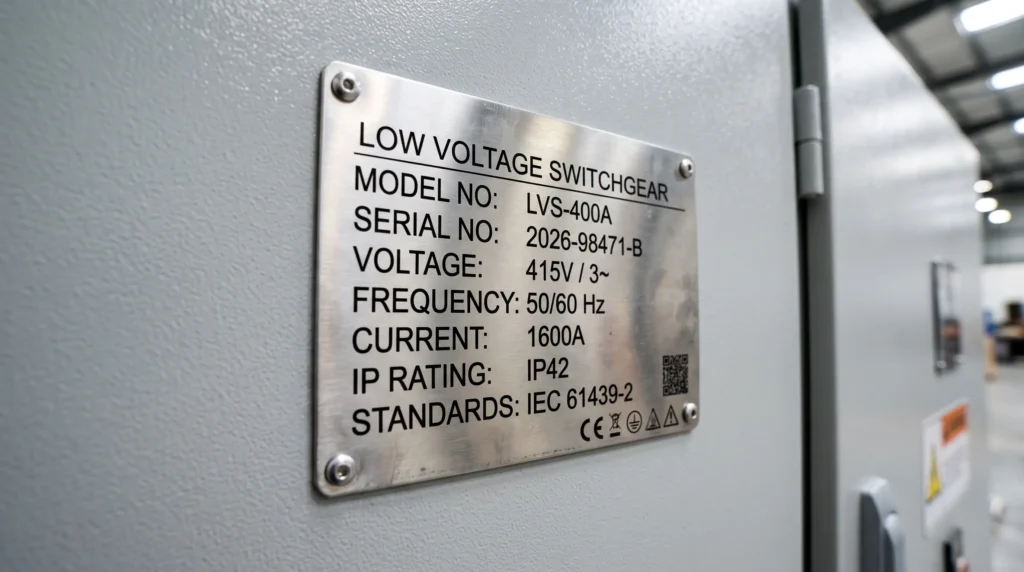
The Rated Diversity Factor (RDF) is critical: it defines the simultaneous loading capability of all outgoing circuits. If an engineering design assumes an RDF that your operational profile exceeds, the switchboard will run significantly hotter than specified.
What should buyers ask for before ordering?
Include these questions in your technical evaluation:
- Which specific part and edition of IEC 61439 does the proposed assembly comply with?
- Which verification method (test, calculation, or design rule) was applied to each required design characteristic?
- Which original verified design (e.g., ABB system) is the switchboard based on, and does the configuration stay within verified limits?
- What are the rated current, short-circuit withstand rating, and rated diversity factor (RDF)?
- What form of separation is provided for busbars, functional units, and cable terminals?
- Will a routine verification test certificate for this specific panel serial number be provided upon factory acceptance?
- Are all installed switchgear components covered under the design verification documentation?
A qualified panel manufacturer provides these documents routinely. Hesitation or vague brochure statements indicate a lack of compliance.
Does an existing panel have to meet IEC 61439?
An existing switchboard manufactured to IEC 60439 remains legally valid under the standard in force at its time of commissioning. Age alone does not make a switchboard non-compliant.
However, compliance questions arise when the board is modified, extended, or refed:
- Adding higher-rated breakers
- Increasing upstream transformer capacity (which increases available prospective short-circuit fault levels)
- Re-routing internal busbars
Any of these modifications can push the panel beyond its original design boundaries. A formal site audit evaluating the nameplate, single-line diagrams, and current thermal and mechanical condition is the first step. Our Diagnostics & Testing Services assess legacy switchgear on-site.
Where upgrades, busbar modifications, or breaker replacements are needed, our Modernization & Retrofit Services engineers provide compliant solutions. For new installations, certified verification is built into our core manufacturing workflow via our Panel Building facilities.
IEC 61439 in short
- Scope: Covers low voltage assemblies up to 1,000 V AC or 1,500 V DC.
- Verification: Replaces “type-tested” with documented design verification (test, calculation, design rules).
- Quality Assurance: Requires individual routine verification for every manufactured panel before dispatch.
- Key Parameters: Form of internal separation, short-circuit rating (Icw), and Rated Diversity Factor (RDF) must always be defined in tender documents.
Talk to ARC Technologies engineers
Reviewing switchgear quotations and evaluating compliance evidence? Share your tender specifications, vendor proposals, and single-line diagrams with our engineering team. We will review your documentation and identify any compliance gaps. Contact ARC Technologies to speak directly with a technical specialist or request an engineering consultation.