

 العربية

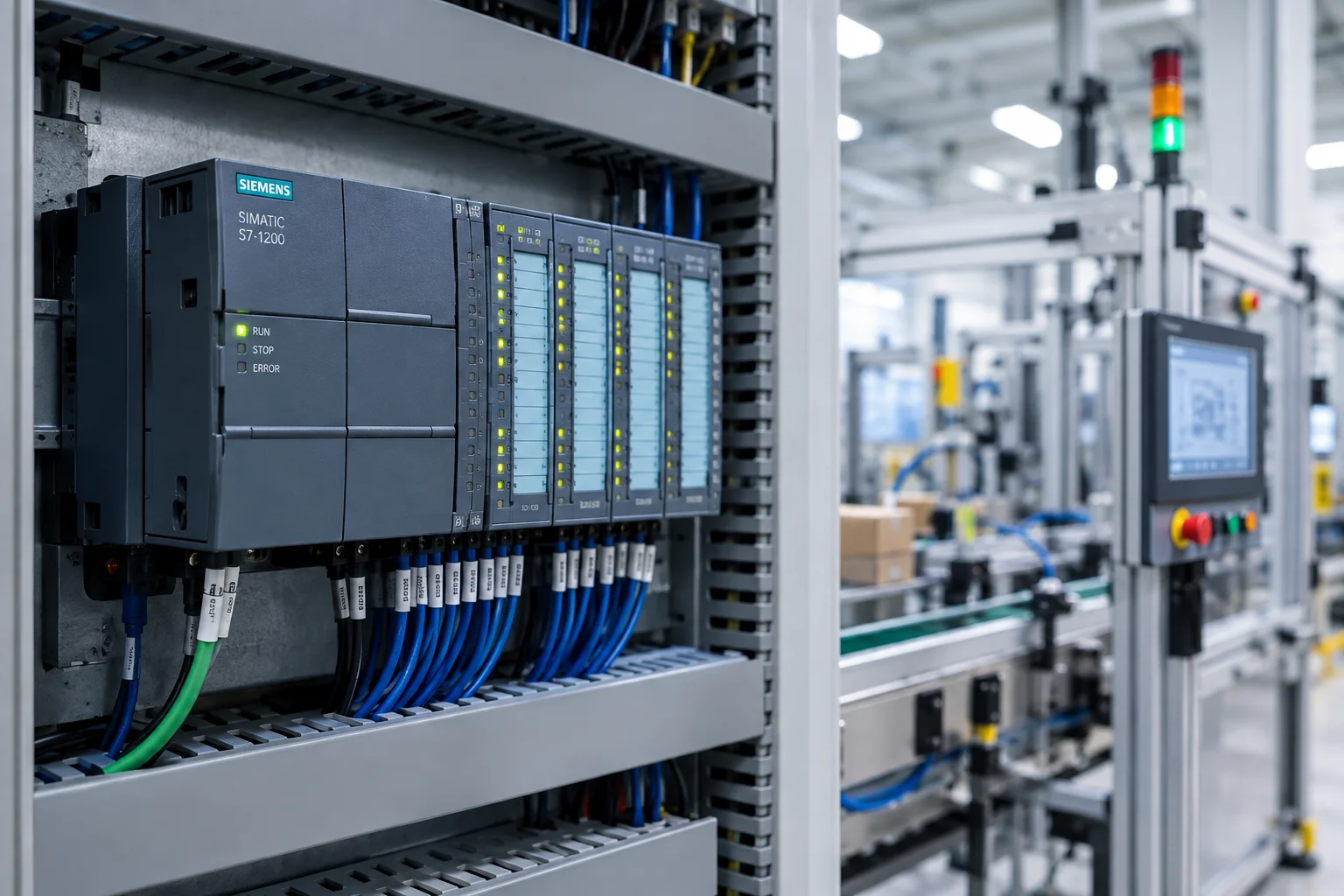
Walk onto almost any production floor, and the machine you notice first is rarely the one actually running the show. The conveyor, the pump skid, and the packaging line. All of it is being coordinated by a grey metal box tucked inside a control cabinet, quietly reading sensors and firing outputs thousands of times a second. That box is a programmable logic controller, and it is arguably the single most important piece of hardware most plant managers rarely think about until it fails.
A programmable logic controller is the piece of industrial hardware that turns raw sensor signals into coordinated machine behavior. It has been doing this job since the late 1960s, when General Motors needed a way to replace rooms full of relay panels with something that could be reprogrammed instead of rewired every time a production line changed. That original problem, cutting downtime and rewiring costs whenever a process changes, is still the reason PLCs are everywhere in manufacturing today.
This article breaks down what a PLC actually is, how it works step by step, the components involved, the major brands you will run into, and where the technology shows up across real facilities.
What Is a PLC?
A PLC is an industrial computer designed to monitor inputs, execute a stored set of instructions, and control outputs in real time, inside an environment that would destroy a standard office computer within days. Heat, vibration, electrical noise, and airborne dust are normal conditions on a factory floor. A PLC is built specifically to tolerate all of it.
Unlike a general-purpose computer, a PLC exists for one job: deterministic control. It runs the same logic cycle over and over, checking inputs, updating outputs, and then repeating, often dozens or hundreds of times per second. A desktop operating system juggles several applications with unpredictable timing. An industrial controller cannot afford that unpredictability. A motor starter that responds a half second late because the controller was busy elsewhere can damage equipment, spoil a batch, or trigger a safety incident.
The term itself is straightforward once you break it apart:
- Programmable means the logic can be written and changed without altering the physical wiring.
- Logic refers to the conditional rules the controller follows; essentially, if this happens, then do that.
- The controller is the hardware executing those rules and managing the connected equipment.
Put together, that is the PLC meaning in practical terms: a ruggedized, reprogrammable brain for automated machinery. So when someone asks what a PLC controller is, the short answer is that it is the device standing between your sensors and your equipment, deciding what happens next.
How a PLC Works: Inputs, Logic, Outputs
Every PLC, regardless of brand or size, runs on the same basic cycle. Understanding this cycle answers most of the practical questions people have about how these controllers actually earn their keep on a production line.
Inputs. Field devices such as proximity sensors, push buttons, pressure switches, and temperature transmitters send signals into the controller. These can be digital, simply on or off, or analog, meaning a variable value like a 4 to 20 mA signal representing pressure, level, or flow.
Processing. The central processing unit reads the current state of every input and evaluates the stored program against it. This is where the logic actually lives. It is most commonly written in one of a few standard languages:
- Ladder logic, the most widely used format, visually resembling an electrical relay circuit
- Structured text, a more programming-like language suited to complex math and data handling
- Function block diagrams, useful for visualizing signal flow between logic blocks
These are among the languages defined under IEC 61131-3, the international standard covering PLC programming, which is part of why controllers from different manufacturers can still be programmed using broadly similar concepts.
Outputs. Based on what the logic determines, the controller energizes or de-energizes outputs. That might start a motor, open a valve, trigger an alarm, or light an indicator on a panel.
This entire sequence—input, logic, output—is known as the scan cycle, and it repeats continuously for as long as the controller is running. A typical scan can take anywhere from a few milliseconds to tens of milliseconds, depending on program size and controller performance. Scan time matters more than most people assume. A slower cycle means a delayed reaction to a changing input, and that delay is a real concern in high-speed packaging lines or anything involving safety interlocks.
It is worth being honest about one thing here: PLC logic is not magic. It only does what it has been programmed to do, and a poorly written program will execute a bad instruction just as faithfully as a good one. This is exactly why programming and commissioning quality matter as much as the hardware itself when a facility plans an automation upgrade.
Key Components of a PLC System
A complete PLC system is more than the controller sitting in the cabinet. Several components work together, and each one has a specific job:
- CPU (central processing unit): executes the program logic and manages memory, timing, and diagnostics.
- Power supply: converts incoming AC or DC power into the voltage the controller and its modules actually need.
- Input/output (I/O) modules: physically interface with sensors and actuators, converting field signals into something the CPU can process, and vice versa.
- Programming device and software: a laptop or workstation running the vendor’s programming environment, used to write, test, simulate, and download logic to the controller.
- Communication interfaces: Ethernet, Modbus, Profibus, or similar protocols that let the PLC talk to other controllers, an HMI, or a plant-wide SCADA system.
- HMI (human-machine interface): technically a separate device, but almost always paired with a PLC, giving operators a screen to monitor and adjust the process without needing to touch the code.
Some smaller machines run these components as a compact, standalone unit inside one enclosure. Larger or more complex lines usually integrate the PLC alongside motor starters, circuit protection, and power distribution as part of a full custom-built control panel. That approach tends to be more practical whenever a single controller is going to manage several pieces of equipment on the same line, since it keeps wiring, protection, and control logic organized in one place instead of scattered across separate enclosures.
Common PLC Brands Used in Industrial Facilities
Several manufacturers dominate industrial automation, and most facilities settle on one or two brands to keep spare parts, training, and programming knowledge consistent across the plant. Names you will run into repeatedly include:
- Siemens
- Allen-Bradley (Rockwell Automation)
- Schneider Electric
- Mitsubishi Electric
- ABB
Each offers controller families that scale from small standalone machines to plant-wide distributed systems. Siemens, for example, offers the S7-1200 for smaller, self-contained applications and the S7-1500 for more demanding, higher-speed control tasks, both of which pair naturally with Siemens HMIs for operator interaction.
ABB, meanwhile, is better known on the drive and soft starter side of automation rather than as a PLC brand on its own. Product lines like the ACS580 and ACS880 variable speed drives, along with the PSTX soft starter series, often work alongside a PLC to control motor speed and starting behavior, rather than replacing the controller itself. In practice, a well-designed automation system frequently combines a PLC handling the logic with ABB drives and soft starters handling the motor control side, all coordinated through the same control architecture.
Brand choice usually comes down to a few practical questions:
- What does the facility already have installed?
- What local support and spare parts are available in the region?
- Does the application need specialized features, such as high-speed motion control or advanced diagnostics?
- Is there existing staff expertise in one programming environment over another?
There is rarely a single “best” brand. There is only the brand that fits the plant’s existing standards, support network, and the specific demands of the process.
PLC vs. Other Control Systems
PLCs are not the only control option available, and it helps to see where they fit relative to the alternatives.
| System | Best suited for | Key limitation |
| Relay logic | Very simple, fixed processes | Hard-wired, expensive and slow to modify |
| PLC | Most industrial machine and process control | Requires programming knowledge to modify |
| DCS (Distributed Control System) | Large, continuous process plants such as refineries and chemical facilities | Higher cost, more complex architecture |
| PC-based control | High-speed motion or data-heavy applications | Less rugged, more susceptible to industrial conditions |
For the vast majority of discrete manufacturing and packaging applications, a PLC hits the right balance of ruggedness, flexibility, and cost. Facilities still running on relay logic typically switch to a PLC specifically because relay panels become a maintenance and downtime liability as processes evolve. That realization often surfaces during a broader retrofit and modernization of aging equipment, when a facility discovers that the control system, not the mechanical equipment, is what is actually holding the line back.
Where PLCs Are Used in Industrial Automation
PLCs show up wherever a process needs consistent, repeatable control logic. Common applications include:
- Conveyor and material handling systems
- Packaging and bottling lines
- Water and wastewater treatment
- HVAC and building automation systems
- Motor control centers and pump stations
- Food and beverage processing lines
- Automotive assembly stations
In most of these cases, the PLC does not operate in isolation. It typically works alongside variable speed drives for motor control, soft starters for controlled acceleration, and a network of sensors feeding real-time data back for monitoring. This is part of what makes industrial automation a systems-level discipline rather than a single-component decision. A facility upgrading one machine often ends up reassessing the surrounding control architecture as well, since a new controller is only as effective as the sensors, drives, and wiring feeding it.
A few practical signs that a facility’s control setup may be due for a closer look:
- Frequent nuisance trips or unexplained downtime tied to relay panels
- Difficulty finding spare relays or replacement parts for aging systems
- Operators relying on manual overrides because automated sequences are unreliable
- Plans to add new equipment that will need to communicate with existing controls
ARC Technologies PLC Integration Services
Specifying and integrating a PLC correctly requires more than picking a controller off a datasheet. It means matching the right hardware to the process, writing and testing logic that actually reflects how the line operates, and making sure the controller is wired into a panel that meets electrical safety and reliability standards.
ARC Technologies works with Siemens PLC platforms, including the S7-1200 and S7-1500 series, and integrates them within panels built to house the full control and power distribution architecture. As an official ABB partner and official ABB panel manufacturer, ARC also pairs PLC-based control logic with ABB drives and soft starters where a process calls for coordinated motor control, so the controller and the equipment it manages are specified as a single system rather than assembled piecemeal.
Our team handles solution architecture, control programming, and panel integration from the ground up. Once a system is commissioned, it does not stop needing attention: our maintenance services support these installations over time, keeping logic, I/O modules, and communication interfaces running reliably as the equipment ages and as production demands shift.
Ready to move forward? If your facility is planning a new automation project or is still leaning on relay panels that have become harder to maintain every year, it is worth having that conversation before the panel design is locked in. Getting the controller, I/O architecture, and motor control specified together as one system tends to save far more in commissioning time and rework than it costs upfront.
Talk to an ARC Technologies automation engineer about PLC integration for your production line. Whether you need a single machine automated or a full control panel built around a Siemens or ABB platform, our team can walk through your process requirements and recommend an architecture that fits your line, your budget, and your long-term maintenance plan.
1 Comment
ABB vs Siemens PLC: Which Automation Partner to Pick?
October 19, 2026[…] vs ABB,” they are often comparing two different things. Siemens built its reputation on the programmable logic controller and the engineering environment around it. ABB built its reputation on what happens after the […]
Comments are closed.