

 العربية

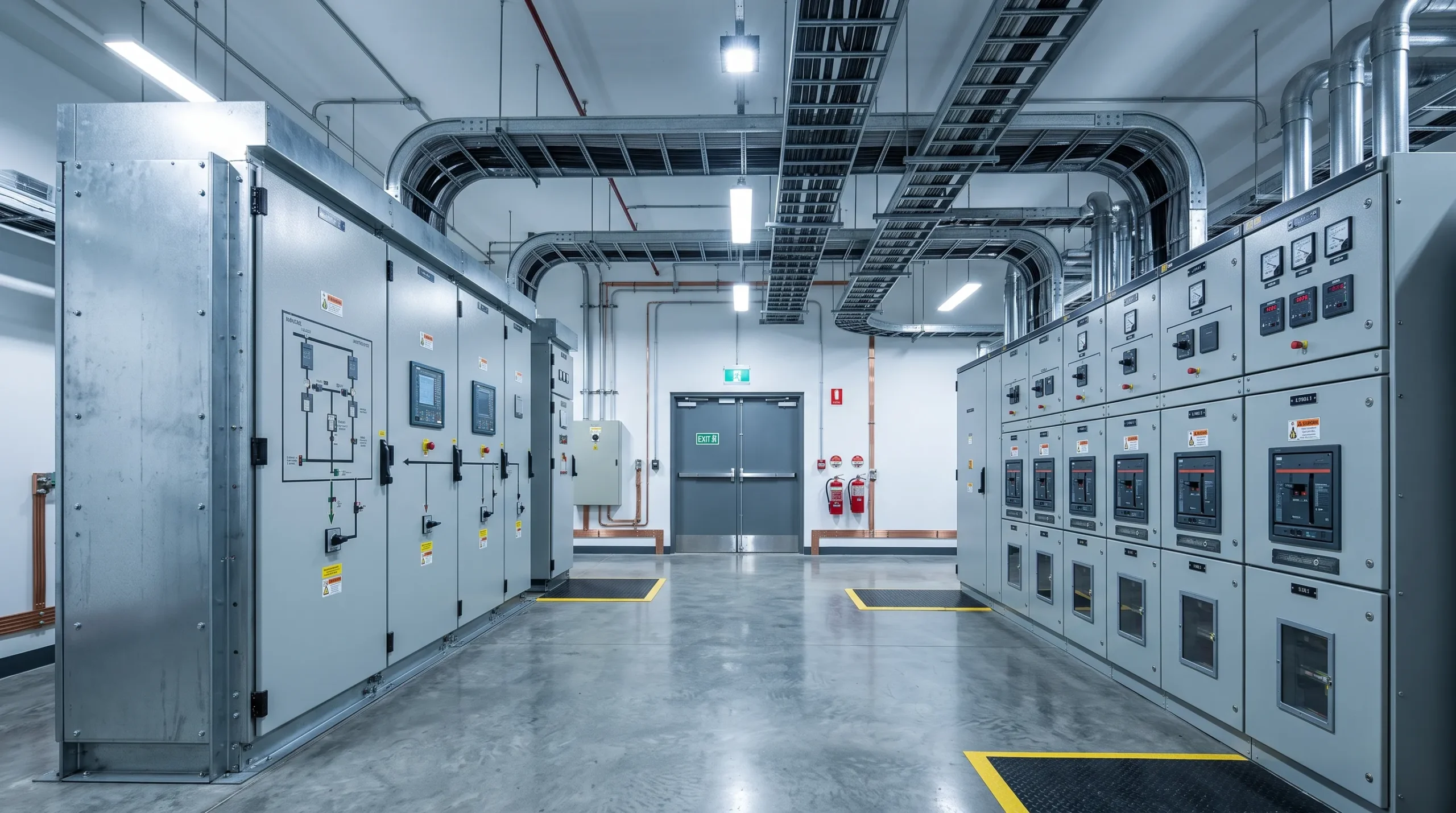
Two quotations land on the same desk. One lists low voltage switchgear, while the other lists medium voltage. Both come from reputable suppliers and look complete, turning the decision into a classic engineering debate of low voltage vs medium voltage switchgear: does your facility need one, the other, or both?
The confusion is understandable. The words “low” and “medium” sound like a matter of size, and the equipment often sits in the same electrical room. In reality, the two classes differ in voltage, in construction, in how they are protected, and in who is allowed to touch them. Getting the class wrong at the design stage is expensive to correct later.
ARC Technologies is an official ABB partner and official ABB panel manufacturer. Low voltage assemblies sit at the center of our panel building work, so this guide focuses on where the two classes meet and how to tell which one your facility is really asking for.
What is the difference between low voltage and medium voltage switchgear?
The difference is the voltage class. Low voltage switchgear works at up to 1,000 V AC, which covers the distribution boards, motor control gear, and machine panels inside a plant. Medium voltage switchgear works above 1 kV and up to 52 kV in the IEC definition and handles the incoming supply, the plant substation, and long feeders.
Factor | Low voltage (LV) | Medium voltage (MV) |
Voltage class | Up to 1,000 V AC | Above 1 kV, up to 52 kV in IEC 62271-200 |
Typical position | Final distribution, motors, machines | Plant intake, substations, long feeders, large motors |
Construction | Compact enclosures, smaller air gaps | Larger clearances, separate compartments, air or gas insulation |
Protection | Breakers with built-in trip units | Breakers with separate protection relays and instrument transformers |
Main assembly standard | IEC 61439 series | IEC 62271 series |
Who operates it | Electricians under standard safe-work rules | Authorised, trained staff under switching procedures |
Space and cost | Smaller and lower | Larger and higher |
The 1,000 V figure is not arbitrary. IEC 61439-2 defines power switchgear and controlgear assemblies as those rated up to 1,000 V AC or 1,500 V DC. Everything above 1 kV falls under the medium voltage standards.
What counts as low voltage switchgear?
Low voltage switchgear is the equipment that distributes power at the voltage your machines and lighting actually use. In everyday terms, that means:
- Main low voltage switchboards and sub-distribution boards
- Motor control centers and starter panels
- Power factor correction panels
- Machine and process control panels
- Final distribution boards for lighting and small power
It is built from breakers, contactors, busbars, and protection devices mounted in a metal or insulated enclosure. Because the voltage is lower, the clearances are tighter, and the panels can be compact enough for a crowded plant room. The market also calls this LV switchgear, and the range of builds is wide, from a small distribution board to a multi-section main board.
Our Power & Control Products Distribution business supplies many components used in these assemblies, which helps when the specification names a particular brand.
What counts as medium voltage switchgear?
Medium voltage switchgear receives power at a higher voltage, switches it, protects it, and sends it on. It is usually a metal-enclosed assembly with separate compartments for the busbars, circuit breaker, and cable connections, and a breaker that is often withdrawable so maintenance can isolate it without disturbing the cables.
IEC 62271-200 covers prefabricated metal-enclosed switchgear for rated voltages above 1 kV and up to and including 52 kV, for indoor and outdoor use. Manufacturers build their ranges around that scope.
ABB’s air-insulated UniGear portfolio, for example, spans several rated voltages up to 40.5 kV, which shows how the class is subdivided by voltage and application. You can see the range on the ABB UniGear portfolio page.
The protection philosophy changes at this level. Instead of a trip unit built into the breaker, MV panels rely on protection relays that read current and voltage through instrument transformers and then tell the breaker what to do. The breaker itself is a subject of its own, covered in our article on the MV circuit breaker.
How do low voltage and medium voltage switchgear work together in one plant?
In most industrial sites, there are two stages of the same chain. Power arrives at medium voltage, passes through MV switchgear that receives and protects it, is stepped down, and then enters the low voltage main board that feeds the rest of the plant.
The device that does the stepping down is the transformer, and its role compared with switchgear is easy to mix up. If you want that distinction clear, read our piece on transformers vs switchgear.
Where the utility supply arrives through a ring network, the intake is often a compact unit that lets you isolate a section without losing the whole ring. We explain why this matters in our article on the ring main unit.
What matters for this comparison is the interface. The MV side sets the fault level that the LV board downstream must withstand, and the LV side sets the load the MV equipment must serve. A mismatch at that point is one of the most common causes of redesign.
Which voltage class does your facility need?
Situation | Typical arrangement | Why |
Small workshop or commercial building supplied at low voltage | LV switchgear only | No MV equipment is needed on site |
Large factory with its own substation | MV intake, then LV distribution boards | Load is too large for a low voltage connection |
Multi-building campus with long cable runs | MV feeders to LV boards at each building | Higher voltage keeps cable size and losses manageable over distance |
Very large motors | MV motor feeders from MV switchgear | Motor rating suits the higher voltage |
Plant expansion adding heavy load | Review both sides | The new load may push fault levels or capacity beyond existing equipment |
Several questions help you place your site in that table:
- At what voltage does the utility supply your site?
- What is the total connected load, and how much will it grow?
- How far apart are the buildings or process areas?
- Are there motors large enough to justify medium voltage?
- What fault level does the supply authority state at the connection point?
- How much space do you have, and how will the equipment be reached for maintenance?
Why does the voltage class change the panel design?
Voltage drives almost every physical decision. At low voltage, relatively small air gaps keep conductors apart, so switchboard sections can be compact. At medium voltage, the insulation distances grow, live parts are enclosed in separate compartments, and the cable terminations need room for stress control. A medium voltage cubicle is therefore deeper and heavier than a low voltage section carrying a similar current.
Current behaves differently too. For the same power, a higher voltage means a lower current, which is why medium voltage suits long cable runs and large loads. The conductors are smaller for the power they carry, and the voltage drop along the cable is easier to keep in check. Low voltage does the opposite: it is convenient and safe to use at the machine, but it becomes expensive when the distance or the power grows.
Fault energy deserves its own mention. A short circuit on the medium voltage side can release far more energy than a typical fault inside a low voltage board, so enclosures, interlocks and relay settings receive careful attention. A low voltage board still needs a short-circuit rating that matches the transformer feeding it, and that rating should be checked every time capacity is added upstream.
What are the safety and maintenance differences?
Both classes can kill. The difference lies in the margin for error and the discipline around the equipment.
Medium voltage panels are designed with interlocks, earthing switches, and, in many designs, an internal arc classification that describes how the enclosure behaves if a fault occurs inside. Working on them depends on formal switching procedures, permits, and trained, authorized personnel. LV boards rely on the same principles, but a wider group of electricians routinely works on them, which is precisely why labeling, isolation, and testing deserve attention.
Maintenance follows the same split. MV equipment usually has planned outages for inspection and testing, and the outage must be coordinated with the whole plant. LV equipment is inspected more often and with smaller consequences, but a missed inspection still adds up over time. Our maintenance services team plans routine work around production schedules so that neither side is neglected.
Testing completes the picture. Insulation, contact resistance, protection settings, and functional checks apply to both classes, with different equipment and different precautions. Our Diagnostics & Testing Services cover these checks for existing switchgear.
What should you ask a switchgear supplier in Egypt?
Whether you are looking for an MV switchgear supplier in Egypt, an LV board builder, or both, the same questions separate a well-prepared supplier from one that is only quoting a price.
- Which standard does the assembly follow, and what evidence can you see?
- What are the rated voltage, rated current, and short-circuit rating of the offered equipment?
- For MV, what internal arc classification applies?
- Who commissions the equipment, and who trains your operators?
- What spares and after-sales support exist locally?
- Does the quotation cover the interface between the MV and LV sides, or only one of them?
If you prefer ABB equipment, ask about the supply route and warranty terms before ordering. Anyone searching for ABB switchgear in Egypt should confirm that the product comes through an official ABB channel, since support and documentation depend on it.
What mistakes do teams make when comparing the two?
The usual ones are easy to spot afterwards.
Some treat the voltage class as a cost question and try to push an LV solution beyond its sensible limits, ending up with oversized cables and heavy losses. Others buy MV equipment for a load that never justified it. A third group compares quotations that cover different scopes, so one price includes the interface and protection study while the other quietly leaves them out.
A calm review of the single-line diagram before ordering is cheaper than any of these.
Low voltage vs medium voltage switchgear: a simple way to decide
- Supplied at low voltage and no large motors: LV switchgear is enough.
- Large load, own substation, or long distances between buildings: you need MV intake with LV distribution.
- Expanding an existing site: check the fault level and capacity of both sides before adding load.
Talk to ARC Technologies engineers
Not sure which class your next project needs, or whether your existing boards can take the extra load? Send us your single-line diagram, load list, and the fault level stated by your utility. Our engineers will review the low voltage side and the interface with your supply and recommend a sensible approach. Contact ARC Technologies to speak with an engineer or to request a technical quote.