

 العربية
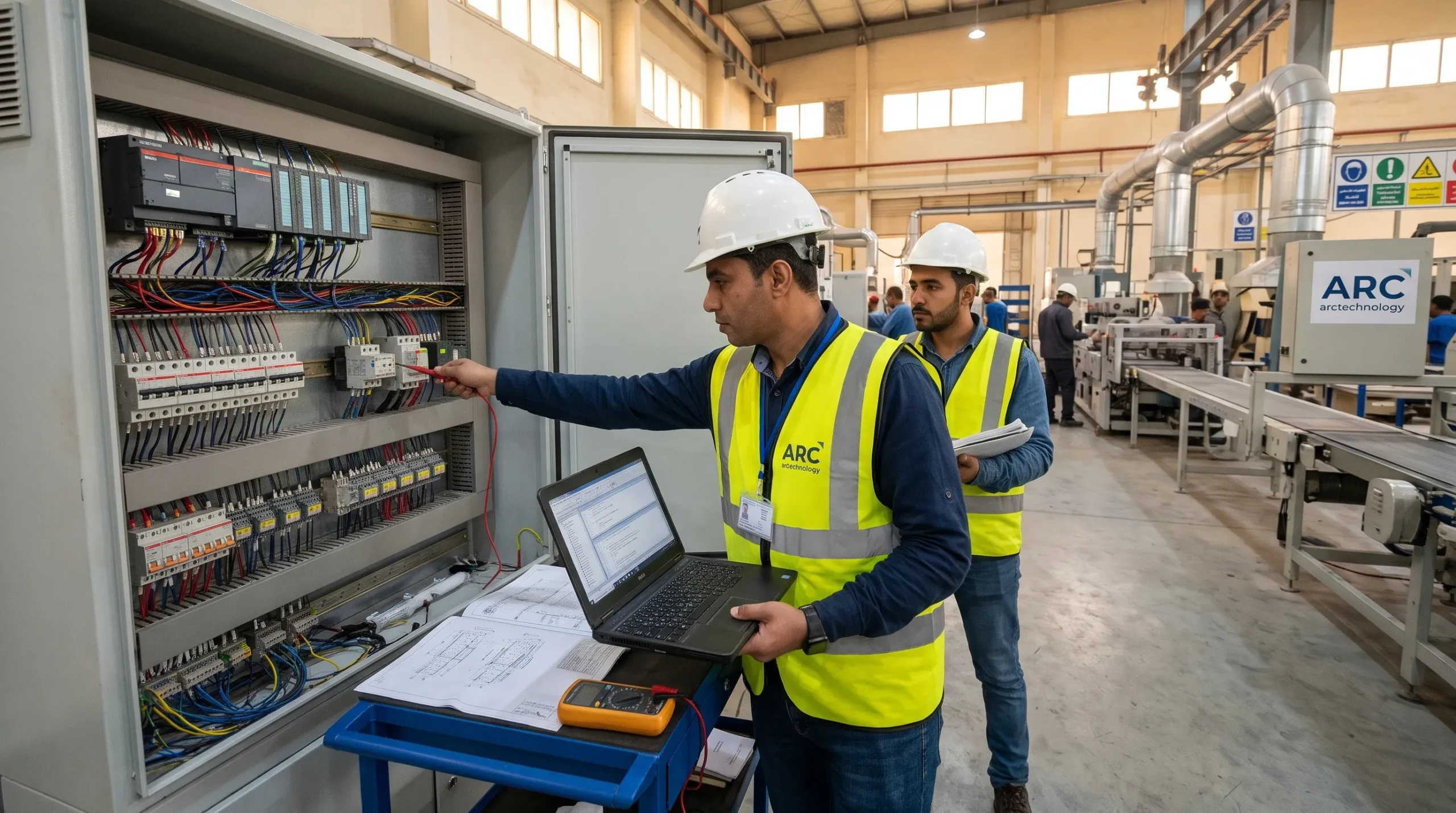
Picking a system integrator Egypt is less about who has the best brochure and more about who will still answer the phone eighteen months after handover. For plant owners in 10th of Ramadan, 6th of October and Sadat City, the integrator ends up holding the logic that runs the line, the drawings that explain it and the passwords that unlock it. This guide covers what an integrator should deliver, how to split scope with the panel builder and electrical contractor, who owns factory and site testing, and how to check local support before you sign.
What Does a System Integrator Actually Deliver?
A system integrator designs, programs, tests and commissions the control system that ties your machines, instruments and drives into one working process. That usually means PLC and HMI software, SCADA, network design and the documentation that lets someone else maintain it later. You can see how ARC handles this scope on its automation and system integration page.
The physical hardware is only part of the job. A typical integrator scope on a food, chemicals or building materials plant includes:
- Functional design: turning the process description into a control philosophy, I/O list and sequence descriptions
- PLC and HMI programming, ideally in the languages defined by IEC 61131-3, the international standard for programmable controller languages, which reached its fourth edition in May 2025
- SCADA and historian configuration, alarm lists and user access levels
- Communication with drives, MCCs, packaging machines and third-party skids
- Factory and site testing, commissioning support and operator training
- As-built documentation and a source code handover
On bigger projects the integrator also links the plant floor to planning systems such as ERP or MES. Here the ISA-95 standard series, also published internationally as IEC 62264, gives a common model for which data moves between production and business systems. You do not need every project to be ISA-95 compliant, but an integrator who understands the levels will design cleaner interfaces and avoid custom links that nobody can maintain.
Splitting Scope Between Integrator, Panel Builder and Contractor
Most disputes on automation projects in Egypt come from gaps between three parties: the integrator, the panel builder and the electrical installation contractor. Write the split down before tender, not after the first site meeting.
A workable division looks like this:
Item | Integrator | Panel builder | Electrical contractor |
|---|---|---|---|
Control philosophy and I/O list | Owns | Reviews | Reviews |
Panel design and manufacture | Inputs | Owns | None |
Cable schedule and field wiring | Inputs | None | Owns |
Loop checks | Witnesses | None | Performs |
Software and commissioning | Owns | Supports | Supports |
The panel side matters more than many owners expect. If the control panels are built to a verified design, with proper segregation, heat calculation and labelling, the integrator’s commissioning goes faster. ARC’s panel building services design panels in line with IEC 61439, which removes one common source of delay.
Some owners prefer a single party to carry everything, from panels to software to field work. That is often called a turnkey package. It reduces interfaces but concentrates risk, so check that the firm offering turnkey automation in Egypt actually has the field crews it claims, rather than subcontracting the installation to whoever is free that month.
Whatever split you choose, name one party as responsible for the overall control system integration. Without that, every fault becomes a conversation about whose cable, whose code or whose panel caused it.
Who Is Responsible for FAT and SAT?
The integrator should own both the factory acceptance test (FAT) and the site acceptance test (SAT), with the owner witnessing and signing each one. Responsibility for preparing the procedures, running the tests and closing the punch list should sit with one party.
A short definition of each:
- FAT is a test of the control system at the integrator’s or panel builder’s workshop, before shipping. Software runs on the real hardware with simulated I/O.
- SAT is the test on site after installation, with real field devices, real utilities and, where possible, real product.
IEC 62381:2024 sets out requirements and checklists for FAT, SAT and site integration testing, and its 2024 edition added an optional factory integration test (FIT) for systems that combine several vendors. Even if your contract does not quote the standard, its checklists are a useful base for writing project test plans.
When you compare proposals, look at how each one treats FAT SAT automation testing. A serious proposal lists the test documents, the number of witness days, what happens when a test fails and who pays for the retest. A weak one writes “FAT and SAT included” and leaves the rest open.
A good FAT catches most software errors. In practice, problems found in the workshop take hours to fix, while the same problems found on site, with production waiting, can take days. That is why skipping or shortening the FAT to save a week usually costs more later.
For the electrical side of site testing, such as insulation resistance, protection relays and motor checks, ARC’s diagnostics and testing services can run alongside the integrator’s SAT so that power and control are proven together.
Documentation You Should Receive at Handover
At handover you should receive everything needed for another competent engineer to maintain, modify or rebuild the system without calling the original integrator. If that test fails, the handover is not complete.
The minimum package:
- Functional design specification and control philosophy, updated to as-built
- I/O list with tag names, ranges and alarm limits
- Electrical drawings for panels and field wiring, as-built, in editable format
- Network architecture drawing with IP addresses, switch configuration and firewall rules
- Unlocked, commented PLC, HMI and SCADA source code, with the software version used
- Signed FAT and SAT records, with the punch list closed or clearly listed
- Spare parts list and licence records, including who owns each licence
- Operator and maintenance manuals, preferably in both Arabic and English
Pay attention to items 5 and 7. Some integrators keep source code locked or hold software licences in their own name. That ties you to them for every change, even a simple set point edit. Put source code ownership and licence transfer into the contract as a condition of final payment.
Judging Local Support Capacity in Egypt
For any system integrator Egypt, local support is judged by people, stock and response history, not by a support line printed on a proposal. Ask how many engineers in Egypt can work on your platform today, where they are based and how fast they reached a plant during the last breakdown they handled.
A plant in 10th of Ramadan with a stopped line cannot wait for an engineer to fly in. Useful questions include:
- How many engineers are certified on the PLC and SCADA platform you are proposing?
- Can someone reach our site within four hours, or within the same shift?
- Do you hold critical spares in Egypt, or does every part come by import?
- Can you show remote support procedures, including how access is approved and logged?
- Will the engineer who programmed the system be available during the warranty period?
Spares deserve their own line. A good automation design is still exposed if the replacement CPU or drive has a twelve-week lead time. ARC’s maintenance services cover spare parts support as well as routine work, so critical parts can be identified and stocked during the project rather than after the first failure.
Questions for an Integrator Prequalification
When you shortlist a system integrator Egypt, a prequalification should filter out firms that cannot deliver before you spend time comparing prices. Keep it short and specific so you get real answers.
Ask each candidate for:
- Three reference projects in a similar industry and size, with a contact you can call
- A sample functional design document and a sample FAT procedure from a past job
- The CVs of the project manager and lead engineer who will actually work on your plant
- Their standard approach to software version control and backups
- Their position on source code ownership and licence transfer
- Current workload, so you know whether your project will get the team shown in the proposal
Call the references. Ask them one simple question: would you hire this firm again for your next line? The pause before the answer often tells you more than the brochure.
It also helps to compare like with like. An industrial automation contractor that mainly installs cable and instruments is a different business from an integrator that writes control software, even if both bid on the same tender. Neither is better in general, but you need to know which one you are hiring.
Red Flags in an Integrator Proposal
The clearest red flag is a price far below the others with no explanation of what was left out. Low prices on automation projects usually mean missing engineering hours, which reappear as variations once the work starts.
Other warning signs:
- No named project manager or lead engineer
- Testing described in one line, with no witness days or procedures
- Hardware listed by brand but not by part number or quantity
- No mention of network design or cybersecurity, even on a system with remote access
- Exclusions buried at the end, such as “software licences by client” or “commissioning support billed per day”
- A schedule with no time allowed for FAT punch list correction
If the plant runs critical loads such as generator systems or UPS-backed controls, also check that the integrator has worked with them before. Control logic for changeover and load shedding is less forgiving than conveyor sequences. When your project includes this equipment, ARC’s critical power solutions cover the generator and UPS side of that interface.
Finally, be careful with proposals that promise to reuse “our standard library” without showing it. Standard function blocks are good practice, but you should see them, test them at FAT and receive them unlocked at handover.
Planning an Automation Project with ARC
ARC works with plants across Egypt on control system design, panel manufacture, testing and long-term support. If you are preparing a tender or reviewing integrator proposals, our engineers can help define scope, test requirements and handover terms before the contract is signed. See our industrial automation solutions for the drives, soft starters and PLCs we supply, or contact our engineers to review an existing system before you expand it.
Choosing a system integrator Egypt is a long relationship, not a single purchase. Clear scope, owned testing, complete documentation and real local support are what separate a system that keeps running from one that keeps calling for help. A system integrator in Egypt who meets these points on paper and in their references is worth paying a fair price for.
Frequently Asked Questions
How long does a typical automation project take in Egypt?
For a single production line with a few hundred I/O, six to nine months from design to SAT is common. Lead times for imported hardware are often the deciding factor.
Should the integrator be tied to one PLC brand?
Not necessarily. Many plants standardise on one platform to simplify spares and training. An integrator that works across brands can help you choose, but should have proven engineers on the platform you select. Our ABB vs Siemens PLC comparison covers the trade-offs between the two most common platforms.
Is FAT really needed for small projects?
Yes, even if it is a one-day test. Running the software on real hardware before shipping catches wiring, addressing, and logic errors that are much slower to fix on site.