

 العربية
Internal arc classification describes what a switchgear assembly has been proven to do when an arc fault starts inside it. It does not promise that the fault will never happen. It tells you that if it does, the doors stay closed, the hot gases leave in a controlled direction, and a person standing in the tested position is protected.
For a plant in Egypt, that one line on a datasheet can decide how a fault ends. Heat, dust, and aging connections all make faults more likely over the years, and the people most exposed are the operators standing in front of the panel.
This guide covers what IAC ratings test, how to read one, when a switchgear room needs arc-rated panels, and how to write the requirement into a tender so that suppliers answer it properly. It reflects the questions that come up in Panel Building projects, where LV and MV assemblies are built for industrial clients.
What Is Internal Arc Classification?
Internal arc classification is a tested rating that shows how well a switchgear assembly protects people and limits damage when an arc fault occurs inside it.
An internal arc is an electrical discharge through air between live parts, or between a live part and earth, inside the enclosure. Typical triggers are a loose connection, damaged insulation, a tool left behind, dust or a small animal bridging two conductors, or a faulty switching operation. Within moments, the arc heats the surrounding air, pressure inside the enclosure climbs, and metal and insulation start to vaporize.
The rating answers three practical questions:
- Do the doors, covers, and side panels stay in place under that pressure?
- Where do the hot gases and glowing particles go?
- Can the assembly return to service afterwards, even in a limited way?
Some suppliers call this arc fault containment. The wording varies, but the tested result is the same: controlled behaviour of the enclosure, not the removal of the fault.
It also helps to keep it separate from a study. Buyers searching for arc flash protection switchgear sometimes mix two different things. An arc flash study calculates the incident energy a person could face when working on or near equipment. Classification is a property of the equipment itself, proven in a laboratory. Most plants need both, and neither replaces the other. A study tells you how bad an event could be, while internal arc classification tells you how the equipment behaves when the event happens.
How IEC TR 61641 Tests an Assembly
IEC TR 61641 is the guide for testing enclosed low voltage assemblies by creating a deliberate arc inside them and checking what the enclosure does.
The IEC states that the purpose of the test is to assess whether an assembly limits the risk of personal injury and damage and whether it stays suitable for further service. You can read the scope on the IEC webstore page for TR 61641. The current edition is the third, published in 2014.
That edition introduced arcing classes, which describe the form of protection on offer:
- personnel protection only
- damage restricted to part of the assembly
- an assembly suitable for limited further service
It also separates two levels of personnel protection. One is for rooms where only skilled persons can reach the assembly, and the other is for areas open to ordinary persons. A locked switchgear room and a workshop floor with passing staff are not the same case, and the rating should match the one you have.
The report treats protection at the front, back, and sides as the normal requirement. It also describes an option where every live conductor is individually insulated, so the assembly becomes an arc ignition-protected zone.
In the laboratory, the arc is started at chosen points inside the assembly, with a set current for a set time, while indicators placed around the enclosure record what escapes. The acceptance checks usually look like this:
- Doors and covers remain secured.
- No parts fly off that could injure someone.
- No holes burn through accessible outer surfaces.
- Indicators are not ignited by hot gases.
- The protective earthing circuit stays effective.
Datasheets sometimes shorten the standard name to IEC 61641, so always confirm which edition is meant.
Reading an IAC Rating on a Datasheet
An IAC rating is a short code that states who may stand near the panel, which sides were tested, the arc current, and its duration.
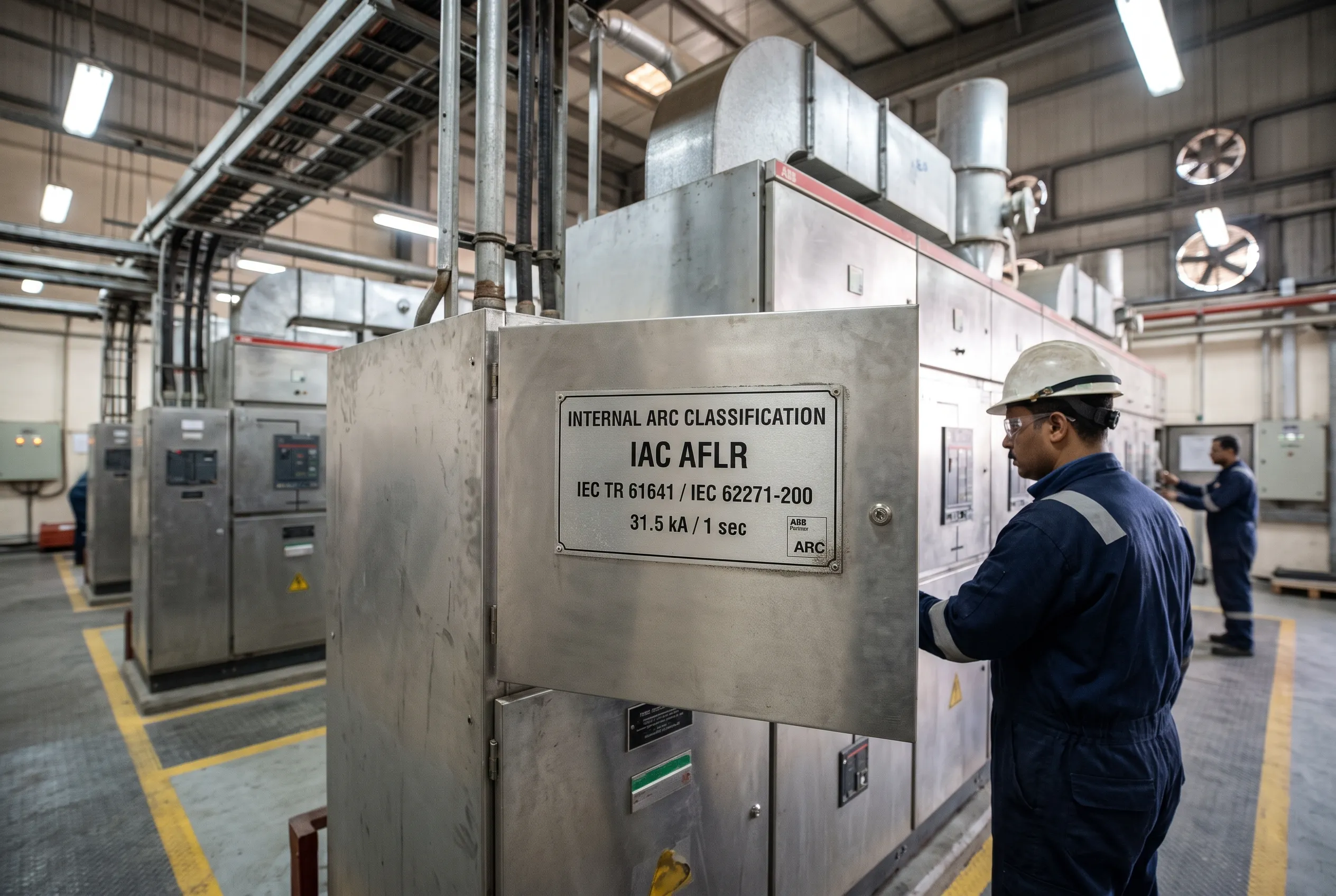
Medium voltage switchgear follows IEC 62271-200, and its code is the one you will meet most often. ABB documentation gives an example written as IAC AFLR 31.5 kA 1 sec. Each part has a meaning:
Part of the code | What it tells you |
A, B, or C | Who can reach the area: authorized personnel only (A), general public (B), or access restricted by the installation itself (C) |
F, L, R | Sides tested: front, lateral, and rear |
kA | The arc current the assembly withstood |
Seconds | How long the test arc lasted |
ABB’s UniSec switchgear catalogue shows the pattern in practice, with an IAC AFLR designation listed next to the tested kA values for each version.
Three checks matter more than the letters:
- The tested current must be at least the prospective short-circuit current at your installation point.
- The tested duration should cover the time your upstream protection needs to clear the fault.
- Every side that people can reach must be covered by the test.
Also read what was tested. A rating earned on one compartment does not automatically apply to the cable or busbar compartment next to it. For low voltage boards, the datasheet should state the arcing class, the personnel protection level, the current, and the time. An internally arc-tested panel should always come with a test report, not only a sticker on the door.
Does Your Switchgear Room Need Arc-Rated Panels?
Usually yes, when people stand in front of energized panels during switching, racking, or inspection, or when an arc would stop production for a long time.
A room is a strong candidate when several of these apply:
- operators switch or rack breakers while the board is live
- The fault level at the board is high
- Contractors or non-skilled staff can enter the room
- The board feeds a process where downtime is very costly
- The existing boards are old, hot, or dusty
Not every board needs the same answer. A small distribution board in a locked room, switched remotely, may meet its safety goals through other measures such as restricted access and arc detection. The decision belongs in the design stage, with the fault level and the working procedures on the table. Retrofitting internal arc classification into a finished room is far harder than choosing it when the layout is still on paper.
Prevention still counts. Routine checks such as those in ARC’s Diagnostics & Testing Services lower the odds of a fault starting. Classification covers the day those odds fail.
Room Layout, Ventilation, and Exhaust Paths
A classified panel protects people only if the room lets the exhaust gases escape the way the test assumed.
The test is carried out in a setup with defined distances to walls and ceiling. The supplier’s installation instructions give the minimum ceiling height, the clearances, and the exhaust arrangement that match it. If your room is tighter than the test setup, the result may not hold, and a rating on paper means little.
Egyptian sites add their own pressures. Heat and dust push designers toward louvers, fans, and filters, and those openings can weaken the room or block the path the pressure relief needs. Plan the room together with the panel, not after it.
A short layout check helps:
- Ceiling height and rear clearance match the supplier’s instructions.
- Cable trays, ducts, and light fittings stay out of the space above the panels.
- Exhaust is directed to a safe area, away from doors and escape routes.
- Ventilation openings and filters do not obstruct pressure relief.
- Doors open outward and escape routes stay clear.
When the lineup is a low voltage board, the Low Voltage Panel Builder page shows the kind of assemblies this applies to.
How to Write IAC Requirements into a Tender
Name the standard, the classification, the current and duration, the sides covered, and the evidence required, all in one clause.
A vague line such as “arc proof panels” gives a supplier room to answer with a promise, and a promise cannot be tested after the board is installed. A specific line forces an answer with a test report. A sample wording for a tender looks like this:
The switchgear shall be internally arc classified in accordance with IEC TR 61641 (low voltage) or IEC 62271-200 (medium voltage), with protection at the front, sides, and rear, for a fault current and duration not lower than [insert kA and seconds] at the point of installation. Independent laboratory test reports for the offered design shall be provided with the bid.
Anchor the clause to the assembly standard, IEC 61439-2, and state arc testing as an explicit extra so nobody treats it as optional.
Common mistakes to avoid in the wording:
- asking for “arc proof” without naming a standard
- mixing the low voltage and medium-voltage references
- accepting one rating for a whole lineup when only part of it was tested
- forgetting to say what happens to the rating when the design is modified
- not requiring the rating on the nameplate
What Should a Panel Supplier Prove?
The supplier should prove that the offered design, not a similar one, passed the test.
Ask for documents, and read them. A good answer includes:
- a test report that covers the same enclosure, layout, component sizes, and ratings as the offer
- the laboratory name and the test date
- the accessible sides and the class or level, stated on both the report and the nameplate
- written installation limits for room height, clearances, and exhaust
- the rules for modifications, meaning which changes void the result
- workshop checks showing that the delivered panel matches the tested design
Ask any supplier for this paper trail, ARC included. As an official ABB partner and official ABB panel manufacturer, ARC presents its work through the ABB Panel Builder page, and the same questions apply there as anywhere else.
If a supplier cannot produce the report, treat the rating as unproven, however confident the sales team sounds. A claim of internal arc classification without a matching document should not score points in your bid evaluation.
Specifying Arc-Rated Panels with ARC
Three decisions sit behind every good specification of internal arc classification: who needs protection, which rating is required, and what proof you will accept. Once those are written down, the tender becomes much easier to compare.
ARC builds LV and MV panels at its Giza facility and can review your requirements with you. Bring the single-line diagram, the fault level at the board, the protection clearing times, a drawing of the room with its ceiling height, and a note on who enters it. Our engineers can then tell you plainly whether the requirement points to a verified assembly design or needs a different approach.
To start that review, Contact Us with those documents, and the discussion can begin with your actual room rather than a generic brochure.