

 العربية

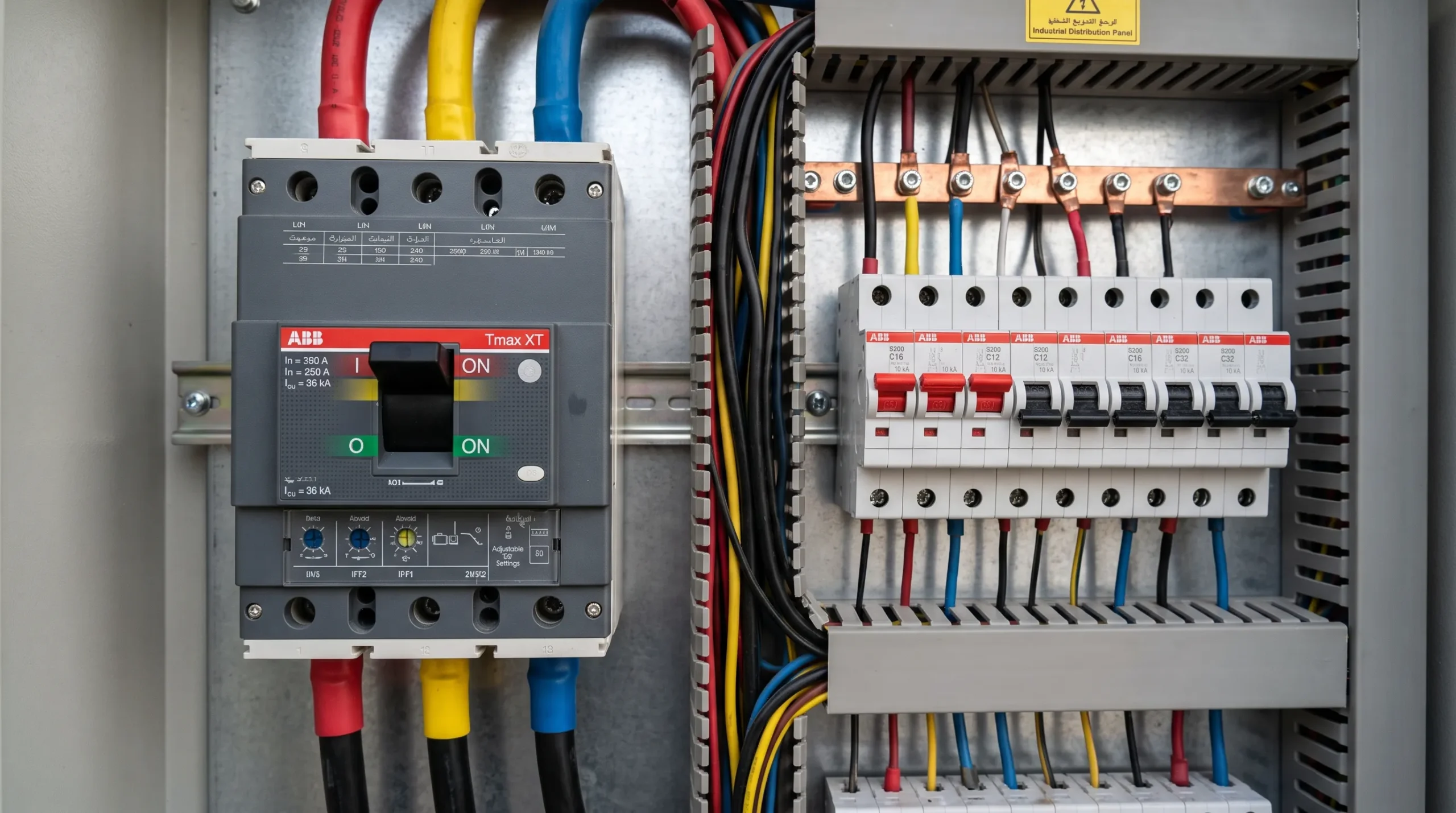
A breaker trips on a Sunday night and takes half a distribution board with it. Was it too small, set too low, or simply the wrong type for the job? In a lot of plants, the honest answer is that nobody chose it on purpose. It was whatever fitted the slot on the day.
MCCB vs MCB is one of the most common choices on a panel drawing, and it is easy to get wrong because both devices look alike on a single-line diagram. They guard against the same two faults: overload and short circuit. What separates them is how much current they carry, how much fault current they can safely interrupt, and how much you can adjust them.
ARC Technologies is an official ABB partner and official ABB panel manufacturer. Our range of low-voltage products includes ABB molded case and miniature circuit breakers, so this guide comes from the daily work of specifying both.
What is the difference between an MCCB and an MCB?
An MCB is a compact breaker for final circuits and smaller loads, with a fixed trip characteristic and a modest current rating. An MCCB is a larger breaker in an insulating molded case, built for feeders and heavy loads, with a higher current rating, a higher breaking capacity, and, in most models, adjustable trip settings.
Feature | MCB | MCCB |
Typical current range | Low, commonly up to 125 A | From small frames up to thousands of amps in the largest frames |
Trip settings | Fixed curve (B, C, or D) | Often adjustable, thermal-magnetic, or electronic |
Breaking capacity | Lower | Higher, suited to main and sub-main boards |
Mounting | DIN rail | Mounting plate; plug-in and withdrawable versions exist. |
Typical use | Lighting, sockets, control circuits | Incomers, feeders, motor circuits |
Accessories | Few | Auxiliary contacts, shunt and undervoltage releases, motor operators |
Size and cost | Small, economical | Larger, higher cost |
Think of the MCB as the guard at each office door and the MCCB as the guard at the building entrance. Both matter. They are not doing the same job.
What is an MCB, and where does it belong?
A miniature circuit breaker protects the last stretch of the installation: the circuits that feed lights, sockets, small heaters, and control equipment. It combines a thermal element for overloads with a magnetic element for short circuits, and you cannot change either threshold once it is installed.
What you can choose is the trip curve. A B curve suits resistive loads and long cable runs. A C curve is the general-purpose option for moderate inrush. A D curve tolerates the sharp inrush of transformers and some small motors without tripping.
IEC describes the scope of IEC 60898-1 as AC air-break circuit breakers for household and similar installations, with a rated current of up to 125 A. Some industrial MCBs are instead tested to the industrial breaker standard, which is why the datasheet matters more than the label on the box.
MCBs belong where the current is low, and the circuits are many:
- Lighting and socket circuits
- Control and auxiliary supplies inside panels, including 24 V power supplies
- Small heaters, fans, and instrument feeds
- Final outlets that need quick, tool-free replacement
What is a molded case circuit breaker, and what makes it different?
A molded case circuit breaker houses the contacts, the operating mechanism, and the trip unit in a sealed insulating case. That construction lets it carry far more current than an MCB and survive much larger fault currents.
The bigger difference is control. Many MCCBs let you adjust the long-time and instantaneous settings, and electronic trip units add short-time and earth-fault protection on top. Those settings are what make coordination possible, because you can tune an upstream breaker to wait while the downstream one clears the fault.
Accessories widen the choice further. Many ABB Tmax XT models offer auxiliary contacts, shunt trips, keylocks, plug-in and withdrawable versions, and a communication module so the breaker can report to a supervision system. A plug-in version is easy to take out for maintenance without disturbing the cabling.
MCCBs fall under IEC 60947-2, which applies to circuit breakers with a rated voltage up to 1,000 V AC or 1,500 V DC.
How does breaking capacity change the choice of breaker?
Breaking capacity is the largest fault current a breaker can interrupt safely. It has to be at least equal to the prospective short-circuit current at the point where the breaker is installed. Otherwise, a fault can wreck the breaker instead of clearing.
On an MCCB datasheet, you will normally find two values. The ultimate breaking capacity (Icu) is the maximum the breaker can interrupt once. The service breaking capacity (ICS) tells you how much of that it can interrupt and remain fit for service afterwards. For a plant that cannot afford a replacement after every fault, Ics is the figure to read first.
Fault current is highest close to the transformer and falls as cable length grows. That is why a main incomer needs a high breaking capacity, while a breaker at the far end of a long feeder can often manage with less. Working it out properly means calculating the prospective fault level at each board, not guessing from the current rating.
A breaker with more breaking capacity than you need is not a problem. One with less is.
Which breaker fits which part of the installation?
Match the device to the job, and the board layout mostly sorts itself out.
Location | Usual choice | Why |
Incomer of a small or medium board | MCCB | High breaking capacity, adjustable settings |
Feeders to sub-boards and motor control centers | MCCB | Settings can be coordinated with downstream devices. |
Motor circuits | MCCB with a motor protection trip unit, or a dedicated motor protection breaker | Start-up current needs a setting that avoids nuisance trips. |
Lighting and socket circuits | MCB | Low current, many circuits, easy replacement |
Control and auxiliary circuits | MCB | Small ratings, DIN rail space |
When the current rises beyond what a molded case can carry, an air circuit breaker takes over. Our guide to the basics of the air circuit breaker explains where that line falls.
Can an MCB replace an MCCB, or the other way round?
Not as a straight swap. An MCB lacks the current rating and the breaking capacity for feeder duty. An MCCB is oversized and costly for a lighting circuit, and its trip range is too coarse for a small load.
There is also the matter of how breakers work together. In a typical board, an MCCB sits upstream of a group of MCBs. You want selectivity so that a fault on one lighting circuit trips only the MCB at that circuit and not the whole feeder. Where the fault level at the board exceeds the rating of the MCBs, manufacturers publish back-up protection tables showing which upstream breaker allows a downstream one to be used safely. Those tables apply to specific combinations, so check them for the exact models you plan to install.
For a wider view of breaker families beyond these two, see our guide to circuit breakers.
What mistakes do buyers make when choosing between an MCCB and an MCB?
Most of them come down to looking at one number and ignoring the rest.
- Choosing the current rating alone and never checking the fault level at the board
- Leaving an MCCB on its factory settings, which can sit well above what the cable or the motor needs
- Putting a standard-curve MCB on a circuit with heavy inrush, then blaming the breaker for tripping
- Forgetting that breakers derate in hot enclosures, which matters for a panel sitting on a summer roof
- Discovering at commissioning that the emergency stop needs a shunt trip nobody ordered
Each one is cheap to fix on paper and expensive to fix in the field.
How should breakers be selected and arranged inside the panel?
Breaker selection is part of panel design, not a separate purchase. The busbar rating, the short-circuit withstand of the assembly, the spacing between devices, and the cooling all depend on which breakers go in and where. Our panel-building team treats them as one decision.
After installation, the settings need checking against the design. Trip tests, insulation checks, and a review of the adjustable settings catch the errors that a drawing cannot. Our Diagnostics & Testing Services cover this for new and existing panels.
What should you check before ordering?
Gather these details, and the choice usually becomes obvious:
- The prospective short-circuit current at the board
- Load current and load type: resistive, motor, or transformer
- Cable size and length on each circuit
- The temperature inside the enclosure on a hot day
- Which upstream and downstream devices the breaker must coordinate with
- Whether you need adjustable settings and which protection functions
- Accessories such as auxiliary contacts, shunt trips, or communication
- Fixed, plug-in, or withdrawable mounting
If you are sourcing an ABB circuit breaker Egypt, also ask for datasheets that state the breaking capacity at your operating voltage, and confirm the supplier is an official ABB channel with local after-sales support. A genuine product with no support behind it is a poor bargain.
MCCB vs MCB: a simple way to decide
- Small circuits with low current and many outlets: use an MCB.
- Feeders, incomers, and motors where fault levels are high, and settings matter: use an MCCB.
- Anything in between: calculate the fault level and the load, then let the numbers choose.
Talk to ARC Technologies engineers
Not sure whether a feeder needs an MCCB or whether a row of MCBs will do? Send us your single-line diagram, load list, and the fault level at the board. Our engineers will review it and recommend breakers that suit the protection and coordination you need. Contact ARC Technologies to speak with an engineer or to request a technical quote.

Leave a comment