

 العربية
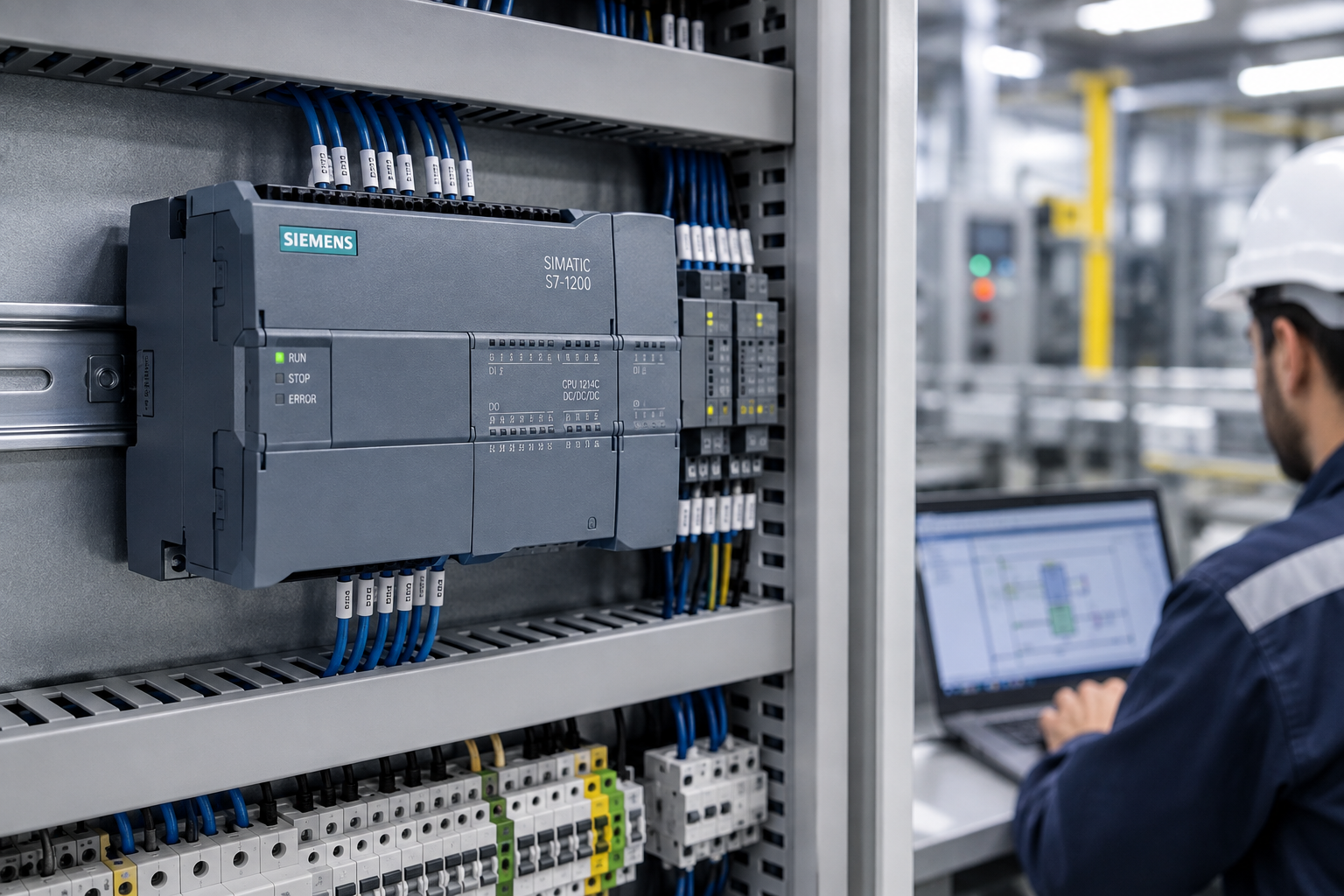
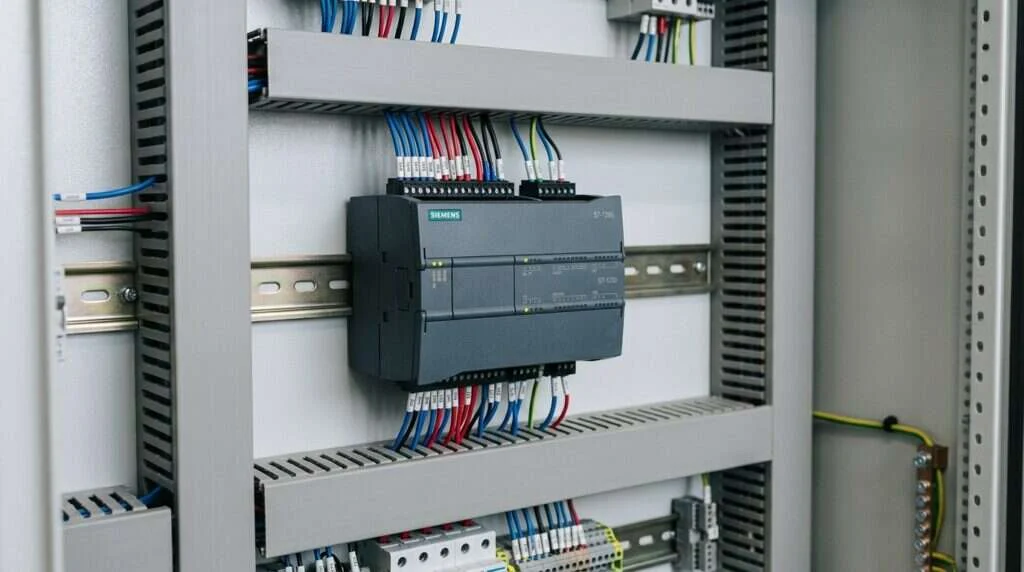
Walk through almost any mid-size production plant in Egypt or the wider region, and there is a good chance a Siemens S7-1200 PLC is sitting somewhere in a control panel, quietly running a conveyor, a packaging line, or a water treatment skid. It earned that place for a practical reason: it balances processing power, I/O flexibility, and cost in a way that suits small and mid-size machines. This article covers what the S7-1200 offers, where it fits best, and how to decide whether it is the right controller for your next automation project.
What is the Siemens S7-1200 PLC?
The Siemens S7-1200 is a compact, modular programmable logic controller built for small- to mid-size automation tasks. It sits in the SIMATIC S7 family above the LOGO! logic modules and below the S7-1500, and it succeeds the older S7-200 line.
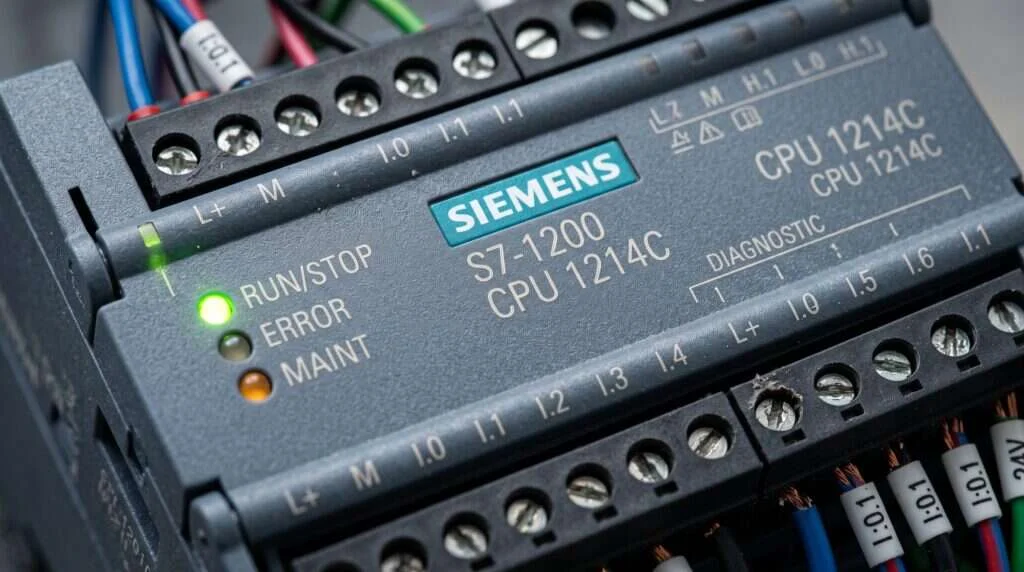
At its core, the PLC S7-1200 is a CPU module that combines the processor, power supply, onboard digital and analog I/O, and communication port in a single compact housing. That keeps the panel footprint small, which matters when a facility is retrofitting an existing enclosure instead of building a new one.
It is aimed at discrete machine control, simple process control, and small-scale system integration, not plant-wide SCADA architectures. That does not make it underpowered. Depending on the CPU, it can handle motion tasks, PID loops, and networked communication that once called for a much larger rack-based system.
One detail is worth knowing early. The S7-1200 is a family of CPU models (the 1211C, 1212C, 1214C, 1215C, and 1217C), each with different memory, I/O counts, and onboard analog channels. Picking the right CPU up front avoids a costly upgrade halfway through a project.
Key Features and Specifications
Specifications change from one CPU to the next, but several features hold across the Siemens PLC S7-1200 line. Once you have the general shape of the hardware, Siemens’ own S7-1200 product overview is the place to confirm exact figures for the CPU you are considering.
I/O and Expansion
Every CPU ships with a fixed number of onboard digital and analog inputs and outputs. When a project needs more, you can mount a signal board directly on the CPU, then add signal modules and communication modules along the rail. An integrator can size the system to the machine instead of paying for capacity nobody will use.
Networking and Motion
Many entry-level controllers need an add-on module for Ethernet. The S7-1200 has PROFINET built into the CPU, so connecting it to HMIs, SCADA systems, and drives costs no extra hardware or panel space. The same CPU carries high-speed counter inputs and pulse train outputs, enough for encoders and simple positioning without a separate motion card.
Memory and SD Card
Work memory grows as you move up the CPU range, from the 1211C to the 1217C. Load memory expands through a memory card slot, which also helps with firmware updates, program transfer, and recipe storage on lines that change configuration between batches.
Environmental Rating
The controller mounts on a standard 35 mm DIN rail and is built for industrial environments, with the vibration, temperature swings, and electrical noise of a factory floor in mind. Panel ventilation still matters on a hot Egyptian summer afternoon, so check the ambient temperature rating for your CPU against the conditions inside the enclosure.
Compared with the relay-based control still found in some older Egyptian facilities, the S7-1200 offers programmable flexibility, diagnostic visibility, and remote monitoring that hard-wired relay logic cannot match. That difference alone often justifies a controls upgrade during a wider panel refurbishment.
Which industrial applications suit the S7-1200?
The S7-1200 suits single machines, skids, and small production lines where compact size, built-in networking, and moderate processing power matter more than plant-wide scale. Packaging, water treatment, HVAC, and OEM machine building are the usual homes for it.
A few places where we see it work well:
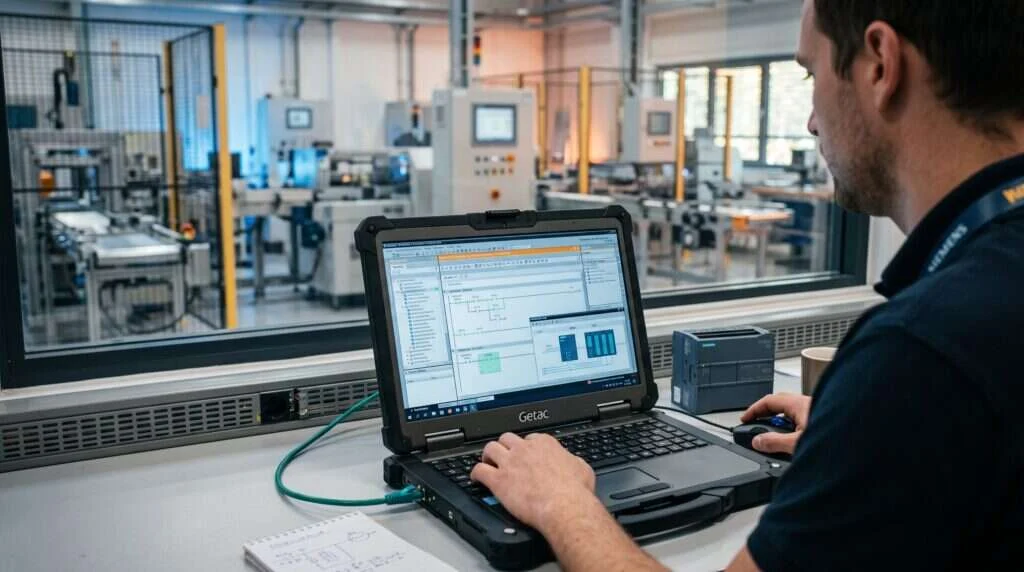
- Packaging and material handling lines, where the PLC sequences conveyors, triggers sensor-based sorting, and keeps machine stations in step.
- Water and wastewater skids, where PID loops handle pump staging, level control, and chemical dosing at a scale too small to justify a full DCS.
- HVAC and utility panels that coordinate chillers, air handling units, and building interfaces in commercial or light-industrial sites.
- OEM machines and standardized skids that get copied across many customer sites.
- Small batching, mixing, and sequential process systems that need PLC reliability without a large control platform.
In all of these, the controller works next to variable speed drives, soft starters, and sensors to close the control loop. ARC Technologies integrates the S7-1200 into wider industrial automation solutions that combine PLC logic with motor control and energy monitoring, because most real automation problems involve more than a controller on its own.
How does the S7-1200 compare with other Siemens PLCs?
The S7-1200 is the mid-range choice: enough performance for most single-machine and small-line work without the cost of higher-tier hardware. The S7-1500 suits larger, faster, or more demanding systems, and LOGO! suits very simple logic tasks.
The S7-1500 offers more processing power, faster scan times, larger memory, and stronger support for demanding motion control. Facilities coordinating many machines over a plant-wide network, or running processes with heavy safety demands, tend to outgrow the S7-1200 and move up to the S7-1500 or to a fail-safe CPU option.
LOGO! sits below it as a simple, low-cost logic module for jobs like lighting control or basic interlocking. It lacks the programming depth and communication options of the S7-1200.
ABB deserves a mention here too. ARC Technologies works with both Siemens and ABB automation platforms, and ABB’s drives and control offerings serve a similar mid-range niche. The right choice usually follows what is already installed at your site and what your operators already know, not a claim that one brand beats the other.
Model | Best for | Relative performance | Typical use case |
LOGO! | Very simple logic, interlocks | Basic | Lighting, small relay replacement |
S7-1200 | Small- to mid-size machines and skids | Moderate | Packaging lines, water treatment, OEM machines |
S7-1500 | Complex, high-speed, plant-wide systems | High | Multi-machine coordination, demanding motion and safety |
Programming the S7-1200 (TIA Portal Basics)
Siemens programs the whole S7-1200 family in the Totally Integrated Automation (TIA) Portal, one engineering environment that also covers HMI configuration, drive parameterization, and network diagnostics.
Setting Up the Project
A project starts with hardware configuration, not code. The engineer picks the exact CPU, signal modules, and communication modules in the device view, and the software generates the I/O addressing automatically instead of leaving it to manual mapping.
Choosing a Programming Language
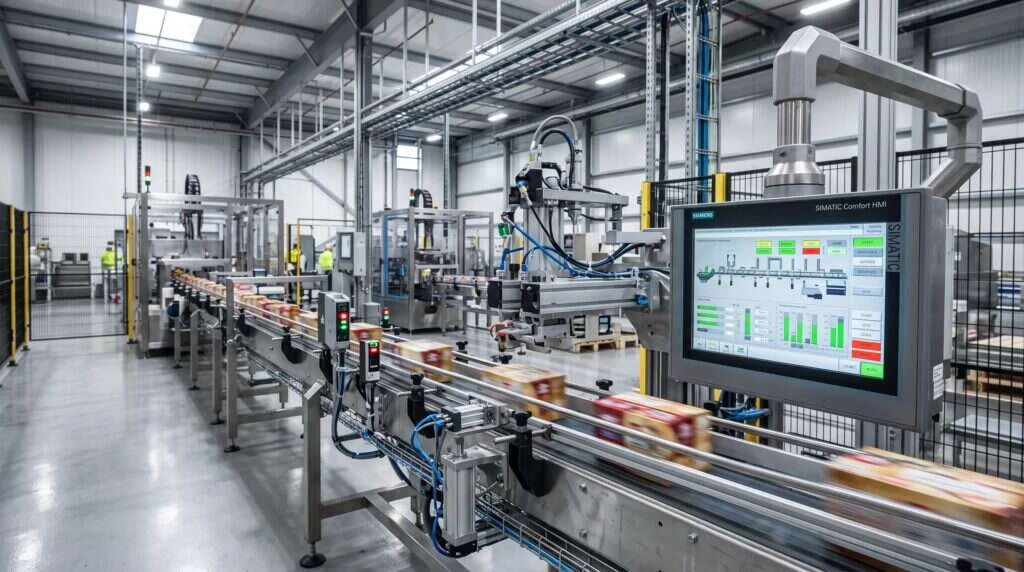
From there, you can program in ladder logic, function block diagram, or structured control language (SCL). The ladder remains the most common choice for discrete machine control because it mirrors the relay logic that many maintenance electricians already read fluently, and that shortens troubleshooting once the machine is running.
Testing and Diagnostics
Before any logic touches real hardware, the simulation tools let an engineer test it on screen. That lowers commissioning risk on machines where a programming error could damage equipment or create a hazard. Once the system is live, online diagnostics show which instruction or input triggered a fault, much faster than tracing relay wiring by hand. Program documentation lives in the same project, which helps sites that keep compliance records or hand programs between shifts and contractors.
A single trained technician can commission a straightforward S7-1200 application. More complex process or motion work benefits from an integrator with hands-on programming depth.
When is the S7-1200 the right fit for your facility?
The S7-1200 is the right fit when you control a single machine, skid, or small line; need PROFINET to an HMI or SCADA without heavy infrastructure; and want to keep hardware and licensing costs below S7-1500 levels.
It usually works well when:
- the application is one machine, skid, or small line rather than plant-wide coordination;
- Your I/O count stays modest, within what your chosen CPU and its expansion modules support;
- You need PROFINET to an HMI or SCADA system without a large communication setup;
- budget rules out the higher hardware and licensing costs of the S7-1500;
- Your maintenance team already knows Siemens conventions or ladder logic in general.
Facilities running demanding safety-rated processes, coordinating dozens of networked machines, or needing very fast scan times for high-speed motion should look at the S7-1500 or a comparable higher-tier platform. Undersizing a controller to save on hardware often costs more in the end, once the site outgrows it and needs a full replacement instead of an incremental upgrade.
A short technical assessment before you buy hardware prevents both mistakes. Review the I/O count, the network requirements, and the expansion plans for the next few years. This kind of review is usually part of a wider Modernization & retrofit services evaluation when a site is deciding whether to upgrade existing controls or replace them outright.
ARC Technologies Siemens PLC Integration
ARC Technologies designs, programs, and integrates Siemens S7-1200 systems as part of its broader electromechanical and industrial automation work across Egypt, the Middle East, and Africa. This includes selecting the CPU and I/O configuration, writing and testing the control logic in TIA Portal, integrating the PLC with drives, sensors, and HMIs, and building the electrical panel that houses the complete system through our panel-building work.
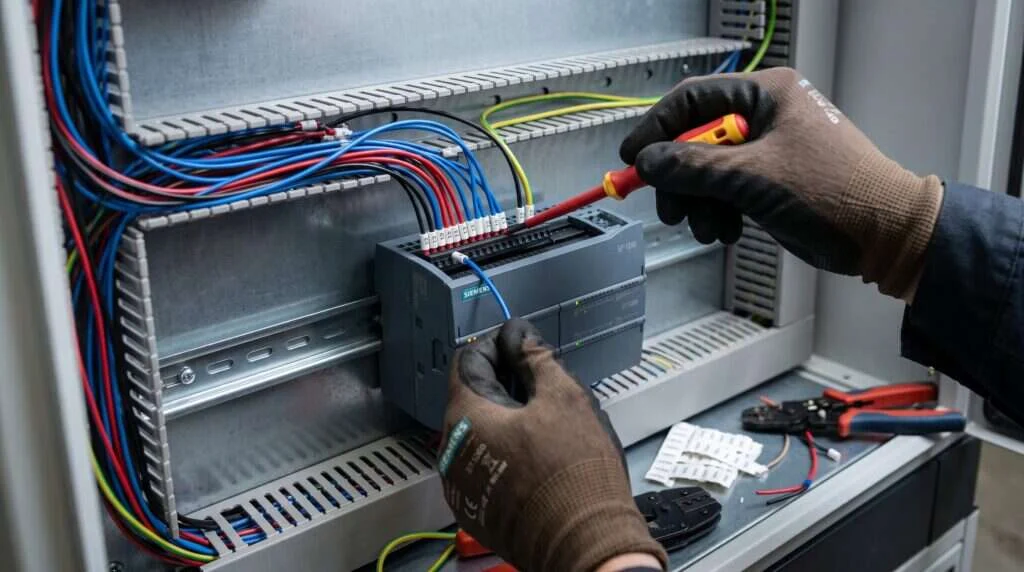
ARC works across both Siemens and ABB platforms and is an official ABB partner and official ABB panel manufacturer. Plants running mixed-vendor equipment do not need to standardize on one brand to get properly integrated control. Most sites collect equipment from several vendors through years of incremental expansion, and a good integrator works with what is installed instead of pushing for a full replacement.
For facilities considering a PLC upgrade, our maintenance services and diagnostics teams can assess whether an existing control system can be retrofitted or needs full replacement. Our training services help in-house teams build the programming and troubleshooting skills to support the system after commissioning.
Talk to ARC Technologies Engineers
Planning a Siemens S7-1200 integration, whether for a new machine, a retrofit of an aging control panel, or a broader automation upgrade? A short technical consultation can settle the CPU configuration, I/O count, and network setup before any hardware is purchased. Contact ARC Technologies to speak with an engineer or to request a technical quote.

Leave a comment