

 العربية
Busbar sizing for a low voltage panel in Egypt isn’t the same exercise as sizing the same panel for a site in Northern Europe. The catalogue rating of a busbar system assumes a cooler room than most Egyptian plants will see in July, and dust pushes designers toward sealed enclosures that trap heat. This guide explains how busbars are rated, how IEC 61439-1 verifies temperature rise, and how to apply derating so a board from our Low Voltage Products range does not start tripping breakers in its second summer.
How Is a Busbar Sized for a Low Voltage Panel?
A busbar is sized so that, at full rated current, its temperature stays within limits that protect the insulation, the connected devices, and the people who touch the panel. For power switchgear assemblies, those limits are checked under IEC 61439-2. Current capacity is a thermal question first, then a short-circuit question.
In practice, the designer works through three checks:
- Continuous current. Cross-section, material, number of bars per phase, and mounting arrangement set how much current a bar carries before it gets too hot.
- Short-circuit withstand. The bar and its supports must survive the peak and thermal forces of a fault at the prospective fault level for the stated duration (often 1 second).
- Temperature at connections. Breaker terminals, cable lugs, and insulators near the bar have their own limits, and they are usually the weak point.
A rule of thumb puts enclosed copper bars at around 1.2 to 2 A per mm², but that figure hides almost everything that matters. The Copper Development Association’s ampacity tables list separate ratings for 30, 50 and 65 °C rises above ambient, and note that higher surface emissivity improves ampacity. Two bars per phase do not carry double the current of one, because of skin and proximity effects in AC systems, and vertical bars cool better than horizontal ones. For real busbar sizing, the busbar current rating should come from the panel system’s tested data, not a generic table.
Temperature Rise Limits Under IEC 61439-1
IEC 61439-1 sets the general rules for low voltage switchgear and controlgear assemblies, including the temperature-rise limits a panel must respect. The limits are expressed as a rise in kelvin above the surrounding air, not as an absolute temperature.
Some of the key limits:
- Terminals for external insulated conductors: 70 K rise
- Accessible external metal enclosures and covers: 30 K rise
- Manual operating handles in metal: 15 K rise
- Busbars and conductors: limited by mechanical strength, the effect on adjacent equipment, and the permitted temperature of insulation in contact with them
- Built-in devices (breakers, contactors, relays): the limits in their own product standards
The original manufacturer can prove these limits in three ways: a physical test, derivation from a tested reference design, or calculation. Calculation is limited to single-compartment assemblies up to 630 A and multi-compartment assemblies up to 1600 A, often using the method in IEC TR 60890. Above 1600 A, temperature rise verification must come from testing or derivation. So a “verified” 3200 A main board should come with test reports or a documented derivation, not a spreadsheet.
Why Does Ambient Temperature Change the Rated Current?
Because the limits are temperature rises, the final temperature of every part depends on where you start. A terminal at its 70 K limit in a 35°C room sits around 105°C. Put it in a 50°C room at the same current, and it heads toward 120°C. Siemens warns in its panel temperature-rise guidance that excessive temperatures can significantly reduce the service life of components in control panels.
IEC 61439-1’s normal service conditions for indoor installations assume an ambient air temperature that does not exceed 40 °C, with a 24-hour average no higher than 35 °C. Most catalogue ratings are based on those conditions.
Egyptian sites break these assumptions often:
- The World Bank’s climate profile for Egypt puts inland summer daytime highs at around 43°C.
- Many electrical rooms rely on natural ventilation or a single split unit that fails or is switched off.
- Panels beside furnaces, compressors, or kilns sit in local air far hotter than the weather report.
- Night temperatures stay high, so the 24-hour average can exceed 35°C for weeks.
When the real ambient exceeds these assumptions, the user must tell the panel builder, and rated currents must be reduced. IEC 61439-1 treats this as a special service condition agreed between user and manufacturer. If nobody writes the real ambient into the specification, the board will be built for 35°C.
Does Dust Change Your Enclosure and IP Choice?
Yes. Dust pushes you toward a higher degree of protection, and a higher degree of protection reduces how much heat the enclosure can shed. Egypt also gets khamsin winds, which the World Bank describes as hot, sand- and dust-laden winds that usually blow between March and May.
Degrees of protection are defined in IEC 60529. The first digit covers solids, and the second covers water. For dusty Egyptian plants, the relevant levels are usually:
- IP31 or IP41: ventilated, suitable for clean, conditioned electrical rooms
- IP54: dust-protected (some dust may enter but not enough to interfere with operation), with splash protection
- IP65: dust-tight, for outdoor or wash-down areas
Every enclosure choice is a trade-off. As you raise the IP rating, electrical panel cooling gets harder. An IP31 board with louvers moves a lot of air by natural convection. An IP54 board with filtered vents moves much less, and in cement, steel, or textile plants, the filters clog fast unless they sit on a real maintenance schedule. A sealed IP65 enclosure loses heat only through its walls, so the same busbar carries noticeably less current as the IP rating goes up.
Practical ways to keep dust out without cooking the panel include a clean, pressurized electrical room with a lower IP rating, filtered fans, air-to-air heat exchangers or panel air conditioners, and a larger enclosure with more surface area. The 2020 edition of IEC 61439-2 added rules for verifying temperature rise in actively cooled assemblies up to 1600 A.
Derating Factors to Account For
Derating means reducing the rated current of a busbar or device to keep temperatures within limits when conditions are worse than the reference conditions. Several factors combine, and they multiply rather than add, which is why busbar sizing done with a single correction usually comes out too optimistic. The IEC TR 60890 method also covers effects like solar radiation and enclosure material.
Ambient temperature. The largest factor on most Egyptian sites. Permissible current scales roughly with the square root of the allowed temperature rise, which is why the copper ampacity tables drop so sharply between the 65 °C and 30 °C rise columns.
Enclosure and IP rating. Higher IP means a lower rating. Ask for the busbar system’s tables at your actual IP code.
Ventilation. Fans or cooling can restore some or all of the rating, provided they are reliable and covered by your maintenance services plan.
Grouping and diversity. Not all outgoing circuits run at full load at once. IEC 61439-2 uses a rated diversity factor that, unless agreed otherwise, ranges from 0.9 for 2 to 3 main circuits down to 0.6 for 10 or more. If everything runs at full load, say so, because the default flatters the design.
Altitude. Ratings under IEC 61439-1 hold up to 2000 m. Almost every Egyptian industrial site sits far below this, so altitude rarely applies.
Device ratings. Breakers have their own ambient derating. Many manufacturers calibrate molded case and air circuit breakers built to IEC 60947-2 at 40°C, so their thermal trip units read a hot panel as overload. This is the most common cause of “nuisance” trips in summer.
A Worked Derating Example for an Egyptian Plant
The numbers below are illustrative; always use the specific panel system’s tested tables. A food plant near Cairo needs a main LV board with a maximum demand of 2000 A. The room has natural ventilation only, and summer readings inside it reach 45°C, close to the inland highs in the World Bank climate data. Flour dust means the client wants IP54.
Step 1: Start from the catalog rating. The panel builder proposes a 2500 A busbar system, rated at a 35°C average ambient in an IP31 enclosure.
Step 2: Apply the ambient correction. Assume a busbar design temperature of 65 °C at 35 °C ambient. Using the square-root relationship behind tables such as DIN 43671:
Correction = √((65 − 45) / (65 − 35)) = √(20 / 30) ≈ 0.82
2500 A × 0.82 ≈ 2050 A
Step 3: Apply the IP correction. Suppose the manufacturer’s table gives 0.90 for IP54 compared with IP31.
2050 A × 0.90 ≈ 1845 A
Step 4: Compare with demand. 1845 A is below 2000 A. The 2500 A system is not enough.
Options:
- Step up to a 3200 A system, which, after derating, gives roughly 2360 A
- Keep 2500 A but cool the room to 35°C or below
- Move the board to a cleaner room and reduce the IP requirement
The point of busbar sizing at the design stage is that you choose between these deliberately, with a panel building partner, rather than discovering the answer through a failed termination in August.
What Happens When Derating Is Ignored?
The board usually passes commissioning tests, which rarely happen at full load in peak summer. Problems appear later, in roughly this order:
- Breaker trips in the afternoon. Thermal trip units in a hot panel operate below their nominal setting. Operators raise the settings, which removes protection.
- Hot joints. Bolted connections cycle between hot and cool and lose clamping force. In accelerated aging tests by the Copper Development Association, aluminum joints lost 38 to 56% of their bolt torque in the first phase, against 9 to 15% for copper.
- Insulation aging. Cable insulation, busbar supports, and device housings age faster at high temperatures.
- Failure. A joint or device fails, sometimes as an arc fault, taking the plant down far longer than any planned outage.
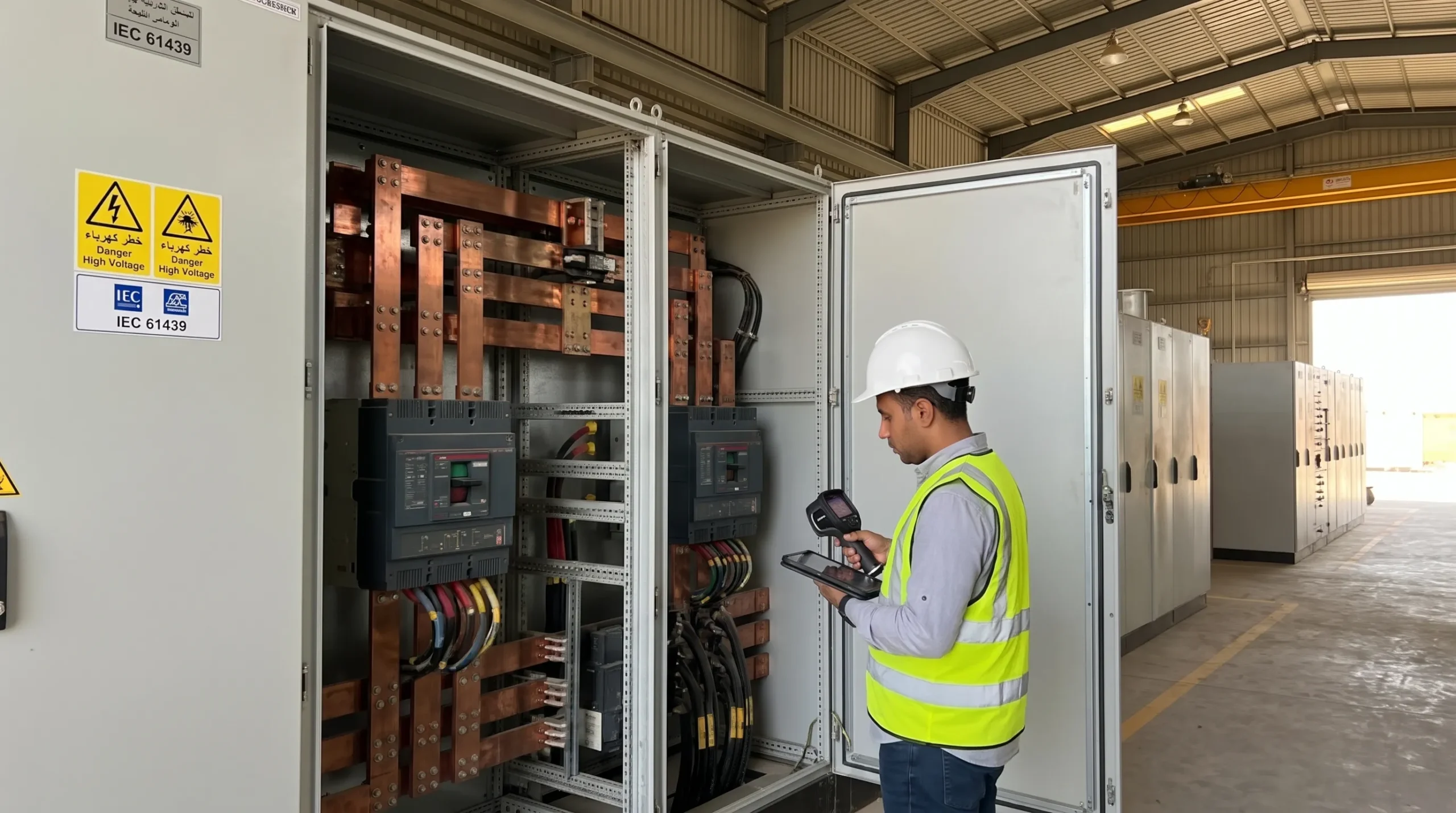
A periodic thermographic survey through ARC’s Diagnostics & Testing Services finds hot joints before they fail, and NFPA 70B now treats a documented maintenance programme as a requirement. Both treat the symptom. A board sized for its real environment avoids most of the problem.
Getting a Verified Design from ARC
ARC designs and builds IEC 61439 assemblies for Egyptian industrial sites, with busbar sizing checked against real room conditions rather than catalogue defaults. We supply busbars systems, breakers and enclosures through our Low Voltage Products range, and our Panel Building team handles design verification and documentation. If an existing board trips every summer, our Modernization & Retrofit Services can assess whether upgrading devices, adding cooling or replacing the busbar system is the better fix.
Frequently Asked Questions
What ambient temperature does IEC 61439-1 assume?
For indoor assemblies, air temperature is up to 40°C with a 24-hour average no higher than 35°C. Anything hotter is a special condition to agree with the manufacturer under IEC 61439-1.
Is an aluminum busbar acceptable in hot climates?
Yes, if it is sized and jointed correctly. The Copper Development Association report notes aluminum needs about 56% more cross-section to match copper’s resistance, and its joints need closer attention.
Can fans restore a derated busbar to full rating?
Much of it, if fans and filters are maintained. A failed fan in summer puts you straight back to the derated condition, so many designers size the fan-off case and schedule checks through preventive maintenance.