

 العربية

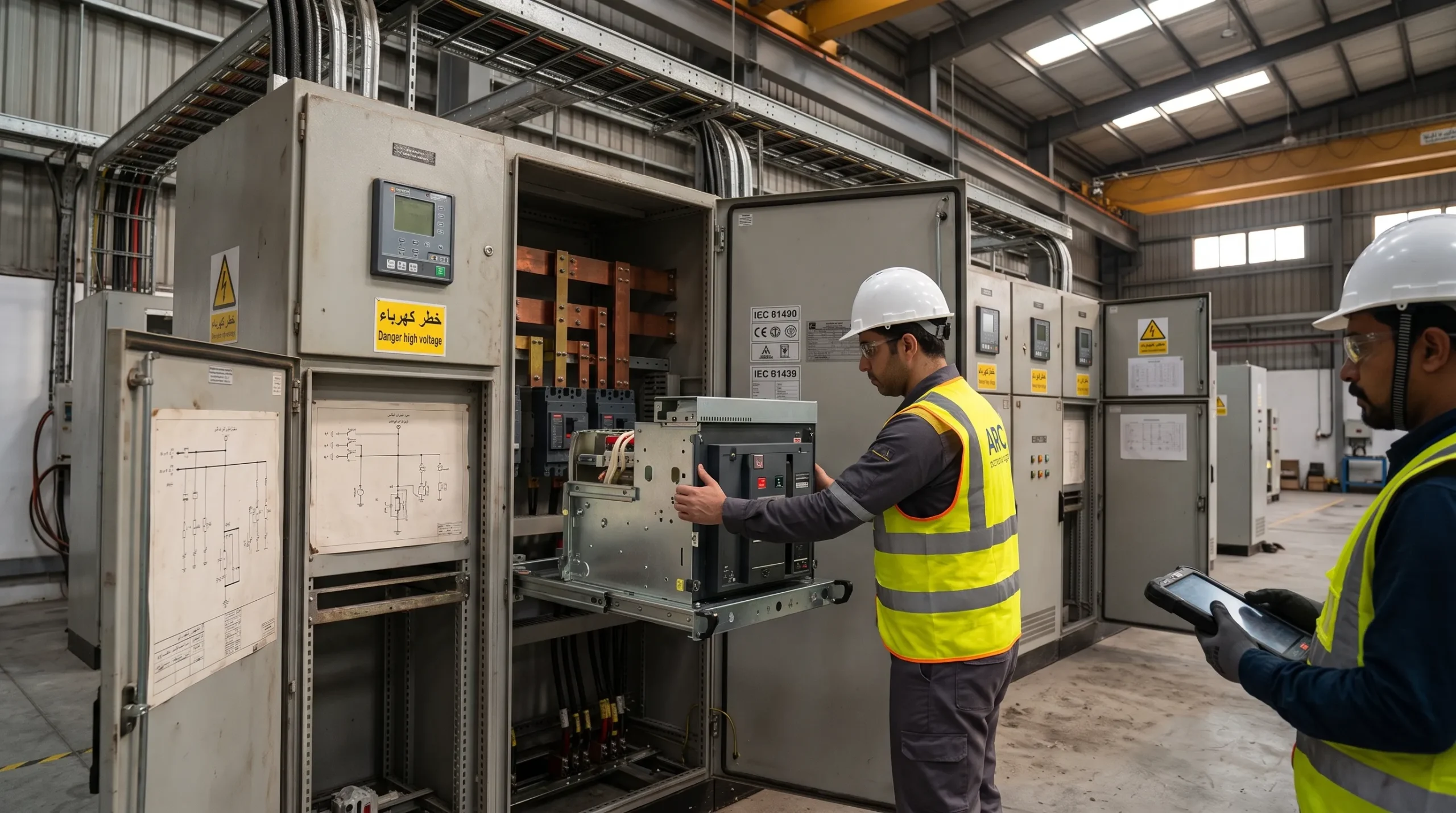
Many Egyptian factories, hospitals, and water plants still run on 11 kV and 22 kV switchboards installed in the 1980s and 1990s. The steelwork and busbars are often in decent shape, but the breakers inside are oil or air-magnetic units that nobody makes parts for anymore. An MV switchgear retrofit replaces those breakers with modern vacuum units while keeping the enclosure, busbars, and cable terminations in place. Done well, it can add many years of reliable service for a fraction of the outage time and cost of a full replacement. Our Modernization & Retrofit Services team handles this kind of work for industrial sites across Egypt.
What Is MV Switchgear Retrofill?
Retrofill is the replacement of the circuit breaker, the moving and wearing part of a switchgear cubicle, with a new breaker built to fit the existing cubicle. The new unit connects to the original primary contacts, racking mechanism, and secondary wiring, usually through a purpose-built adapter or truck.
It sits between two other options. Retrofit, in the narrow sense some manufacturers use, means modifying the cubicle itself, for example, by fitting new spouts, shutters, or a new truck design. Full replacement means removing the lineup and installing new assemblies. In daily use, many engineers say “retrofit” for both, which is exactly why tender documents should spell out which parts are being replaced and which are staying.
The appeal is easy to see. The expensive, slow-to-change parts (enclosure, busbars, cable boxes, cable trenches, and civil works) stay where they are, and only the part that wears out and loses support is renewed. If you are weighing this route against a new build, our Panel Building page explains what a new assembly involves from design to factory testing.
Signs That Aging Switchgear Needs Attention
The clearest sign is a breaker you can no longer support. When the manufacturer stops supplying spare coils, contacts, or mechanism parts, every failure turns into a long outage while someone hunts for parts or improvises a repair. This is the core of legacy switchgear obsolescence: the equipment may still work today, but you cannot fix it quickly when it stops.
Other warning signs to watch for:
- Slow or inconsistent trip times in breaker timing tests
- Oil leaks, dark oil or rising moisture content in oil breakers
- Damaged arc chutes and eroded contacts in air-magnetic breakers
- Hot spots on breaker contacts or busbar joints during thermography
- Repeated mechanism faults, such as closing springs that fail to charge
- Operators avoiding manual switching because they no longer trust the gear
Site conditions in Egypt speed up this ageing. High summer temperatures, fine desert dust and, in coastal plants, salty humid air all attack insulation, lubricants and contact surfaces. A board in a poorly ventilated substation in an industrial zone will usually show these signs years earlier than the same model in a clean, air-conditioned room.
Safety regulators take ageing oil switchgear seriously. The UK Health and Safety Executive’s guide Electrical Switchgear Safety: A Guide for Owners and Users notes that failures are rare but can be catastrophic, and asks owners to assess and manage the risk. Its more detailed guid Keeping Electrical Switchgear Safe (HSG230) covers three-phase switchgear from 1 kV up to 33 kV using oil, air, SF6 or vacuum. If you are not sure what condition your boards are in, routine inspections under ou Maintenance Services programme are a sensible first step.
Retrofill or Replace: How Should You Decide?
Retrofill makes sense when the enclosure and busbars are sound, and the fault level has not grown beyond the original ratings. Replacement is the better choice when the structure itself is the problem or when the network around it has changed.
A practical way to decide is to check five points:
- Short-circuit rating. Has the fault level at your intake risen since the board was installed? A larger transformer or a stronger utility connection can push it above the busbar’s short-time withstand rating.
- Enclosure condition. Corrosion, cracked bushings, or tracking marks on insulation point toward replacement.
- Internal arc performance. Older boards were rarely tested for internal arc faults. A retrofill does not change how the enclosure behaves during one.
- Spare capacity. If the plant needs more feeders, extending an old lineup with new cubicles is often harder than replacing it.
- Outage tolerance. A plant that cannot stop for several weeks will usually favor a staged retrofill.
Cost matters too. Retrofill normally avoids new civil works, cable re-termination, and long shutdowns, so the total project cost is often well below that of a new lineup. But a cheap retrofill on a weak enclosure only moves the risk somewhere else. When the honest answer is new equipment, our Power & Control Products Distribution team can supply complete medium voltage assemblies and components.
Replacing Oil and Air-Magnetic Breakers with Vacuum Units
Vacuum interrupters have become the default for medium voltage breakers. They need little maintenance, contain no oil to test or dispose of, and offer long mechanical and electrical life. A retrofill vacuum breaker is engineered so its contact arms, racking height, auxiliary contacts, and interlocks match the original truck it replaces.
The new breaker should be designed and type-tested to IEC 62271-100, the international standard for AC circuit breakers above 1 kV. Ask the supplier for test evidence that covers the breaker inside its adapter, not only the bare breaker. The adapter changes the current path and the clearances, so a test on the breaker alone does not prove the combined unit.
Pay attention to the control voltage and the closing mechanism as well. Old breakers often used solenoid closing on large DC batteries, while modern units use spring mechanisms with small motors. That may let you downsize the battery and charger, but the wiring changes must be drawn and checked before work starts.
A retrofill is also a good moment to move away from electromechanical relays. Many projects fit numerical protection relays at the same time, with metering and communication ports that report breaker status, trip events, and load to a plant SCADA system. If you want that data in your control room, our Industrial Automation Solutions team can handle the integration.
Can the Original Enclosure Be Reused Safely?
Yes, in many cases, but only after a proper inspection. The enclosure and busbars were designed for a specific rated current, short-time withstand current, and insulation level. The new breaker has to work inside those limits, not the other way around.
The inspection should cover:
- Busbar joints and supports, checked for torque, discolouration and tracking
- Primary contacts and spouts, replaced if pitted or worn
- Shutters and earthing switches, tested for smooth mechanical operation
- Insulation resistance and, where possible, partial discharge measurements
- Secondary wiring, since old insulation can crack once it is disturbed
The reference for metal-enclosed assemblies above 1 kV and up to 52 kV is IEC 62271-200. Its first edition was published in 2003 and replaced IEC 60298, so many older Egyptian boards were built to the earlier standard. That matters because the newer standard introduced clearer classes for internal arc performance and service continuity. A retrofill does not make an old enclosure compliant with today’s edition, and no supplier should claim it does. Our retrofit engineering assessments record exactly what the existing enclosure can and cannot support, so the decision is made on evidence.
Planning Outages and Staged Cubicle Upgrades
The biggest practical advantage of an MV switchgear retrofit is that it can be done one cubicle at a time. Once the first adapter is proven on a pilot panel, later cubicles often take a day or two each, depending on wiring changes and testing.
A typical staged plan looks like this:
- Survey every cubicle and record nameplate data, relay types, and wiring diagrams.
- Retrofit one non-critical feeder as a pilot and run it in service for a few weeks.
- Group the remaining feeders by process area so each shutdown affects one production line.
- Leave incomers and bus section breakers for a planned plant shutdown, such as an annual maintenance stop.
- Update the single-line diagram, protection settings, and operating procedures after each stage.
Order the breakers and adapters early. Retrofill units are often made to order for a specific cubicle type, so lead times can run to several months. Keep at least one spare retrofitted breaker on site once the project is finished, since it can be racked into any matching cubicle within minutes if another unit needs service.
Critical loads can keep running during the works through temporary generators or by transferring load to another busbar section. Our Critical Power Solutions cover the backup power arrangements that keep production going during planned outages.
Testing Requirements After a Retrofill
Every retrofitted cubicle should be tested before it goes back into service, exactly as if it were new equipment. Skipping tests to save outage time is how retrofit projects create the very faults they were meant to prevent.
The usual test list includes:
- Insulation resistance and power-frequency withstand on the breaker and adapter
- Main circuit contact resistance
- Timing tests for close and open operations
- Mechanical operation and interlock checks in test and service positions
- Secondary injection of the protection relay and a full trip-chain test
- Primary injection where current transformers have been changed or rewired
Maintenance after handover should follow a recognised framework. The 2023 edition of NFPA 70B turned electrical maintenance from a recommended practice into a standard, with intervals based on equipment condition, criticality and operating environment. For the commissioning tests listed above, our Diagnostics & Testing Services team brings the instruments and issues a full test report.
Reviewing Your MV Switchgear with ARC
If your plant has switchgear that is getting harder to support, start with a condition survey rather than a purchase order. A good survey tells you which cubicles can be retrofilled, which should be replaced and in what order. That turns switchgear life extension into a planned budget line instead of an emergency purchase after a failure.
ARC Technologies works with industrial facilities across Egypt on MV switchgear retrofit studies, supply, installation and testing. Talk to our Modernization & Retrofit Services team to book a site survey of your medium voltage boards.
Frequently Asked Questions
How long does an MV switchgear retrofit last?
A well-executed retrofill commonly adds 15 to 20 years of service, provided the busbars and enclosure are sound and the equipment is maintained on a regular schedule.
Is retrofill cheaper than replacing the switchgear?
Usually, yes. It avoids new civil works, cable re-termination and long shutdowns. It stops being good value when the enclosure is damaged or the fault level has outgrown the busbar rating.
Can retrofill be done without shutting down the whole plant?
In most cases, yes. Feeder cubicles are usually upgraded one at a time during short local outages, while incomers are left for a planned plant shutdown.