

 العربية

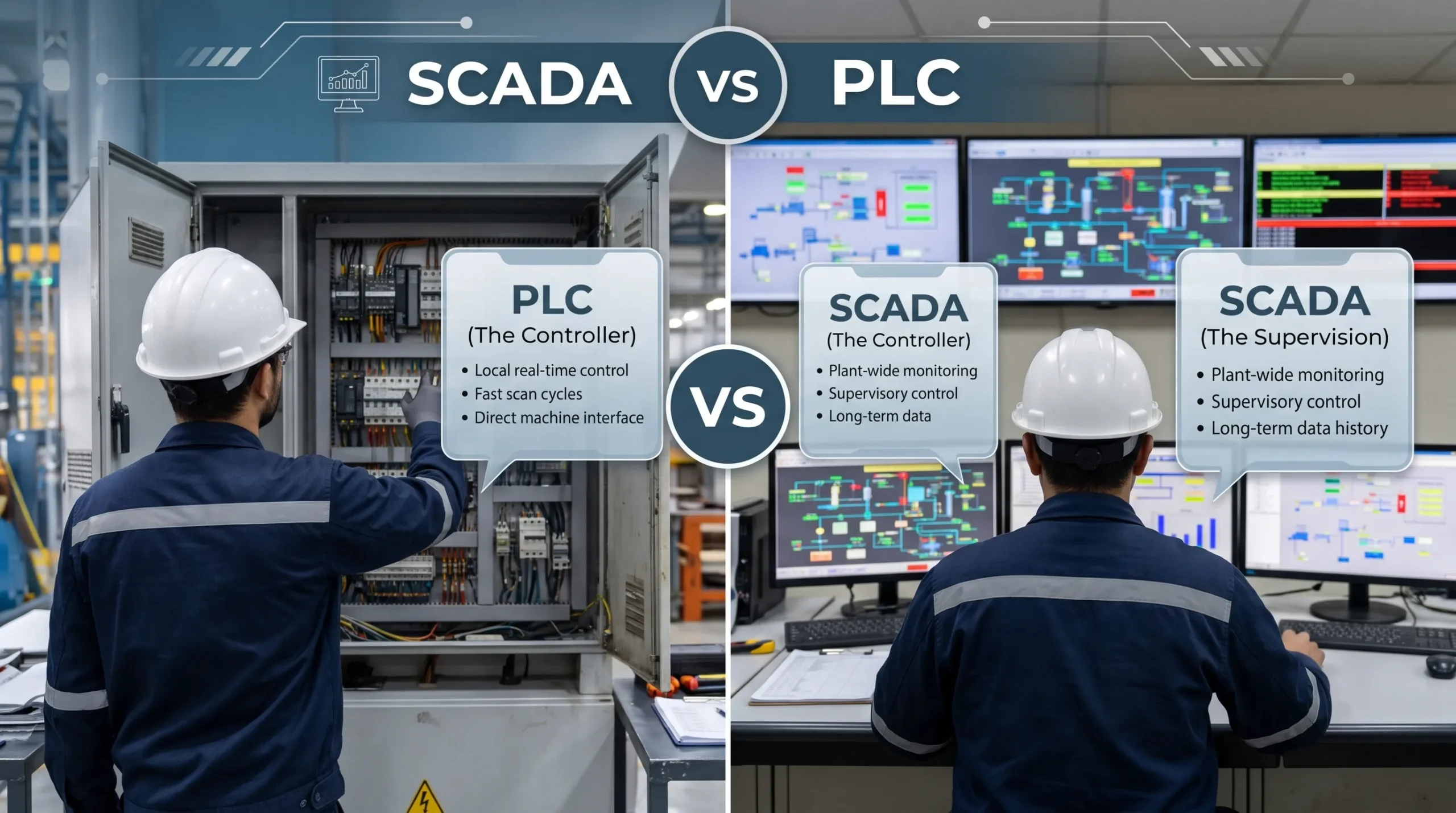
A factory floor produces a constant stream of signals: pump pressures, tank levels, motor currents, line speeds, alarm states. Someone has to see all of that in one place and act on it quickly. That is the job of a SCADA system.
SCADA stands for Supervisory Control and Data Acquisition. It collects data from machines across a plant, shows it to operators on screens, stores it for analysis, and sends their commands back to the equipment. This guide explains what a SCADA system does in practice, what it is made of, and how it differs from a PLC, the controller most plant teams already know.
What Is a SCADA System?
A SCADA system is a combination of software and hardware that lets a plant be monitored and controlled from a central point. It gathers real-time data from sensors, drives, and controllers; presents it to operators; records it, and passes operator commands back down to the equipment.
The word “supervisory” matters. SCADA does not usually run a machine cycle by cycle, because local controllers do that. It sits above them and answers different questions. Is the plant healthy? Which pump tripped? Why did output drop at 2 a.m.? In that sense, it works as an industrial monitoring system with the authority to intervene, and it is why a small control room team can oversee several buildings, or several sites, at once.
How Does SCADA Work?
Field devices measure the process, local controllers act on those measurements, a network carries the data to a SCADA server, and operators see and command the process through screens. Every layer passes data upward and commands downward.
In a typical factory, the sequence runs like this:
- Sensors and instruments measure pressure, temperature, flow, level, current, or speed.
- Controllers read those signals and run the control logic at the machine.
- A network, wired or wireless, carries the values to the SCADA server.
- The server logs the data, checks alarm limits, and refreshes the screens.
- The operator reviews the display and, when needed, sends a setpoint or a start command back.
A SCADA system collects this data by polling or by exception. Polling asks every device for its values at a fixed interval. Exception reporting sends data only when a value changes beyond a set threshold, which saves bandwidth on slow links. Protocols such as Modbus, Profinet, EtherNet/IP, and OPC UA give equipment from different manufacturers a common language, which matters in plants that have grown over many years.
Core Components of a Factory SCADA Architecture
Most installations are built from the same few blocks:
- Sensors, transmitters, drives, and valves that touch the process directly.
- Controllers, usually PLCs or remote terminal units, that read inputs and execute local logic.
- A communications layer of industrial Ethernet, fieldbus, radio, or fiber.
- SCADA servers that poll devices, process alarms, and manage the tag database.
- A historian, the database that keeps trends and events for reporting and root-cause work.
- Operator workstations running the screens.
Critical plants often duplicate servers and network paths so a single failure never blinds the operators. The switches, power supplies, and I/O that carry this traffic live inside cabinets, so the quality of the panel building behind the system shows up directly in uptime.
SCADA HMI: What Operators See on Screen
The SCADA HMI is the screen an operator lives with all shift. A good one stays quiet most of the time and gets loud only when something matters.
Typical pages include a process overview, trend charts, an alarm list, and detail views for each major asset. Muted colors work best for normal running, with red and amber kept for abnormal states. The operator should see the likely cause of an alarm, not just the symptom.
Note the difference in scope. A touchscreen bolted to one machine is an HMI, but a SCADA HMI spans many machines and areas at once.
Alarm floods are the most common failure. When everything flashes, nothing gets attention. Teams that review each alarm during commissioning, decide its priority, limit, and expected response, end up with a far calmer control room.
SCADA Software: What to Look For
SCADA software is where the server, tag database, alarm engine, historian, and screen builder come together. Platforms differ widely, so it helps to compare them against a short list:
- Drivers for the controllers and drives already installed on site.
- Redundancy and failover options.
- Room to grow in tags, clients, and sites.
- A built-in historian and flexible reporting.
- Web or mobile access with role-based permissions.
- Security features such as authentication and audit logs.
- Local engineering support when something goes wrong at night.
Tag count or client count often prices licensing, so a realistic point estimate early in the project prevents unpleasant surprises later. It also pays to ask how easily screens and data can be exported, because a platform that locks your data in becomes expensive to leave.
How Is SCADA Different from a PLC?
A PLC controls a machine or process section in real time. SCADA supervises many controllers across a plant, showing data, logging history, and handling alarms. The PLC acts, and SCADA watches and directs.
A programmable logic controller is a rugged industrial computer that reads inputs, runs control logic in a fast repeating scan, and switches outputs. It keeps running even if the network or the supervisory layer goes down. For a fuller explanation, read What a PLC is.
The SCADA vs PLC question is easiest to settle side by side:
Aspect | PLC | SCADA |
Main job | Real-time control of a machine or section | Plant-wide supervision and data collection |
Scope | One machine or process area | Many controllers, areas, or sites |
Speed | Fast scan cycles for control | Slower updates suited to supervision |
Operator interface | Basic local panel | Full graphics, alarms, and trends |
Data history | Limited | Long-term historian |
Runs on | Industrial controller hardware | Servers and workstations |
If it fails | The machine stops or goes to a safe state. | Control continues locally; visibility is lost. |
The two are partners, not rivals. The PLC makes the process run, and SCADA makes it visible and manageable.
Do You Need Both a PLC and SCADA?
Not always. A single machine with a local touchscreen rarely needs SCADA. Once the plant grows beyond that, the picture changes.
Signs that a plant has outgrown local control:
- Operators walk the floor to read gauges and write numbers on paper.
- Controllers from several vendors need to be watched from one place.
- Management wants trend history and shift reports without manual collection.
- Remote or unmanned sites need to be watched from a central room.
- Auditors or customers ask for records of alarms and operator actions.
If two or three of these sound familiar, a supervisory layer will probably pay for itself.
What Does SCADA Do for a Factory?
It gives the plant one version of the truth. Operators, maintenance staff, and managers all see the same live values, alarms, and history, instead of working from phone calls and handwritten logs.
A SCADA system also shortens the time between a fault and a response. An alarm that reaches the right screen in seconds can save a motor, a batch, or a shift.
Trend data brings further benefits:
- Run hours and start counts support planned maintenance before breakdowns happen.
- Consumption trends on motors, compressors, and pumps show where energy is wasted, which feeds directly into industrial energy management work.
- Automatic reports replace hours of manual data entry.
- Event logs make root-cause analysis faster and less political.
Where Factories Use SCADA
Water and wastewater plants were early adopters, since pumps, tanks, and treatment stages are spread over large areas. Food and beverage plants use it to track batches and temperatures. Cement and building materials sites rely on it to keep kilns, mills, and conveyors coordinated. Pharmaceutical and chemical plants use it for process records, while utilities and large facilities apply it to substations and power distribution.
The pattern is the same everywhere: many assets, one control room, and a need for reliable records.
Is SCADA Secure?
It can be, but only if security is designed in from the start. Supervisory networks connect control equipment to servers and sometimes to the corporate network, and every connection is a possible way in.
The IEC 62443 series is the main international family of standards for industrial automation and control system security.
Government guidance helps too. The NIST guide to operational technology security covers architecture, risk, and recommended safeguards for control systems.
In practice, a few habits do most of the work: separating the control network from the office network, removing default passwords, giving each user only the rights they need, testing patches before rolling them out, and keeping tested backups of server configurations and project files.
How to Plan a SCADA Project
The projects that go smoothly tend to follow the same order:
- Write down what the system must achieve, such as fewer stoppages, better reports, or remote visibility.
- List the signals, tags, and alarms, and survey the controllers and protocols already on site.
- Design the network, the server layout, and the level of redundancy.
- Agree naming rules and screen standards before anyone draws a page.
- Test communications, alarms, and failover before go-live, not after.
- Train operators on the real screens and keep a backup of the final project.
Skipping step 2 causes most overruns. Discovering a controller with no usable driver in the last week of commissioning is expensive.
Planning SCADA with ARC Technologies
ARC Technologies is an official ABB partner and official ABB panel manufacturer, delivering industrial automation solutions to plants across Egypt. Our team can help you assess whether your plant is ready for a SCADA system, define the controller and network architecture around it, and build the panels that house the hardware.
To talk through your plant, your existing controllers, and your reporting needs, contact us, and our engineers will take it from there.