

 العربية

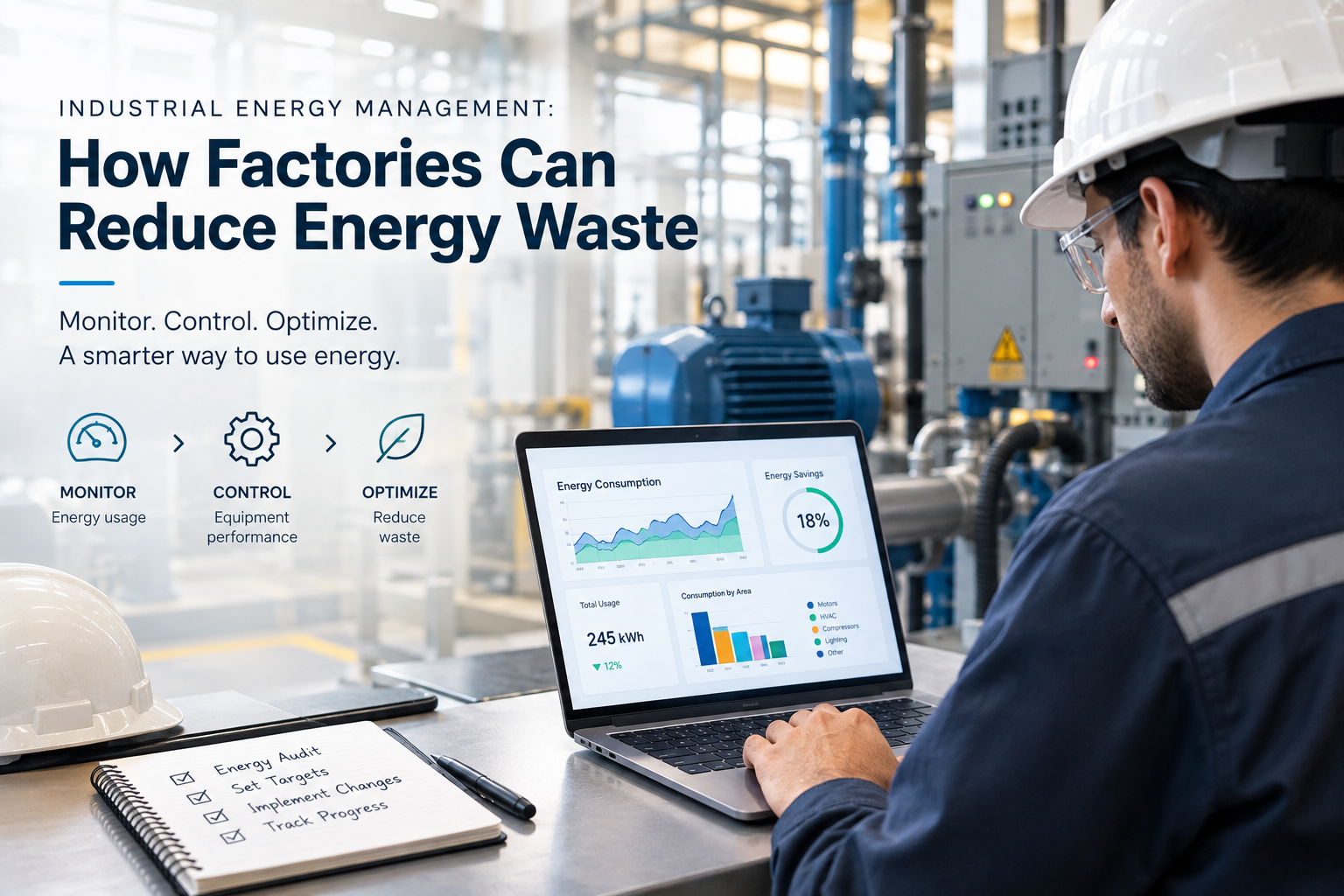
Rising electricity costs make untracked energy waste one of the most expensive blind spots in a factory. A compressor that runs through lunch breaks, a motor sized for a production line that was upgraded years ago, and a chiller cycling harder than it should because a sensor drifted out of calibration: none of these show up on a monthly utility bill as a line item, yet together they can account for a meaningful share of a plant’s operating costs.
This is exactly the gap that industrial energy management is designed to close. Rather than treating energy as a fixed overhead, it treats energy as a resource that can be measured, controlled, and optimized in the same way a plant manages raw materials or labor hours.
For facility managers, plant engineers, and procurement teams under pressure to control operating expenses, understanding how industrial energy management works and how to start building a program around it is quickly becoming a practical necessity rather than a nice-to-have.
What Is Industrial Energy Management?
Industrial energy management is the systematic process of monitoring, controlling, and improving how a facility generates, distributes, and consumes energy. It combines data collection, equipment performance analysis, and operational decision-making to reduce waste without compromising production output or safety.
At its core, industrial energy management answers three questions on an ongoing basis: where is energy being used, how much of that use is necessary, and what changes would reduce consumption without disrupting operations. This is different from a one-time energy audit. An audit is a snapshot. Energy management is a continuous discipline, closer to how a plant handles quality control or preventive maintenance.
The scope typically covers electrical loads such as motors, drives, compressors, HVAC systems, and lighting, along with the electrical infrastructure that distributes power to them, including panels, switchgear, and control systems. Because these systems interact, a problem in one area, such as an undersized panel or an aging motor, can quietly inflate consumption across an entire production line.
Building an Energy Management Plan
An industrial energy management plan is the structured document that turns awareness of energy waste into an actionable program. Without one, energy-saving efforts tend to happen in isolated bursts, usually after a spike in utility bills, rather than as a sustained practice.
A workable plan generally includes the following components:
- Baseline data. Historical utility bills, submetering data where available, and equipment inventories that establish current consumption patterns.
- Priority areas. The systems or departments responsible for the largest share of consumption, identified through load analysis rather than assumption.
- Measurable targets. Specific, time-bound goals, such as reducing compressed air system losses by a defined percentage within a set period.
- Assigned ownership. A clear point of accountability, whether that is a dedicated energy manager, a facilities engineer, or a cross-functional team.
- Review cycles. Scheduled intervals to compare actual performance against targets and adjust the plan accordingly.
The international standard most commonly referenced for structuring this kind of program is ISO 50001, which provides a framework for managing energy performance, covering energy efficiency, energy use, and energy consumption. Facilities do not need to pursue formal certification to benefit from the underlying structure. Even a simplified version of the ISO 50001 approach, built around baseline measurement, target-setting, and regular review, gives a plant a repeatable process instead of a one-off initiative.
Energy Management Strategy: Where Most Factories Start
An industrial energy management strategy defines how a facility will actually pursue its plan, and most factories find it easier to start with the interventions that require the least capital investment before moving toward larger infrastructure upgrades.
A practical starting sequence looks like this:
- Behavioral and operational changes. Shutting down idle equipment, adjusting shift schedules around peak demand periods, and correcting simple issues like compressed air leaks. These require little to no capital and often deliver the fastest visible results.
- Maintenance-driven efficiency. Motors that are misaligned, bearings that are worn, or panels that are running hotter than they should all consume more energy than a properly maintained system. Routine inspection catches these issues before they become chronic waste.
- Equipment upgrades. Replacing outdated motors, drives, or lighting with higher-efficiency alternatives once the lower-cost measures have been exhausted.
- Automation and control upgrades. Adding variable frequency drives, programmable controllers, or centralized monitoring to match energy input more precisely to actual production demand.
This sequencing matters because factories that jump straight to expensive equipment replacement without first addressing operational waste often find that the new equipment still underperforms, simply because the underlying inefficiencies were never corrected. A sound energy management strategy treats capital investment as the final stage, not the starting point.
Common Sources of Energy Waste in Industrial Facilities
Energy waste in industrial facilities rarely comes from one obvious source. It accumulates across several systems, and identifying where the losses are concentrated is usually the first real step toward reducing them.
| Source | Typical Cause | Impact |
| Compressed air systems | Leaks, oversized compressors, pressure set too high | Can account for a large, often underestimated share of a facility’s electrical load |
| Electric motors | Oversized for the load, poor maintenance, no variable speed control | Continuous energy loss during partial-load operation |
| HVAC and process cooling | Poor insulation, outdated controls, lack of scheduling | Excess consumption outside production hours |
| Lighting | Legacy fixtures, no occupancy controls | Constant draw regardless of actual need |
| Electrical panels and distribution | Loose connections, overloaded circuits, aging components | Heat losses and reduced system efficiency |
| Idle equipment | Machines left running during breaks or changeovers | Consumption with zero production output |
Compressed air is worth singling out. It is one of the most expensive forms of energy in an industrial setting to generate, and leaks are notoriously easy to overlook because they do not stop production; they simply run in the background, adding cost every hour the system is pressurized.
Aging or poorly maintained electrical panels also deserve attention. A panel with loose terminations or degraded components does not just create a safety risk; it runs less efficiently, generating heat that represents wasted energy. Facilities that have not had their distribution equipment reviewed in several years often find this is where a portion of their unexplained consumption originates.
Digital Monitoring and Energy Management Solutions
Digital energy management solutions give facilities visibility into consumption patterns that would otherwise stay hidden inside a single monthly utility bill. Instead of estimating where energy goes, submetering and monitoring platforms break consumption down by department, production line, or individual piece of equipment, in something close to real time.
This level of detail matters for two reasons. First, it turns energy management from a reactive exercise into a proactive one. A sudden increase in a specific line’s consumption can flag a developing mechanical problem, such as a failing bearing or a motor drawing more current than it should, well before that problem causes unplanned downtime. Second, it gives decision-makers the data needed to justify capital investment. It is far easier to approve a motor replacement or a compressor upgrade when there is measured consumption data showing exactly how much that piece of equipment is costing to operate.
ABB, whose automation and electrification technologies are widely used across industrial facilities in the region, offers digital energy management tools designed to track consumption, flag inefficiencies, and support this kind of data-driven decision-making. As an official ABB partner, ARC Technologies works with facilities to integrate these ABB energy management solutions into existing electrical infrastructure, connecting monitoring data to the panels, drives, and control systems that generate it.
Digital monitoring works best when it is paired with the automation layer that actually controls equipment behavior. Variable frequency drives, programmable logic controllers, and soft starters allow a facility to translate the insight gathered from monitoring into automatic adjustments, rather than relying on manual intervention every time a pattern is identified. For plants exploring this integration, ARC’s industrial automation solutions extend this capability across drives, controllers, and the broader control architecture.
Measuring the ROI of an Energy Management Program
Return on investment for an energy management program is measured by comparing the reduction in energy costs against the cost of implementing the program, but the calculation should account for more than the utility bill alone.
A reasonably complete ROI assessment considers:
- Direct energy savings, based on submetered or utility-reported consumption before and after implementation.
- Reduced maintenance costs, since equipment operating within its designed efficiency range typically experiences less thermal stress and wear.
- Avoided downtime, where early detection of abnormal consumption prevents equipment failure that would otherwise halt production.
- Extended equipment lifespan, as motors, panels, and drives running under proper load conditions tend to degrade more slowly.
- Demand charge reduction in facilities billed on peak demand, where shifting or flattening load profiles can lower a significant portion of the total electricity cost.
Payback periods vary widely depending on which measures a facility implements. Low-cost operational changes, like fixing compressed air leaks or adjusting equipment schedules, can pay for themselves within months. Capital-intensive upgrades, such as replacing a fleet of motors or installing a full monitoring system, naturally take longer to recoup, but they also tend to deliver savings that compound over the equipment’s remaining service life. The U.S. Department of Energy’s manufacturing programs track how industrial energy management efficiency measures affect operating costs across the sector, offering a useful reference point when building an internal business case.
Rather than evaluating an energy management program purely on the electricity bill, facilities get a more accurate picture by tracking these factors together over a full operating cycle, typically twelve months, to account for seasonal variation in HVAC and process cooling loads.
ARC Technologies Energy Management Services
Reducing industrial energy waste is rarely a single project. It usually involves electrical infrastructure that needs inspection, automation systems that need integration, and monitoring tools that need to be connected to the equipment they are meant to track. ARC Technologies works across these layers, from diagnostics and testing services that identify where panels and distribution equipment are underperforming to automation upgrades that give a facility finer control over how equipment responds to actual production demand.
As an official ABB partner and official ABB panel manufacturer operating across Egypt, the Middle East, and Africa, ARC Technologies combines electrical panel expertise with ABB’s automation and digital energy technologies to help industrial facilities move from estimating their energy use to actually managing it. For plants where aging distribution equipment is part of the problem, this often overlaps with routine maintenance services, since a panel or motor that is properly maintained is also one that runs closer to its intended efficiency.
Every facility’s energy profile is different, and a program that works for a continuous-process plant will not necessarily fit a facility running on shift-based production. If your factory is looking to identify where energy is being wasted and build a plan to address it, request an energy management consultation from ARC to start with a facility-specific assessment rather than a generic checklist.

Leave a comment