

 العربية
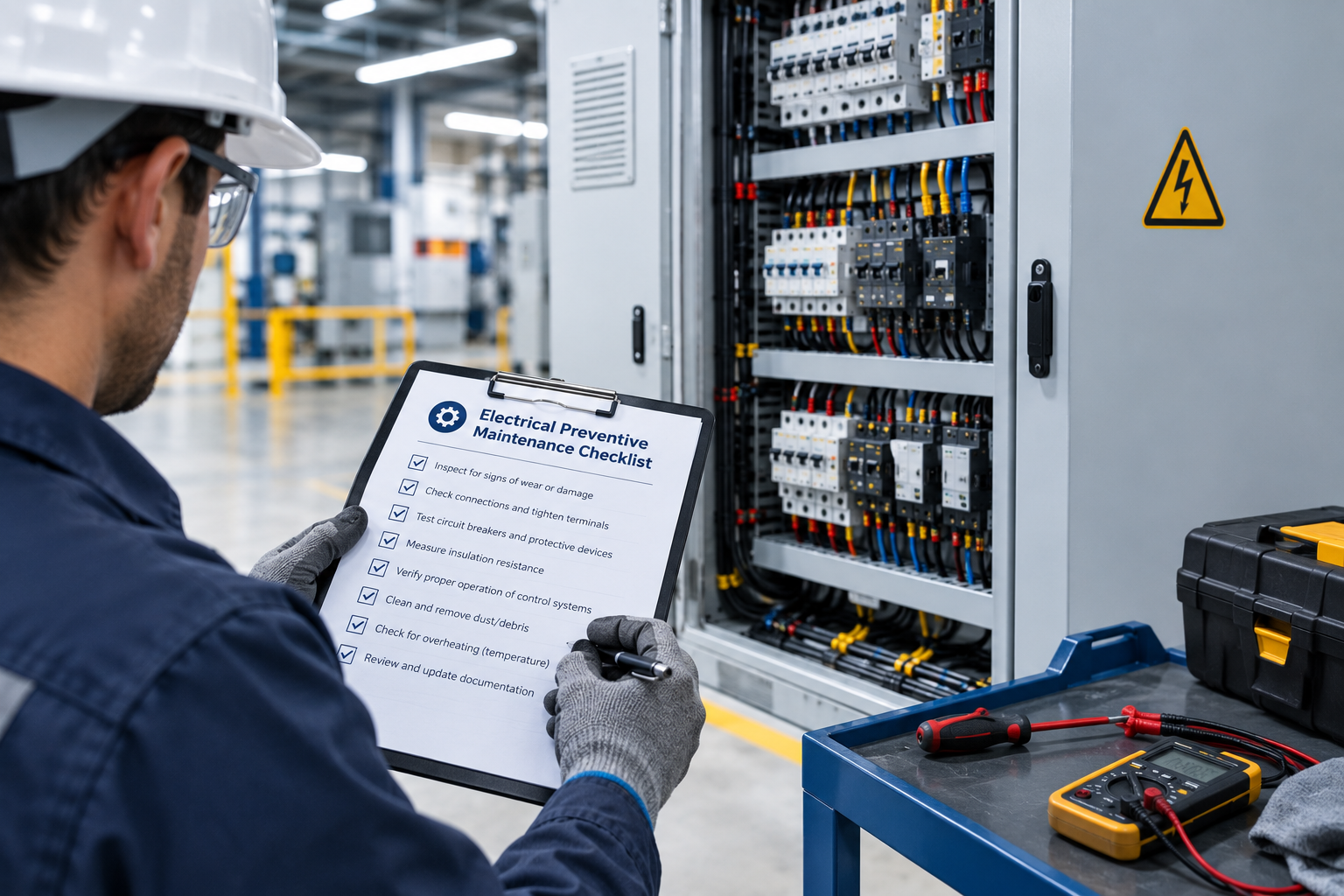
Most electrical failures do not happen without warning. A breaker that trips intermittently, a motor that runs slightly warmer than usual, a panel with a faint burning smell during peak load: these are signals, not surprises. The problem is that in a busy industrial facility, these signals are easy to miss unless someone is looking for them on a regular schedule. That is exactly what an electrical preventive maintenance checklist is designed to do. It turns vague awareness of “the system seems fine” into a structured routine that catches deterioration while it is still cheap and safe to fix.
For facility managers, plant engineers, and maintenance teams running industrial operations, an electrical preventive maintenance checklist is not a paperwork exercise. It is the difference between a planned five-minute breaker replacement and an unplanned six-hour production stoppage. This article walks through what preventive maintenance actually covers, what it costs to skip it, and how to build a checklist and schedule that your team will actually follow.
What Is Electrical Preventive Maintenance?
Electrical preventive maintenance is a set of scheduled inspection, cleaning, testing, and adjustment tasks performed on electrical equipment before a fault occurs, rather than after. Instead of waiting for a breaker, motor, or panel to fail and then repairing it, preventive maintenance targets the early indicators of wear: loose connections, insulation breakdown, overheating, contamination, and mechanical fatigue.
A typical electrical preventive maintenance program includes:
- Visual inspections for corrosion, discoloration, moisture ingress, or physical damage
- Torque checks and tightening of electrical connections
- Insulation resistance testing on cables, motors, and transformers
- Infrared thermography to detect hot spots before they cause failures
- Cleaning of panels, contacts, and ventilation paths to remove dust and debris
- Functional testing of protective devices such as breakers and relays
This is different from reactive maintenance, which responds to a failure after it happens, and from predictive maintenance, which uses condition monitoring data to forecast when a component is likely to fail. Most well-run facilities combine all three, but preventive maintenance is the backbone: it is scheduled, predictable, and does not depend on sensors or historical failure data to be effective. ARC Technologies structures its maintenance services around this same layered approach, pairing preventive, predictive, and reactive maintenance so gaps in one method are covered by another.
The Cost of Skipping Preventive Maintenance
Skipping preventive maintenance rarely saves money. It defers cost and usually increases it. A loose terminal connection that would take a technician a few minutes to retighten during a scheduled visit can, left alone, overheat, arc, and destroy the breaker, the panel bus bar, and potentially the equipment it feeds. What was a minor line item becomes an emergency call-out, expedited parts shipping, and unplanned downtime.
The operational impact tends to matter more than the repair bill itself. In continuous-process industries such as food and beverage, pharmaceuticals, cement, or textiles, an unplanned electrical outage can halt an entire production line, spoil in-process material, and push delivery schedules past contractual deadlines. In facilities running critical loads such as data centers, hospitals, or cold storage, the consequences of a preventable electrical failure extend beyond cost into safety and regulatory exposure.
There is also a safety dimension that should not be understated. Deteriorated insulation, loose connections, and overheating equipment are common contributors to electrical fires and arc flash incidents. Maintenance work on this equipment should only be performed by qualified personnel, a principle reinforced by OSHA’s electrical safety standards, which require documented competence for anyone working on or near energized systems. A structured electrical preventive maintenance checklist reduces the frequency of emergency repairs, which in turn reduces the number of times personnel are exposed to fault conditions or live troubleshooting scenarios.
Monthly, Quarterly, and Annual Checklist Items
Not every task needs to happen every month, and trying to inspect everything on the same schedule usually means nothing gets inspected properly. A workable electrical preventive maintenance checklist breaks tasks into three tiers based on urgency, equipment criticality, and how quickly a given fault mode tends to develop.
Monthly tasks focus on quick visual and operational checks that catch obvious problems early:
- Visual inspection of panels, breakers, and switchgear for discoloration, corrosion, or unusual odors
- Verification that panel doors, covers, and enclosures are properly secured
- Check of indicator lights, alarms, and control panel readouts for abnormal signals
- Inspection of UPS and battery backup systems for warning indicators
- Cleaning of accessible ventilation openings and cooling fans on critical panels
Quarterly tasks go deeper and typically require the equipment to be de-energized or tested under controlled conditions:
- Infrared thermography scans of panels, switchgear, and motor control centers
- Torque verification on accessible bus bar and terminal connections
- Testing of ground fault protection devices
- Inspection and testing of emergency lighting and backup power transfer systems
- Lubrication of mechanical components in circuit breakers and disconnect switches
Annual tasks are the most comprehensive and often align with a full shutdown or planned maintenance window:
- Insulation resistance testing across feeders, motors, and transformers
- Full functional testing of protective relays and trip settings
- Transformer oil sampling and dielectric testing where applicable
- Load bank testing of standby generators and UPS systems
- Detailed review of protection coordination settings against current load profiles
| Frequency | Primary Focus | Typical Tasks |
| Monthly | Visual and operational checks | Panel inspection, indicator checks, UPS status review |
| Quarterly | Condition-based testing | Thermography, torque checks, ground fault testing |
| Annual | Comprehensive diagnostics | Insulation resistance testing, relay testing, load bank testing |
Combining scheduled inspection with instrumented diagnostics is what separates a genuinely useful electrical preventive maintenance checklist from a box-ticking exercise. ARC Technologies supports this level of testing through its diagnostics and testing services, which cover insulation resistance testing, relay testing, and protection coordination studies for LV and MV systems.
Critical Equipment to Prioritize
Not all electrical equipment carries the same risk if it fails. When a facility has limited maintenance hours and budget, prioritization matters. Four categories consistently deserve the most attention.
Electrical panels and switchgear are the distribution backbone of any facility. A single failed panel can take down multiple downstream loads at once. Loose connections, overheating breakers, and degraded bus bar insulation are the most common failure points. If your facility has experienced recurring nuisance trips or breaker damage, it is worth reviewing common electrical panel problems and how to fix them to understand what typically drives these failures. ARC Technologies also provides comprehensive electrical panel design, installation, and maintenance support for facilities upgrading aging distribution equipment.
Motors are mechanical and electrical systems in one, which means they fail in more ways than most other equipment. Bearing wear, insulation breakdown, misalignment, and voltage imbalance all shorten motor life. Preventive checks should include vibration observation, insulation resistance testing, and verification that overload protection settings still match the motor’s actual load profile.
Transformers are expensive, long-lead-time assets, and their failure modes develop slowly, which is exactly why scheduled inspection matters. Oil quality degradation, moisture ingress, and loose winding connections rarely cause sudden failure; they build up over months or years. Preventive maintenance of transformers, including oil testing, thermal imaging, and cleaning, catches this degradation while replacement parts and downtime are still manageable.
UPS systems and standby power equipment protect the loads that cannot tolerate interruption. Batteries degrade even when the system appears to be functioning normally, which is why battery testing under load, not just a visual check, is essential. ARC Technologies’ critical power solutions cover UPS systems, generators, and switchgear for facilities where backup power reliability is non-negotiable.
Building a Maintenance Schedule That Works
A checklist only produces value if it is actually followed, and the schedules that fail are usually the ones built around an ideal calendar rather than the facility’s real operating constraints. A few principles make the difference between a maintenance schedule that sticks and one that quietly stops happening after the first busy quarter.
Start with equipment criticality, not equipment age. A ten-year-old panel feeding a non-essential storage area does not need the same attention as a two-year-old panel feeding a production line. Rank equipment by the operational and safety impact of its failure, then set inspection frequency accordingly.
Align maintenance windows with production schedules wherever possible. Quarterly and annual tasks that require de-energizing equipment should be planned around existing shutdown periods, not treated as separate disruptions. This is usually where facilities benefit from outside coordination, since planning maintenance around live production requires close scheduling between operations and maintenance teams, which ARC Technologies supports directly through its operations and field services.
Document everything, even when nothing was found wrong. A record showing that a panel was inspected and tested clean six months ago is what allows a technician to recognize a new hot spot as new, rather than wondering if it has been there all along. This documentation also supports compliance with recognized maintenance frameworks such as NFPA 70B, which outlines structured requirements for electrical maintenance programs, including inspection intervals based on equipment condition and criticality.
Finally, build in a review step. A schedule set up two years ago may no longer reflect current load conditions, added equipment, or lessons learned from recent failures. Revisit the checklist itself, not just the equipment, at least once a year.
Preventive vs Predictive Maintenance
These two terms are often used interchangeably, but they describe different approaches, and understanding the distinction helps facilities decide where to invest.
Preventive maintenance is time-based. Tasks happen on a fixed schedule (monthly, quarterly, annually) regardless of the equipment’s actual condition at that moment. Its strength is predictability: budgets, labor, and downtime windows can be planned well in advance. Its limitation is that some equipment gets serviced before it strictly needs it, while a failure could theoretically still develop between scheduled inspections.
Predictive maintenance is condition-based. It relies on continuous or periodic monitoring, such as vibration analysis, thermal trending, or oil analysis, to estimate when a component is likely to fail, and schedules intervention accordingly. Its strength is efficiency: maintenance happens closer to when it is actually needed. Its limitation is that it requires monitoring infrastructure, data analysis capability, and usually a longer runway to implement well.
In practice, the two are complementary rather than competing. A preventive maintenance checklist provides the baseline coverage that keeps a facility safe and compliant, while predictive techniques applied to the most critical assets, such as main transformers or production-critical motors, sharpen the timing of interventions on the equipment where failure would be most costly.
ARC Technologies Maintenance Programs
Running an effective electrical preventive maintenance checklist across an entire facility takes more than a spreadsheet. It takes trained technicians, calibrated test equipment, and enough breadth of experience to know which findings need immediate action and which can wait for the next scheduled window.
ARC Technologies supports industrial facilities across Egypt and the wider region with integrated maintenance services that combine preventive, predictive, and reactive maintenance, backed by diagnostics and testing services for insulation resistance testing, relay testing, and protection coordination studies. For facilities running aging equipment, ARC also provides modernization and retrofit services to extend equipment life and improve reliability without a full system replacement.
Whether your facility needs a maintenance program built from scratch, a second review of an existing schedule, or targeted testing on a specific piece of critical equipment, the goal is the same: catch the warning signs before they become downtime.
Request a maintenance assessment from ARC Technologies to review your current electrical preventive maintenance checklist and identify where your facility’s real risk is concentrated.