

 العربية

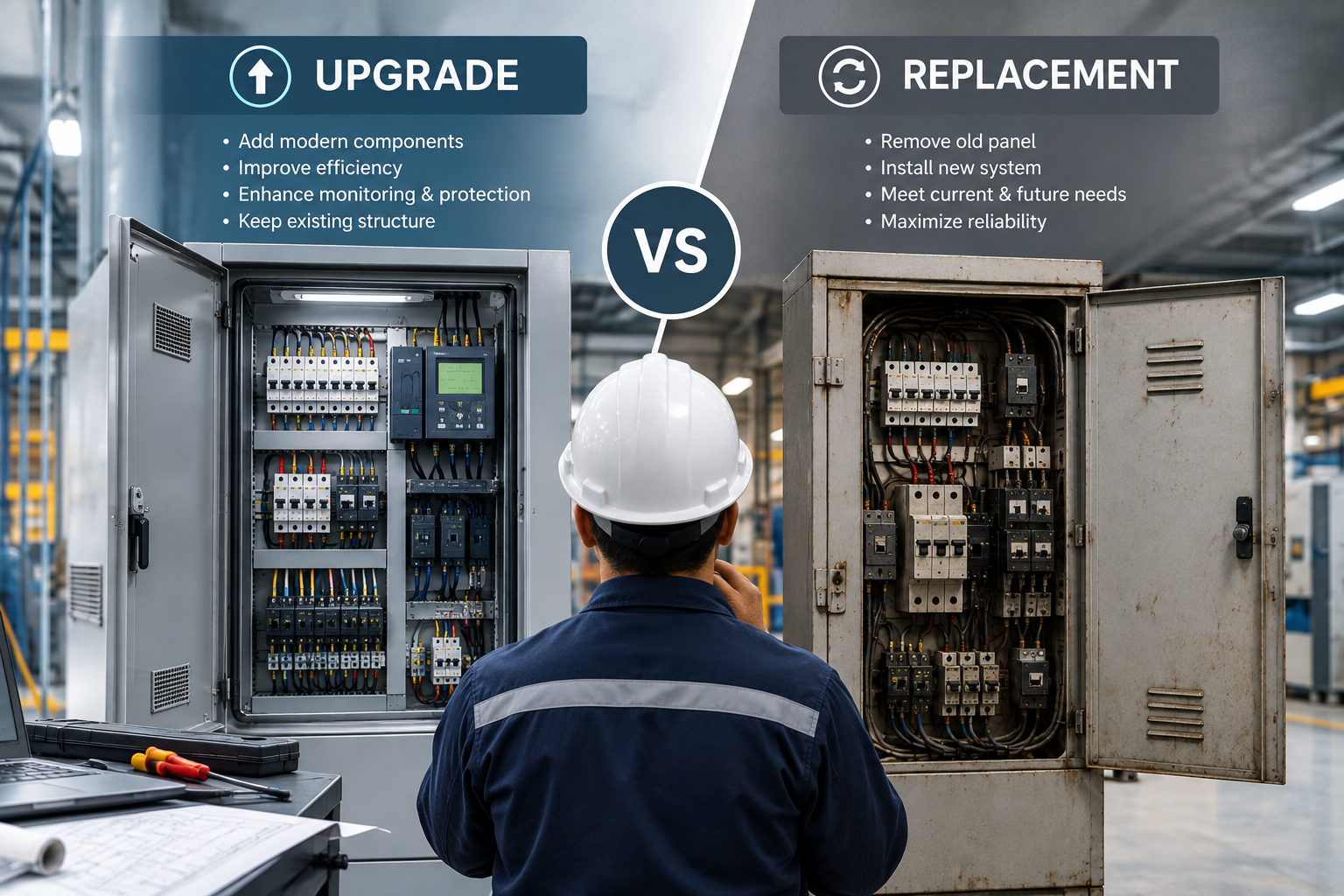
Electrical panel replacement is not always necessary when an industrial panel starts showing signs of age. In some cases, a targeted upgrade can address outdated components, protection requirements, or monitoring needs without replacing the entire assembly. However, when the enclosure, busbar system, capacity, or overall design has reached its practical limits, replacement may be the more appropriate solution.
Choosing between an upgrade and replacement depends on equipment condition, load growth, protection coordination, future expansion, and the amount of production disruption your facility can tolerate. This guide explains the key differences and the factors to consider before deciding which approach your factory needs.
Why Aging Electrical Panels Become a Production Risk
An electrical panel does not fail all at once. It degrades gradually, and the risk grows quietly until an incident makes it visible. Insulation can dry out and become brittle after years of thermal cycling. Contact surfaces can oxidize, increasing resistance and generating localized heating.
Mechanical components inside breakers also wear through repeated switching, and aging or degraded protective devices may no longer perform as expected without showing obvious external signs of trouble. None of these issues may be visible during a routine walk-through inspection. They often become apparent only when the system is placed under fault conditions, when protection either fails to operate correctly or responds too slowly to limit damage.
This is also why electrical hazards remain a persistent concern in industrial settings, a point reflected in workplace electrical safety guidance published by OSHA, which addresses shock, electrocution, fire, and explosion hazards tied to electrical equipment. The operational consequence for a factory is rarely a dramatic failure. More often it’s an unplanned trip during a production run, a nuisance fault that recurs under load, or a breaker that no longer coordinates properly with upstream and downstream protection.
A structured electrical panel inspection and diagnostic assessment provides a more reliable basis for identifying these conditions before they contribute to unplanned production interruptions.
Signs Your Electrical Panel Needs Attention
Short answer: repeated tripping, visible heat damage, unusual noise, and difficulty sourcing spare parts are the clearest indicators that a panel needs professional evaluation.
Watch for these practical warning signs on the plant floor:
- Repeated or nuisance tripping that isn’t tied to an obvious overload, which often points to drifting breaker calibration or degraded contacts.
- Discoloration, scorch marks, or a burning smell near breakers or busbars, indicating localized overheating.
- Buzzing, humming, or crackling sounds from inside the enclosure, which can signal loose connections or arcing.
- Corrosion or rust on the enclosure, busbars, or mounting hardware, especially in humid or dusty industrial environments.
- Obsolete components where the manufacturer has discontinued replacement parts, leaving the facility dependent on used or refurbished stock.
- Insufficient physical or electrical capacity for equipment already installed, forcing overloaded circuits or improvised workarounds.
- Panels that predate recent facility expansions, where load calculations were never revisited after new machinery was added.
Any one of these on its own may not be urgent. Several appearing together, or any sign combined with unexplained downtime, is a strong signal that the panel needs a professional look rather than a wait-and-see approach.
Electrical Panel Upgrade vs Replacement: What’s the Difference?
An electrical panel upgrade improves selected components or capabilities within an existing assembly, while a full replacement involves removing the existing panel and installing a new assembly designed to meet current and future operational requirements.
An upgrade may involve replacing aging circuit breakers, adding protective devices, integrating digital monitoring, or making other targeted improvements to a panel whose core structure remains suitable for continued service. In these cases, the enclosure, frame, and bus system may remain in place, allowing the facility to address specific reliability, protection, or monitoring requirements without replacing the entire assembly.
A replacement, by contrast, involves installing a completely new panel. This approach is generally considered when the existing enclosure is compromised, the bus system cannot accommodate current or anticipated loads, or the overall design has become too outdated to meet the facility’s protection, capacity, or operating requirements. A well-engineered replacement should be designed around the facility’s actual load profile, protection requirements, operating conditions, and expected future expansion rather than adapting new requirements to the limitations of an aging installation. ARC Technologies’ panel building capabilities support purpose-built panel configurations for both new installations and full replacement projects.
Both options should be assessed against the applicable technical and assembly requirements. For low-voltage switchgear and controlgear assemblies, IEC 61439 provides internationally recognized requirements covering areas such as construction, service conditions, and verification. Evaluating the condition and limitations of the existing system against these requirements provides a stronger foundation for determining whether an upgrade or full replacement is the more appropriate solution.
When an Electrical Panel Upgrade Is the Right Choice
An upgrade makes sense when the panel’s structure, enclosure, and busbar system remain sound, but individual components have become outdated, unreliable, or insufficient for present-day protection needs.
Typical upgrade scenarios include:
- The enclosure shows no corrosion, physical damage, or thermal degradation, but breakers are aging and increasingly hard to source.
- Load growth is moderate and within the physical and thermal limits of the existing busbar and enclosure.
- Protection coordination needs improvement, but can be achieved by replacing specific breakers or adding relays rather than redesigning the entire system.
- The facility wants to add digital monitoring or remote diagnostics without a full rebuild.
This approach is consistent with ABB’s published guidance on low-voltage switchgear retrofits, which describes replacing outdated breaker components with newer-generation equipment as a way to extend the operational life of switchgear without a full rebuild. ARC Technologies applies the same logic through its modernization and retrofit services, which focus on reinforcing existing infrastructure rather than defaulting to a full teardown whenever it isn’t necessary.
An upgrade is almost always the lower-capital, lower-disruption path when the panel’s core structure qualifies for it. The mistake facilities make is assuming an upgrade is always cheaper in the long run. It is only cheaper when the underlying enclosure and bus system genuinely have useful service life left.
When Full Panel Replacement Is Necessary
Replacement becomes necessary when the panel’s structural condition, capacity, or design has reached a point where targeted repairs no longer resolve the underlying risk.
Common triggers for electrical panel replacement include:
- Enclosure damage or corrosion severe enough to compromise the panel’s mechanical integrity or ingress protection.
- Bus capacity that physically cannot support current or planned electrical loads, regardless of which breakers are installed.
- Discontinued platforms where the entire panel family, not just individual breakers, is no longer supported by the original manufacturer.
- Repeated failures or nuisance tripping that persists even after targeted component replacement, indicating a deeper design or capacity limitation.
- Major facility expansion or process changes that shift load requirements well beyond what the original design anticipated.
- Documented safety concerns identified during a professional inspection that cannot be resolved through partial component replacement.
Facilities sometimes delay replacement because the panel is still technically functioning. The problem is that functioning and reliability are not the same thing. A panel that has reached the end of its practical service life may be more likely to cause operational problems under demanding conditions, particularly when underlying capacity, condition, or protection issues remain unresolved. Condition-based maintenance and documented inspection findings provide a stronger basis for replacement decisions than waiting for equipment failure. Systematic electrical maintenance practices also support a proactive approach to managing reliability and safety risks.
What Affects Electrical Panel Replacement and Upgrade Costs
Cost is one input into this decision, not the deciding factor on its own. The lowest upfront price rarely equals the lowest lifecycle cost or the lowest operational risk.
Several variables shape both electrical panel replacement cost and upgrade cost:
- Voltage class and current rating. Higher-capacity assemblies require heavier busbars, larger enclosures, and breakers with higher interrupting ratings, all of which raise material cost.
- Breaker and protection device selection. Component choice affects both price and long-term reliability; sourcing quality low voltage components rated correctly for the application matters more than choosing the cheapest available part.
- Engineering and design work. A custom panel configured around actual load profiles and future growth requires design time that a generic off-the-shelf assembly doesn’t.
- Fabrication complexity. Custom enclosures, specialized cable entry configurations, and integration with existing switchgear add labor hours.
- Installation logistics. Site access, existing wiring condition, and how much of the surrounding infrastructure needs to be touched all affect labor cost.
- Downtime cost. This is frequently underweighted. A lower-cost panel that requires a longer installation window can cost more overall once lost production time is factored in.
- Lifecycle and maintenance cost. A panel built with readily available, well-supported components tends to cost less to maintain over its service life than one assembled from the cheapest parts on the market.
The practical takeaway: request a scope that separates equipment cost from installation and downtime cost. That breakdown makes it much easier to compare an upgrade against a full replacement on genuinely equivalent terms.
How to Modernize Electrical Panels Without Disrupting Production
Short answer: the disruption from a panel upgrade or replacement is manageable when the work is planned around your production schedule rather than treated as a single all-at-once event.
A few practices consistently reduce downtime during panel modernization projects:
- Sequence the work around planned shutdowns. Scheduling major switchover work during existing maintenance windows avoids adding a separate production stoppage.
- Pre-fabricate and pre-test offsite. Building and testing a replacement panel before it arrives on site reduces the time the facility is without power to that section.
- Use phased cutovers where possible. Some upgrades, particularly breaker or relay replacements, can be staged section by section rather than de-energizing the entire panel at once.
- Confirm protection coordination before energizing. Review protection settings and coordination requirements before commissioning. Where applicable, the settings should be verified against the approved protection study and system design before the equipment is energized.
- Pair the project with a documented maintenance plan. Coordinating panel work with ongoing electrical maintenance services means the new or upgraded equipment is inspected on a defined schedule going forward, rather than left until the next visible problem appears.
Facilities that treat modernization as a planned, sequenced project rather than an emergency response consistently see shorter outages and fewer surprises during commissioning.
ARC Technologies Electrical Panel Modernization Services
ARC Technologies works across both sides of this decision, from targeted upgrades and retrofits to complete panel replacement, and supports the assessment work that determines which one a given facility actually needs. As an official ABB partner and official ABB panel manufacturer, ARC Technologies configures panels around genuine load and protection requirements rather than defaulting to a standard template, drawing on established panel-building expertise, diagnostics and testing capability, and ongoing maintenance support to keep the resulting infrastructure reliable over its service life.
That combination matters because the upgrade-versus-replacement decision is rarely obvious from a visual inspection alone; it depends on documented condition data, load calculations, and an honest look at what the existing structure can and cannot support going forward.
Request an electrical panel assessment from ARC Technologies to evaluate your panel’s condition, capacity, and protection requirements before your next planned shutdown. A documented technical assessment can help your facility determine whether a targeted upgrade or full replacement is the more practical long-term solution.