

 العربية
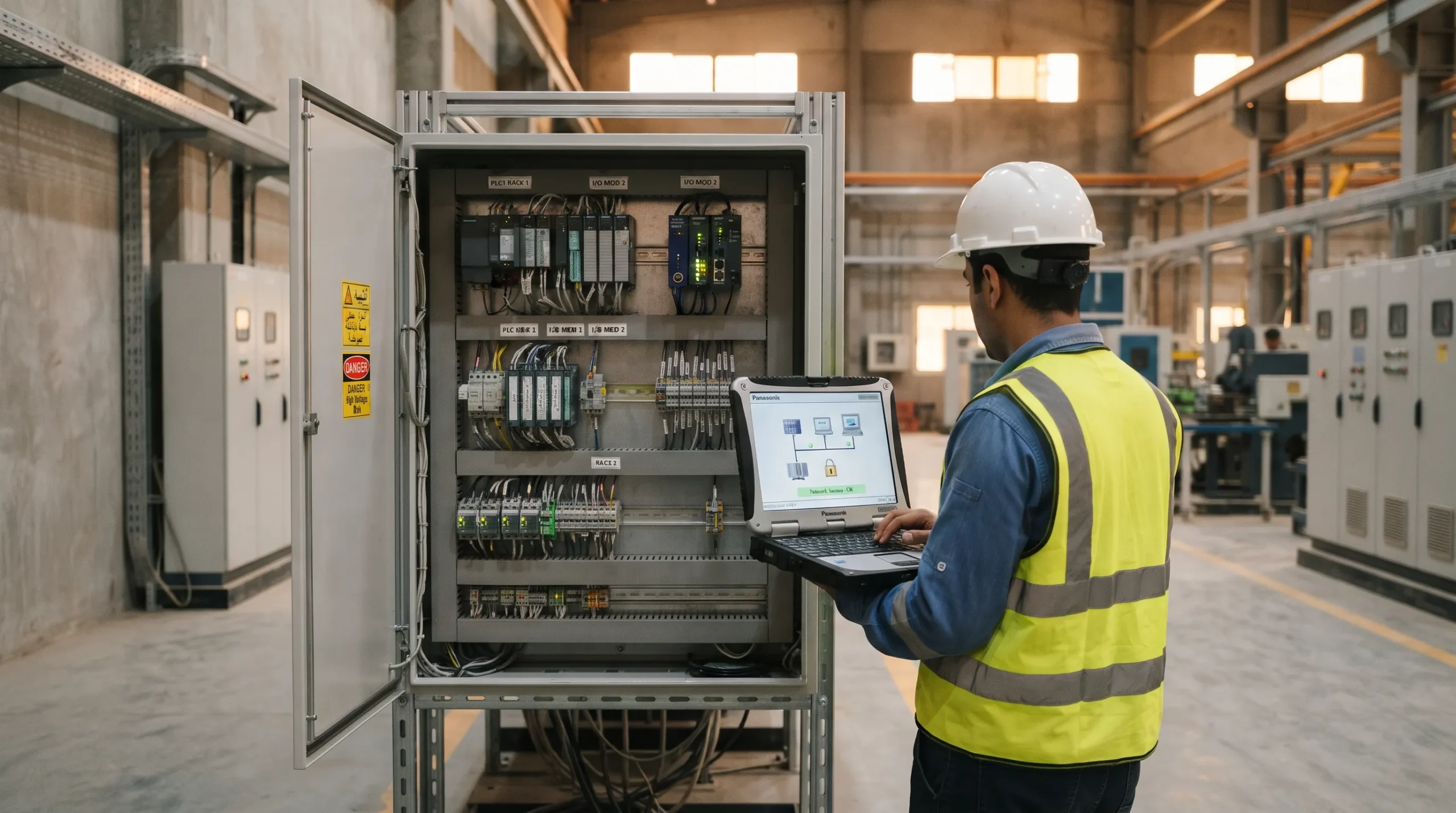
Industrial control system cybersecurity is the work of keeping the PLCs, HMIs, SCADA servers, and networks that run a production line safe from unauthorized access, tampering, and disruption. For a factory in the 10th of Ramadan City or the 6th of October City, it is no longer a topic for banks and telecom companies only. A line that is connected to the ERP, to an OEM’s remote support portal, or to an energy dashboard is reachable from outside the fence, and that changes how it should be designed, tendered, and maintained.
This guide covers why plant networks get attacked, how the standards organize the problem, and what to put in your next tender.
Why Are Factory Control Networks Targeted?
Factory networks are targeted because stopping production costs money quickly, and many control systems were never designed to resist an attacker. A PLC installed in 2012 usually accepts any command from any device on its network, with no password at all.
Attackers know this. In its 2026 report covering the previous year, Dragos tracked 119 ransomware groups affecting 3,300 industrial organizations, up from 80 groups a year earlier. Manufacturing made up more than two-thirds of the victims. Most of these attacks start on the office side through a phishing email or a stolen VPN password and then spread to the plant because nothing stops them.
Three things make plants especially exposed:
- Flat networks. Office PCs, HMIs, and PLCs often sit on the same subnet, sometimes on the same unmanaged switch.
- Old software. Engineering workstations running Windows 7 or Windows 10 builds that no longer receive updates are common, because the programming software only runs there.
- Unmanaged connections. A 4G router installed by a machine builder for remote support, a TeamViewer session left open, and a USB stick carrying a recipe file.
Downtime is the real risk. A plant can lose a week of output without a single file being stolen, simply because the HMIs are encrypted.
How the 62443 Series Structures Security
The ISA/IEC 62443 series of standards is the main international framework for securing industrial automation and control systems. It was developed by the ISA99 committee together with IEC Technical Committee 65, and it covers the whole life of a system, from product design to operation.
The series is useful because it splits responsibility between three parties, which matches how projects actually run in Egypt:
- The asset owner (your plant), who defines the risk and runs the system day to day. Parts 2-1 and 3-2 apply here.
- The system integrator, who designs and builds the solution. Part 2-4 sets requirements for service providers, and part 3-3 lists the security requirements a complete system must meet.
- The product supplier, who makes the PLCs, switches and software. Parts 4-1 and 4-2 cover secure development and component requirements.
Two ideas from the series are worth learning by name.
Zones and conduits. A zone is a group of assets with the same security needs, for example all PLCs on a packaging line. A conduit is the controlled path between zones, such as a firewall between the packaging zone and the SCADA zone. You design security around these boundaries instead of trying to protect every device equally.
Security levels (SL 1 to 4). SL 1 protects against accidental misuse. SL 2 protects against intentional attacks using simple means, such as a curious employee or basic malware. SL 3 and SL 4 cover skilled attackers with specialist knowledge and significant resources. Most Egyptian food, plastics and building materials plants can target SL 2 for most zones, with SL 3 for safety systems or critical utilities.
Segmenting Office IT From the Plant Floor
Segmentation means dividing the network so that a problem in one area cannot spread to another. In industrial control system cybersecurity, it is the most effective single control for a running plant, and it can usually be added without touching the PLC programs.
The common reference is the Purdue model, which stacks the plant in levels: field devices at level 0, PLCs at level 1, HMIs and SCADA at level 2, site operations at level 3, and business IT at levels 4 and 5. Good OT network segmentation places a firewall and an industrial DMZ between level 3 and level 4. Nothing from the office network talks directly to a PLC. Data that the ERP needs, such as production counts, goes to a historian or a replica in the DMZ, and the office reads it from there.
Inside the plant, split further by line or by function. A practical layout for a mid-size factory looks like this:
- One zone per production line or process area
- A separate zone for utilities (compressors, chillers, boilers, MV substation monitoring)
- A zone for the SCADA servers and historian
- A management zone for engineering workstations, reached only through a jump host
Dragos found in its earlier review that plants with strict IT and OT separation and tested offline backups recovered much faster from ransomware and avoided paying the ransom. That is a strong argument to give management when the firewall budget is questioned.
Segmentation also depends on physical installation. Managed industrial switches, labeled patch panels, and documented VLANs inside your control panels make the design maintainable. If your panels are being rebuilt or upgraded, our Modernization & Retrofit Services can include the network hardware in the same outage.
Is Remote Vendor Access Your Weakest Point?
For many Egyptian plants, yes. Remote access from machine builders and OEMs is often the easiest way in, because it is set up quickly during commissioning and then forgotten.
A typical case: a filling machine arrives with a cellular router in the cabinet for remote support. Nobody on site owns the password, and it bypasses every firewall the plant has.
CISA’s primary mitigations for operational technology rank protecting remote connections into OT among the top actions for owners, alongside removing internet exposure and changing default passwords. In practice, secure remote access means:
- One entry point. All vendors come through a single gateway or jump server in the DMZ, never through their own router.
- Named accounts with multifactor authentication. No shared “vendor” login.
- On-demand sessions. Access is switched on for a specific job and window, then switched off. The plant engineer approves each session.
- Recording and logging. Sessions are logged, and ideally recorded, so you can see what was changed.
- Least privilege. A drive supplier sees the drives, not the whole SCADA system.
Ask every OEM on site to list how they currently connect. You will often find more paths than you expected.
Hardening PLCs, HMIs, and SCADA Servers
Hardening means removing the weaknesses that come with default settings. It is ordinary maintenance work, and much of it costs nothing but engineering time.
PLCs and controllers
- Set the CPU to run mode with the key switch or software protection, so programs cannot be downloaded without authorization.
- Enable password protection for the project and for online access where the controller supports it.
- Disable web servers, FTP and other services the application does not use.
HMIs and SCADA servers
- Change every default password, including Windows, the SCADA runtime and the database.
- Remove browsers and email clients from operator stations.
- Block USB storage, or allow it only through a scanning kiosk.
- Use role-based accounts: operators, supervisors and engineers should not share one login.
Network devices
- Replace unmanaged switches in critical zones with managed ones.
- Turn off unused switch ports.
- Keep firewall rules specific: named source, destination and protocol, never “any to any”.
The NIST SP 800-82 guide to OT security gives detailed hardening checklists that work well alongside vendor documentation.
Backups, Patching and Change Control
Backups are what turn a cyber incident into a bad day instead of a lost month. Every plant should hold current, tested copies of PLC programs, HMI projects, SCADA configurations, drive parameters, and network device settings.
Keep at least one copy offline, on media that is not connected to any network. Test a restore at least once a year on a spare controller or virtual machine. Many plants discover during an incident that their backup is three years old or missing the last modification.
Patching is harder in a plant than in an office, because a running line cannot reboot every Tuesday. A workable approach:
- Keep an asset inventory with firmware and software versions.
- Review vendor security advisories monthly. Siemens, ABB, Schneider Electric, and Rockwell all publish them.
- Rank patches by exposure. A server in the DMZ gets patched quickly; a PLC deep inside a well-protected zone can wait for the planned shutdown.
- Test on a spare system where possible, then apply during planned maintenance.
Change control ties this together. Every modification to a program or configuration should have a reason, an author, a date, and a backup taken before and after. Our Maintenance Services team can help set up backup and change routines during scheduled shutdowns.
Security Clauses to Add to Automation Tenders
The cheapest time to get ICS security right is in the tender. Retrofitting segmentation and accounts after handover always costs more, so treat industrial control system cybersecurity as a line item in the specification.
Clauses worth adding to your next specification:
- Standard reference. The integrator shall design the system according to the 62443-3-3 requirements for a stated security level per zone.
- Zone and conduit drawing. A network architecture drawing showing zones, conduits, firewalls and IP plan shall be delivered at the design stage for approval.
- No default credentials. All default passwords shall be changed before FAT, and a credential handover list shall be delivered in a sealed format.
- Remote access. No vendor shall install routers, modems, or remote software without written approval. Remote access shall use the plant’s gateway.
- Hardening record. A hardening checklist for each PLC, HMI, server, and switch shall be part of the FAT and SAT documents.
- Backups at handover. Complete, restorable backups of all programs and configurations shall be delivered with the as-built documentation.
- Supported software. Operating systems and software shall be within the vendor’s support period at handover, with the end-of-support dates listed.
- Patch and advisory support. The integrator shall state how they will notify the plant of relevant security advisories during the warranty period.
Reviewing Your Control Network with ARC
Industrial control system cybersecurity works best when it is built into the automation design, not added after an incident. ARC Technologies designs, builds, and supports control systems for factories across Egypt, and we can review an existing network against the measures in this guide: zones, remote access paths, hardening, backups, and documentation.
If you are planning a new line or tendering an upgrade, our Industrial Automation Solutions team can help you write the security requirements into the specification and deliver a system that meets them. For an existing plant, a site assessment is a good first step toward a clear, prioritized plan for industrial control system cybersecurity that fits your production schedule and budget.
Frequently Asked Questions
Is an air-gapped plant safe from cyber attacks?
Rarely in practice. Most “air-gapped” plants have at least one hidden link: a vendor router, a dual-homed laptop or USB transfers. Verify the gap before relying on it.
Do small factories need this?
Yes, scaled to size. A small plant can start with segmentation, password changes, controlled remote access and offline backups. These four steps cover most real incidents.
Will security measures slow down production?
Properly designed, no. Firewalls and accounts add no delay to control loops. Poorly planned changes cause problems, which is why testing during shutdowns matters.