

 العربية

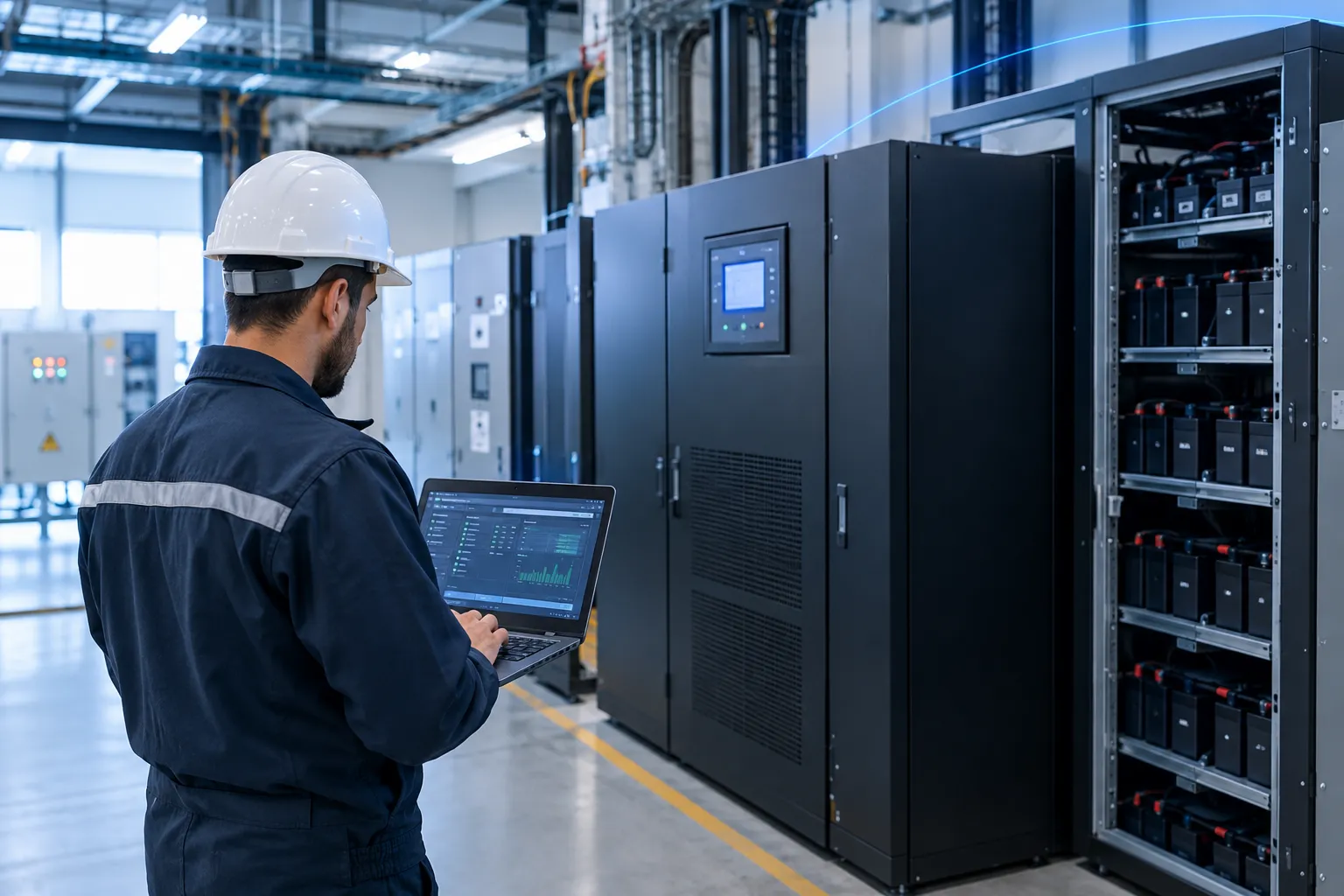
A voltage dip lasting a fraction of a second can be enough to interrupt sensitive industrial equipment, trip a drive, or force a PLC through its start-up routine. An industrial UPS helps protect critical loads against interruptions and power-quality disturbances, and Borri offers a three-phase range covering applications from smaller industrial and facility loads to high-power critical installations. This Borri UPS Egypt guide explains what an industrial UPS does, how the main Borri series differ, and what plant and facility teams should consider before selecting a system.
What Is an Industrial UPS, and How Does It Differ From an Office UPS?
An industrial UPS is a power-protection system installed between the electrical supply and a critical load. It provides conditioned power during normal operation and uses stored energy when the incoming supply is interrupted.
Compared with small office UPS units, industrial systems are typically selected for larger loads, three-phase distribution, longer operating life and more demanding applications. Depending on the installation, they may also involve parallel UPS units, static bypass arrangements, external battery systems, monitoring and dedicated electrical-room requirements.
Many industrial UPS systems use online double conversion. In this topology, incoming AC power is converted to DC, which supplies the inverter and charges the battery system. The inverter then supplies the AC output to the connected load. This configuration helps isolate the load from many input power disturbances while maintaining a controlled output supply.
IEC 62040-3:2021 defines performance and test requirements for UPS systems, including requirements for complete UPS systems and their functional units. Borri’s product documentation identifies models such as Ingenio Plus and B9000FXS within online double-conversion UPS applications.
For a plant installation, the UPS is only one part of the electrical system. The overall design may also include the upstream feeder, protection devices, bypass arrangements, batteries, ventilation, monitoring and the distribution panels supplied by the UPS.
Which Borri UPS Series Fit Industrial and Facility Loads?
Borri’s current three-phase portfolio includes several UPS families covering different capacity ranges and application requirements. The main ranges relevant to industrial and facility applications include Ingenio Compact, Ingenio Plus, Ingenio Max, B9000FXS and B9600FXS.
Series | Design | Rating | Typical published applications |
Ingenio Compact | Three-phase | 10–20 kVA | Networks, servers and smaller critical loads |
Ingenio Plus | Three-phase, transformer-free | 30–160 kVA | Industrial processing, buildings, networking, healthcare and other critical applications |
Ingenio Max | Three-phase, transformer-free | 200–600 kVA | Medium to large critical installations and industrial applications |
B9000FXS | Three-phase, transformer-based | 60–300 kVA | Process control, machine tooling, HVAC, safety systems and critical infrastructure |
B9600FXS | Three-phase, transformer-based | 400–800 kVA | High-power critical installations, process applications and infrastructure |
Borri lists the Ingenio Plus from 30 to 160 kVA, the Ingenio Max from 200 to 600 kVA, the B9000FXS from 60 to 300 kVA and the B9600FXS from 400 to 800 kVA.
Parallel configuration is another important consideration. Borri states that Ingenio Plus systems can be paralleled up to 960 kVA. The B9000FXS supports parallel configurations up to 1.8 MVA, while the B9600FXS can be configured in parallel up to 4.8 MVA.
Generator operation should also be considered during specification. Borri describes its Ingenio Plus and Ingenio Max series as offering low input current distortion, high input power factor and soft-start features that support compatibility with generator operation. Actual compatibility should still be checked between the selected UPS and the specific generator during engineering design.
The Borri portfolio also includes smaller single-phase UPS products for applications such as server rooms and individual equipment. Those products are outside the main scope of this industrial three-phase guide.
Transformer-Based or Transformer-Free: Which Suits Your Site?
Neither design is automatically the right choice for every installation.
Transformer-free UPS systems such as the Ingenio Plus can provide a compact solution where floor space, installation access and system efficiency are important considerations. Borri identifies the Ingenio Plus as a transformer-free three-phase UPS from 30 to 160 kVA.
Transformer-based systems such as the B9000FXS and B9600FXS are designed for applications where transformer isolation and power conditioning requirements form part of the electrical design. Borri identifies both series as transformer-based, with the B9600FXS featuring a built-in inverter transformer for galvanic protection of industrial-type loads.
The physical difference can also matter. For example, the Borri technical specifications show that UPS weight varies considerably between models and ratings. This affects floor loading, access routes, lifting arrangements and available room space. The exact dimensions and weight should therefore be checked against the selected model before installation.
Whether a transformer-based or transformer-free architecture is appropriate depends on the load characteristics, electrical arrangement, isolation requirements, available space and protection design. The final choice should be confirmed during an engineering review rather than from the product category alone.
What Should You Check Before Specifying a Borri UPS in Egypt?
Six areas should be settled before selecting the final UPS configuration: the actual load, required autonomy, redundancy, installation environment, surrounding electrical system and long-term service requirements.
Load Size and Future Growth
Start with the actual critical load rather than choosing a UPS based only on the equipment nameplate.
Measure the existing demand where possible, identify the equipment that genuinely requires UPS protection and consider expected load growth over the planned service life of the system.
Also identify the type of connected equipment. A control system, server load and motor-driven process equipment can have different electrical characteristics and may require different approaches to UPS sizing.
Check both the kVA and kW ratings of the exact UPS model selected. Borri’s published specifications show that these values can differ between product families, so the final selection should always be based on the manufacturer’s data for the specific model.
Battery Autonomy
Determine what the battery system actually needs to accomplish.
If a standby generator is designed to restore supply quickly, the required battery autonomy may be relatively short. In another installation, the UPS may need to support a controlled shutdown of critical equipment for a longer period.
Autonomy affects battery capacity, cabinet or rack space, ventilation requirements, installation cost and maintenance. It should therefore be established early in the design process.
Redundancy
A single-UPS architecture can create a single point of failure. A properly designed parallel configuration can provide additional capacity or redundancy, depending on the system architecture and available UPS capacity.
For example, an N+1 arrangement can allow the load to remain supported while one UPS unit is unavailable, provided that the remaining units have sufficient capacity and the system has been designed for that operating condition.
Some critical facilities also use independent power paths and static transfer switches. The appropriate architecture depends on the required availability and the consequences of losing the protected load.
The UPS Room and Battery Area
Room conditions are an important part of UPS design.
Where a UPS room is exposed to high ambient temperatures or dust, ventilation, cooling, filtration and room layout should be considered from the beginning. Battery service life is particularly sensitive to elevated temperature, making the battery environment an important part of the installation design.
The selected UPS should also be checked against the manufacturer’s specified operating temperature, humidity, clearance and installation requirements.
Upstream and Downstream Electrical Design
The UPS cannot be specified in isolation from the rest of the electrical system.
The design review should consider:
- Generator compatibility
- Input voltage and frequency
- Input current distortion
- Short-circuit levels
- Upstream protection
- Bypass arrangements
- Downstream protection
- Earthing arrangement
- Cable sizing
- Battery protection
- Distribution panel configuration
The choice between a single-phase and three-phase UPS should also be established early because it affects the surrounding distribution architecture.
For a detailed comparison, see ARC Technologies’ guide to the difference between single-phase and three-phase UPS systems.
Service and Maintenance Access
Before purchasing a UPS, confirm how the system will be commissioned, maintained and supported after installation.
Consider service response, spare-parts availability, battery replacement planning, monitoring, preventive maintenance and access to the equipment.
A lower purchase price does not necessarily represent the lowest lifecycle cost if maintenance access or replacement planning has not been considered.
Batteries, Maintenance and Lifecycle After Installation
Battery condition is a major factor in UPS availability. Battery capacity changes over time and can be affected by operating temperature, charging conditions, age and other environmental factors.
A sound maintenance programme can include periodic visual inspection, battery condition checks, review of alarms and operating data, and testing where practical and appropriate for the installation.
Maintenance intervals should be based on the battery technology, operating environment, loading conditions and the manufacturer’s recommendations. Regular maintenance reduces operational risk but cannot guarantee that a battery or UPS component will never fail.
For an installed UPS system, ARC Technologies provides Maintenance Services and Diagnostics & Testing Services that can form part of an ongoing electrical maintenance strategy.
Older UPS installations also deserve periodic review. If a legacy system is approaching end of support, spare parts are becoming difficult to source or the connected load has grown beyond the original design, planned replacement or modernization can be easier to manage than an emergency replacement.
ARC Technologies also provides Modernization & Retrofit Services for existing electrical installations.
ARC Technologies' Role in a Borri UPS Project
ARC Technologies lists Borri among its strategic partnerships and provides UPS solutions in both single-phase and three-phase configurations.
A UPS project also involves more than selecting the correct cabinet. The surrounding electrical infrastructure has to be considered, including feeders, protection, bypass arrangements, distribution panels, batteries, testing and future maintenance.
Issues can arise at these interfaces if the UPS is specified without considering the wider electrical installation. For example, feeder sizing, protection coordination, battery-room conditions and distribution-panel requirements should be reviewed as part of the overall design.
Because ARC Technologies also provides Panel Building, the UPS installation can be considered alongside the electrical panels and distribution equipment it supplies. Testing, maintenance and future modernization can then be considered as part of the system lifecycle.
Preparing Your Borri UPS Enquiry
Before requesting a quotation or technical review, prepare the information that will affect the UPS configuration:
- Critical load in kW and kVA
- Existing and expected future load
- Required battery autonomy
- Required redundancy level
- Input and output voltage
- Generator information, if applicable
- Site temperature and ventilation conditions
- Available electrical-room space
- Battery installation requirements
- Existing protection and distribution arrangement
- Any special load or isolation requirements
This information makes it easier to compare the Borri product range against the actual requirements of the facility.
For example, the Ingenio Plus may suit applications where a transformer-free design is appropriate, while the B9000FXS and B9600FXS provide transformer-based options for applications with different power-conditioning and isolation requirements. Larger installations may also require parallel configurations to meet capacity or redundancy objectives.
If you are specifying a new system or reviewing an ageing UPS installation, you can request a technical consultation through the ARC Technologies Contact page and provide your load data, autonomy target, redundancy requirements and site conditions for evaluation.

Leave a comment