

 العربية

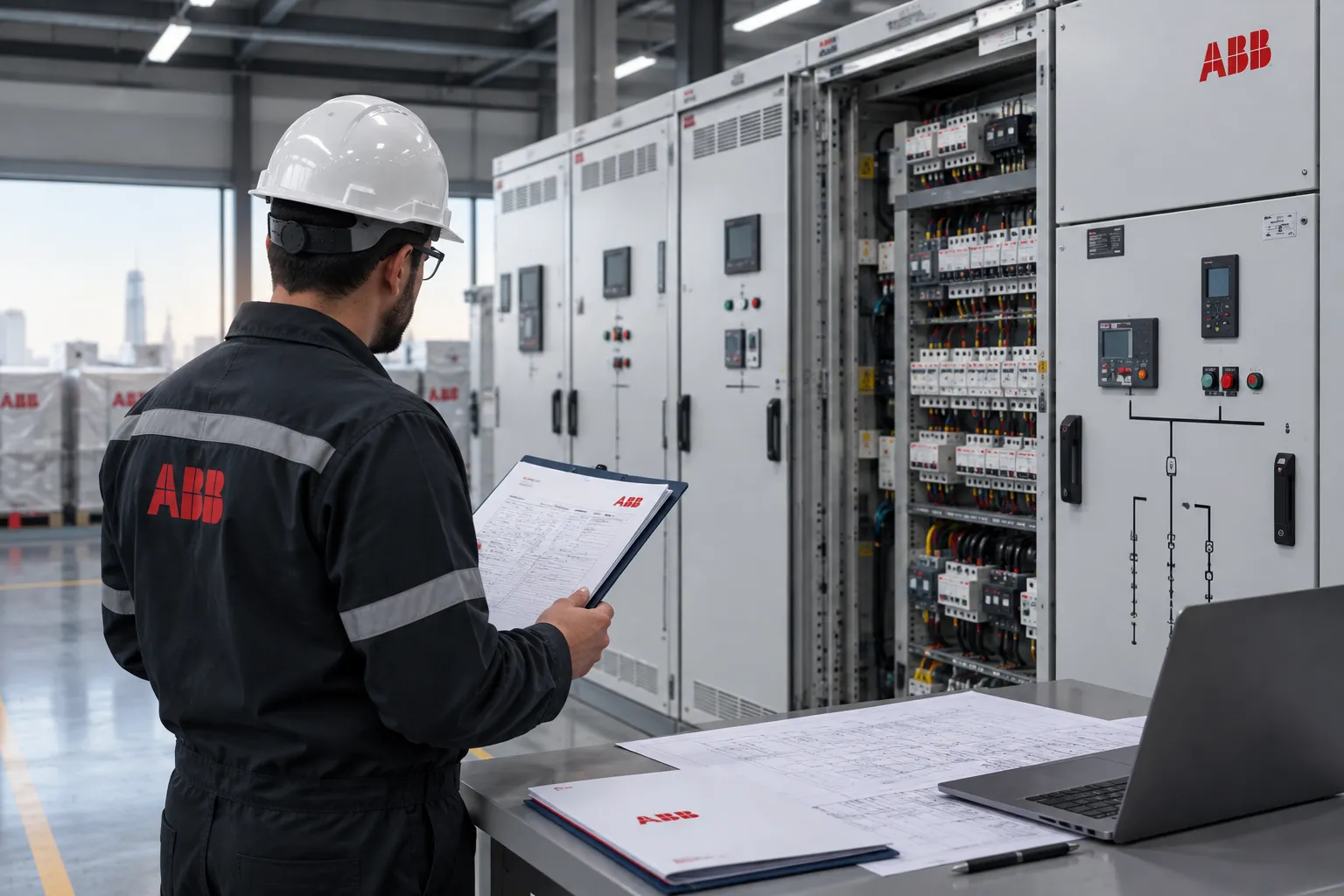
Choosing an ABB panel builder is not only about comparing prices or checking which company has the most products on its website. For industrial facilities, commercial buildings, and infrastructure projects in Egypt, it is equally important to verify the supplier’s ABB relationship, engineering capability, manufacturing process, testing procedures, and after-sales support.
A company may supply ABB components without necessarily having the same role or scope as an ABB-recognized panel builder. That distinction matters when you are purchasing a complete electrical assembly rather than individual components.
This guide explains what procurement teams, consultants, contractors, facility managers, and engineers should verify before selecting an ABB panel builder in Egypt.
What Does an ABB Panel Builder Do?
An ABB panel builder designs and assembles electrical panels using ABB technologies and components for specific applications. Depending on the project and product scope, this can include main distribution boards, sub-distribution boards, motor control centers, ATS panels, and other low-voltage assemblies.
ABB maintains a dedicated panel-builder ecosystem in Egypt and states that its certified panel builders deliver locally assembled low-voltage solutions across industrial, commercial, infrastructure, and other sectors. ABB also maintains a channel-partner network in Egypt that includes low-voltage panel builders.
For buyers, however, the important point is simple: do not treat the presence of an ABB logo on a supplier’s website as proof of its current status.
Instead, ask the supplier to explain its current relationship with ABB and provide documentation supporting the specific claim being made.
You can also review ARC Technologies’ dedicated ABB panel builder solutions to understand the scope of its ABB panel-building offering.
Why Verification Matters Before You Issue a Purchase Order
A complete electrical panel is an engineered assembly. Its performance depends on more than the brand of the individual components.
The final solution can be affected by:
- Rated current
- Short-circuit withstand requirements
- Protection settings
- Busbar arrangement
- Temperature rise
- Internal separation
- Enclosure construction
- Cable termination
- Installation environment
- Testing and verification
- Future expansion requirements
IEC 61439-1:2020 establishes general requirements covering definitions, service conditions, construction requirements, technical characteristics, and verification requirements for low-voltage switchgear and controlgear assemblies. The applicable part of the IEC 61439 series must also be considered when determining conformity.
That is why procurement teams should evaluate the engineering and verification process behind the panel, not just the component list.
1. Verify the Supplier’s Current ABB Status
Start with a straightforward question:
What is your current relationship with ABB, and can you document it?
Ask the supplier to provide relevant evidence supporting its stated status. Depending on the relationship and project scope, this may include:
- ABB partner documentation
- Partner listing or reference
- Applicable authorization or agreement
- Information about the relevant ABB panel-building program
- Product or system scope covered by the relationship
ABB’s Egypt channel-partner information specifically separates low-voltage panel builders from other partner categories, such as distributors and system integrators. ABB also states that listed channel partners have entered into agreements following due-diligence procedures.
The exact terminology matters. A supplier should be able to explain whether it is acting as a panel builder, distributor, system integrator, OEM, or another type of ABB partner.
Do not assume that selling ABB products automatically means a company has the same role as an ABB panel builder.
2. Check Whether the ABB Relationship Covers Your Required Solution
Not every ABB-related supplier provides the same scope.
Before moving forward, define what you actually need.
Your project may require:
- Main distribution boards
- Sub-main distribution boards
- Motor control centers
- Automatic transfer switch panels
- Control panels
- Low-voltage switchgear assemblies
- Medium-voltage equipment
- Retrofit solutions
- Industrial automation integration
Then ask the supplier whether its ABB relationship and engineering capabilities cover the specific equipment required for your project.
This prevents a common procurement problem: selecting a supplier based on a broad ABB product claim and discovering later that another company must handle part of the engineering, assembly, testing, or commissioning.
3. Ask Who Is Responsible for the Panel Design
One of the most important questions is:
Who actually designs the panel?
Ask whether the supplier’s engineering team is responsible for:
- Load calculations
- Single-line diagrams
- Component selection
- Protection requirements
- Busbar sizing
- Enclosure configuration
- Internal separation
- Cable entry and termination
- Thermal considerations
- Short-circuit requirements
- Future expansion provisions
A supplier that only sources components and sends the assembly to an unrelated third party gives you a different level of control than a company with an established panel engineering and manufacturing process.
For industrial projects, engineering responsibility should be clearly defined before the purchase order is issued.
4. Request the Applicable Technical Documentation
Do not wait until commissioning to ask for technical documentation.
Before placing the order, establish what documents will be provided as part of the project.
Depending on the panel and project specification, documentation may include:
- Approved drawings
- Single-line diagrams
- General arrangement drawings
- Component schedules
- Wiring diagrams
- Technical datasheets
- Design verification documentation
- Routine verification records
- Test reports
- Inspection records
- Operation and maintenance information
IEC 61439-1:2020 specifically includes verification requirements for low-voltage switchgear and controlgear assemblies.
The exact documentation required should be agreed between the project consultant, purchaser, and manufacturer based on the application and technical specification.
5. Understand How IEC 61439 Applies to Your Panel
If you are purchasing a low-voltage switchgear and controlgear assembly, ask the supplier how the proposed assembly is designed and verified against the applicable requirements of IEC 61439.
IEC 61439-1:2020 provides the general rules for low-voltage switchgear and controlgear assemblies. It is used together with the relevant part of the IEC 61439 series when determining assembly conformity.
This means that simply writing “IEC 61439 compliant” in a quotation is not enough for a technical evaluation.
Ask:
- Which part of IEC 61439 applies to the assembly?
- What design verification information is available?
- What routine verification will be performed?
- Which characteristics were specified for the application?
- What documentation will be delivered with the panel?
These questions give your engineering and procurement teams concrete information to evaluate.
6. Visit the Panel-Building Facility When Practical
For major industrial projects, a factory or workshop visit can reveal information that a quotation cannot.
Look at how the company handles:
- Panel assembly
- Wiring
- Component identification
- Busbar preparation
- Cable management
- Labeling
- Quality inspection
- Testing
- Documentation
- Final inspection
- Storage before delivery
The purpose of a site visit is not to judge a facility by appearance alone. It is to understand whether there is a repeatable process behind the panel being supplied.
Ask to see how completed panels are inspected and tested before dispatch.
If a supplier cannot clearly explain its manufacturing and testing workflow, ask for additional documentation before making a technical commitment.
7. Ask About Testing Before Delivery
A panel should not reach the site with its first meaningful inspection taking place during installation.
Ask the supplier what testing and verification are performed before dispatch and what records are generated.
Depending on the project, this can include checks related to:
- Wiring
- Connections
- Protection devices
- Control circuits
- Insulation
- Functional operation
- Labels and identification
- Mechanical construction
- Routine verification requirements
The specific tests should be determined by the applicable standard, design, and project specification.
For projects that require broader electrical-system studies, it can also be useful to work with a supplier that understands the relationship between the panel and the wider electrical network.
ARC Technologies provides diagnostics and testing services for LV and MV systems, including short-circuit studies, protection coordination, relay testing, insulation resistance testing, power-quality analysis, and other electrical technical studies.
8. Check Whether the Supplier Can Support LV and MV Interfaces
Some projects involve more than one voltage level.
A facility may have medium-voltage equipment upstream and low-voltage distribution downstream. In that situation, the interface between the systems needs to be clearly defined.
Ask:
- Does the supplier work with LV systems only?
- Can it coordinate with the MV equipment supplier?
- Who is responsible for the interface?
- Are protection requirements coordinated across the system?
- Who handles testing and commissioning?
- Who provides technical support after energization?
ARC Technologies’ panel products include low-voltage distribution boards, control panels, motor control centers, ATS solutions, and other electrical panel applications.
The objective is not necessarily to find one company for every part of a project. It is to make sure responsibilities are clearly defined.
9. Review the Supplier’s Actual Panel Portfolio
Ask to see examples of panels similar to your project.
For example, if you are purchasing an industrial MDB, ask for references involving comparable:
- Rated current
- Fault level
- Environmental conditions
- Installation type
- Industrial application
- Distribution architecture
- Future expansion requirements
A supplier’s portfolio should be evaluated for technical relevance, not simply the number of projects displayed on its website.
ARC Technologies’ electrical panel solutions include MDBs, SMDBs, control panels, motor control centers, ATS panels, synchronization panels, and other special applications.
10. Evaluate What Happens After Delivery
The supplier relationship should not end when the panel reaches the site.
Before purchasing, ask about:
- Commissioning support
- Troubleshooting
- Spare parts
- Maintenance
- Emergency response
- Future modifications
- Retrofit requirements
- Technical documentation retention
This becomes particularly important for industrial facilities where an electrical panel may remain part of the power-distribution system for many years.
A supplier that understands the original design can be better positioned to support later modifications when the required technical records are maintained.
ARC Technologies provides electrical maintenance services covering preventive, predictive, and reactive maintenance support for electrical systems.
11. Put Verification Questions Into the RFQ
One of the easiest ways to improve supplier comparison is to include technical verification questions directly in the request for quotation.
Instead of asking only:
“What is your price for an ABB panel?”
include questions such as:
- What is your current ABB panel-builder or partner status?
- What documentation supports that status?
- Which ABB systems and products are covered by your scope?
- Where will the panel be designed and assembled?
- Who is responsible for the engineering design?
- Which IEC 61439 requirements apply to the proposed assembly?
- What design verification information can you provide?
- What routine verification will be performed?
- What testing documentation will be supplied?
- What commissioning and after-sales support is included?
- Can you provide references for comparable projects?
- How are future modifications and spare parts handled?
This turns the procurement process into a technical comparison rather than a simple price comparison.
12. Watch for Documentation Gaps
Several signs should prompt additional questions during supplier evaluation.
These include:
- Vague descriptions of the ABB relationship
- No clear engineering responsibility
- Generic claims about IEC compliance
- No explanation of testing procedures
- No project-specific technical documentation
- Inability to identify the manufacturing location
- Unclear responsibility for commissioning
- No defined after-sales process
- References that are unrelated to the proposed application
A single documentation gap does not automatically determine whether a supplier is suitable. The important point is to resolve unclear areas before the commercial commitment is made.
What Should Be Included in Your Final Technical Evaluation?
Before approving an ABB panel builder in Egypt, your technical evaluation should cover five areas.
ABB Relationship
Can the supplier substantiate its current ABB relationship and explain the applicable scope?
Engineering
Does the supplier have the engineering capability required for your panel and electrical system?
Manufacturing
Where is the panel assembled, and what quality-control process is followed?
Verification
What design and routine verification information will be provided?
Lifecycle Support
Who will support the panel after installation, commissioning, and handover?
This approach helps procurement teams evaluate the complete supply rather than choosing based only on component brand or initial quotation price.
How ARC Technologies Supports ABB Panel Projects in Egypt
ARC Technologies provides ABB-based electrical panel solutions for industrial, commercial, and infrastructure applications in Egypt.
Its ABB panel-building solutions include low-voltage distribution panels, motor control centers, smart panels, ATS panels, and medium-voltage solutions, with engineering based on project requirements.
For projects requiring broader electrical support, ARC Technologies also provides supply and installation services, diagnostics and testing, panel products, and maintenance services.
If you are evaluating an ABB panel builder for a new installation, expansion, or retrofit project, start by defining your electrical requirements and documentation requirements clearly. From there, you can compare suppliers based on their ABB relationship, engineering scope, manufacturing process, verification approach, and long-term support.
Final Checklist for Procurement Teams
Before approving an ABB panel builder, confirm that you have answers to these questions:
- Is the supplier’s current ABB relationship documented?
- Does its scope cover the ABB solution required for the project?
- Is the engineering responsibility clearly defined?
- Has the applicable IEC 61439 scope been identified?
- Are design and routine verification requirements documented?
- Can the supplier explain its manufacturing and testing process?
- Has the supplier provided relevant project references?
- Are commissioning responsibilities clearly defined?
- Is after-sales and maintenance support available?
- Are drawings, test records, and technical documents included in the handover package?
A reliable procurement decision starts with verifiable information. When comparing ABB panel builders in Egypt, look beyond the brand name and evaluate the engineering, documentation, manufacturing, verification, and support behind the finished assembly.
If you are preparing an electrical panel project in Egypt, reviewing these requirements before issuing an RFQ can help your procurement and engineering teams ask more precise questions and define the required scope from the beginning.

Leave a comment