

 العربية

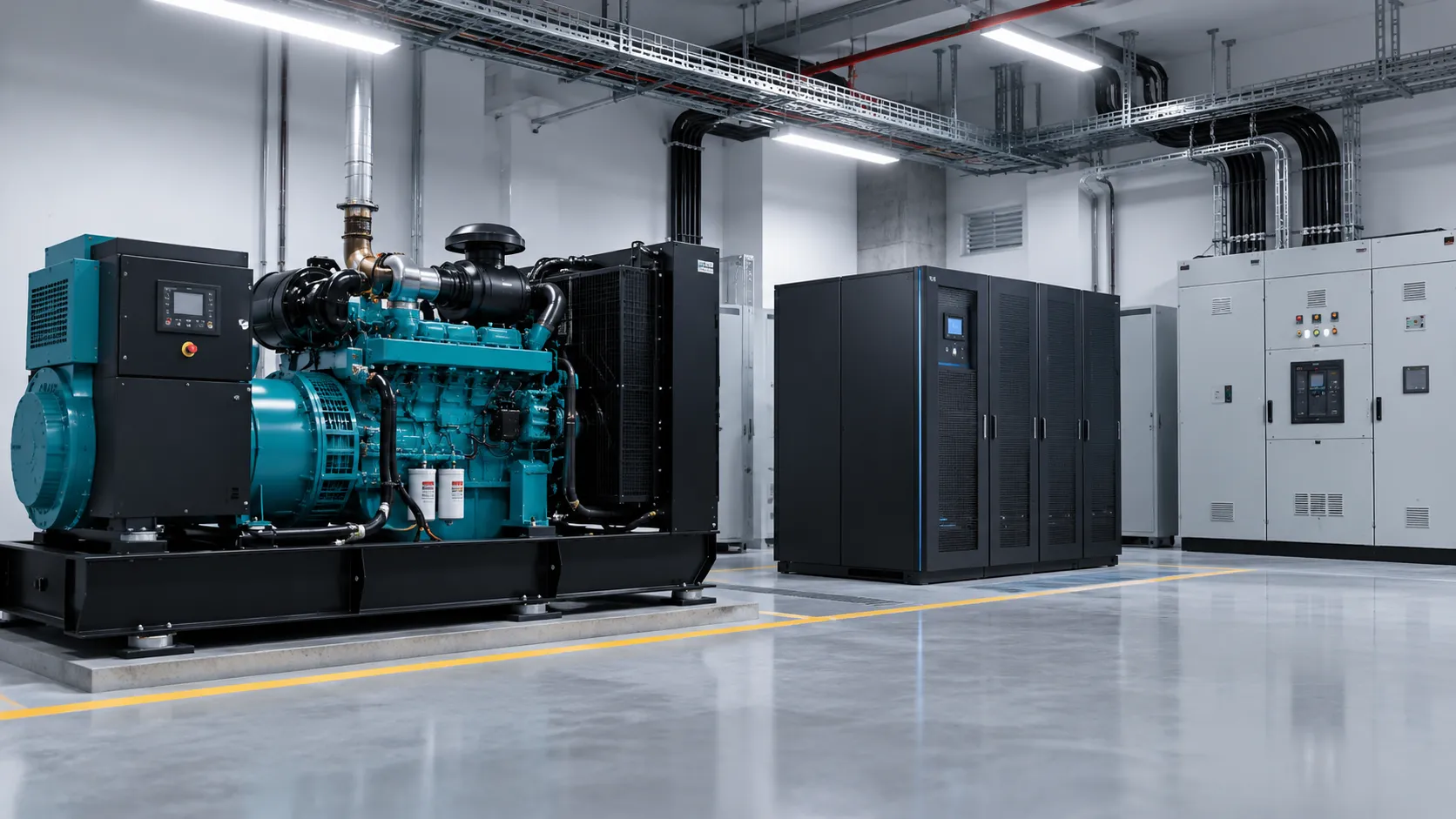
The grid drops at 3 a.m. A PLC resets, a conveyor stops, and the server room goes quiet, all within a fraction of a second.
Somewhere in the building, a diesel generator is cranking. It will need several seconds, sometimes more, before it can carry the load. For a lighting circuit, that gap is an annoyance. For a production line, it can mean a scrapped product and a restart that eats the rest of the shift.
That gap is the heart of the diesel generator vs UPS question. The two are not rivals. They solve different problems, and facilities that treat them as interchangeable usually find out which one they were missing at the worst moment.
ARC Technologies is an official ABB partner and official ABB panel manufacturer. Our critical power range covers Borri UPS systems and static transfer switches.
Through our supply and installation services, we also supply and install generators, so this comparison looks at the whole backup system, not at one product. Our engineers come in where the generator, the UPS, and the panels have to work as one system.
What is the real difference between a diesel generator and a UPS?
A diesel generator produces power for as long as it has fuel, but it needs time to start, and its output is not perfectly clean. A UPS delivers power with no gap, but only while its batteries last. One covers duration; the other covers continuity.
Factor | Diesel generator | UPS |
Start-up | Several seconds to start and pick up the load | Instant, from batteries |
Runtime | Hours or days, as long as fuel lasts | Minutes in most designs |
Power quality | Voltage and frequency can wander under load steps | Clean, regulated output in online designs |
Best for | Whole-site loads: motors, pumps, chillers, lifts | Sensitive loads: PLCs, servers, instruments |
Main upkeep | Fuel, oil, filters, load testing | Batteries, fans, cooling |
Space needs | Room or enclosure, exhaust, fuel storage | Cabinet, battery space, ventilated room |
Think of the UPS as a bridge and the generator as the destination. The UPS keeps the load alive for the minutes it takes the generator to take over or to shut things down in an orderly way.
Each has its own standards. UPS performance falls under the IEC 62040 series, while generating sets follow standards such as ISO 8528 and NFPA 110 for emergency power systems. Check the IEC website before you write anything into a specification.
Why can’t a diesel generator protect sensitive equipment alone?
Two reasons: the start delay and the quality of the power it produces.
- Anything that needs continuous power stops during the start-up seconds, and the transfer itself causes a brief interruption that many PLCs, drives, and servers do not ride through.
- Big motor starts make generator voltage dip and frequency sag, which electronic loads dislike.
A standby generator built for emergency service is commonly designed to accept load within roughly ten seconds, though the real figure depends on the set and its controls. Ten seconds is enough to trip a process, corrupt a database, or lose a batch.
A UPS between the generator and the critical load smooths all of this out, which is why the two appear together so often.
When is a diesel generator the right choice?
Choose a generator when outages can last for hours, when the load includes motors, pumps, chillers, and lifts, or when you need to run most of a facility rather than a few protected circuits. No battery bank is practical at that scale.
A factory in an industrial zone can lose the grid long enough to spoil a full production run. Batteries cannot carry cooling, compressed air, and process pumps for that long. A diesel generator can, as long as the fuel store matches the outages you actually expect.
What a generator needs on site:
- Floor space and a ventilated room or enclosure
- An exhaust path and fuel storage
- Noise control toward neighbors
- Regular running under real load, because an engine that idles lightly for years can build up unburned fuel and run badly when it finally matters
It also loses output in high ambient temperatures, so the rating on paper is not always the rating on an Egyptian summer afternoon.
If you are sourcing a commercial generator in Egypt, ask the supplier for sizing based on the starting current of your largest motor, not only the running load, and for the stated derating at your site temperature. Those two questions prevent most undersized purchases.
When is a UPS the better answer?
Choose a UPS when a fraction of a second without power does damage, or when outages are short and frequent. Typical loads:
- Control systems and PLCs
- Servers and network equipment
- Medical equipment
- Instruments and measurement systems
Plenty of plants lose more to brief disturbances than to long outages. A sag lasting a heartbeat will not trigger a generator start, but it can reset a controller and stop the line.
New to UPS systems? Start with our guide on what a UPS is and how it works. Not sure which type fits your supply? Our article on single-phase and three-phase UPS explains the difference.
The limit is runtime. Batteries are sized in minutes, and stretching that to hours means a large, costly battery room that still needs cooling and replacement every few years. Our note on common UPS selection mistakes lists the usual traps.
To see what we supply, browse the Borri UPS range in Egypt.
Do you need both a generator and a UPS?
For most industrial and commercial sites with critical loads, yes. A complete backup power system, or an emergency power supply in Egypt, as many buyers search for it, pairs a UPS for the first minutes with a generator for the long run.
Here is how the sequence runs:
- The grid fails, and the UPS carries the critical loads on battery.
- The generator starts and stabilizes.
- The transfer switch moves the UPS input and the rest of the plant onto the generator.
- When the grid returns, the transfer switch moves back and the UPS recharges.
Where two independent sources feed one critical load, a static transfer switch can move between them without a noticeable break. It is part of ARC’s critical power range for that reason.
One detail catches many projects: compatibility. A UPS rectifier is a nonlinear load, and a generator only slightly larger than the UPS may struggle with it, with distorted voltage or a hunting frequency. The generator usually needs real margin over the UPS rating, and the exact figure depends on the UPS design. Ask both suppliers to confirm the pairing in writing.
How much UPS runtime do you need to cover a generator start?
Enough to cover three things, plus a margin:
- The generator start and the transfer to it
- An orderly shutdown of your slowest system, in case the generator fails to start
- Extra time for a start that takes longer than the datasheet suggests
More runtime means more batteries, more space, and more cooling, so the answer is rarely “as much as possible.” Size it to the generator’s proven start time and the shutdown time of the system that takes longest to close down.
Then confirm it in practice. A planned transfer test during a maintenance window tells you more than any calculation, and it shows whether the generator, the transfer switch, and the UPS really cooperate.
How do generator and UPS maintenance and running costs compare?
Neither is maintenance-free. Skipping either one is how backup systems fail on the day they are needed.
Factor | Diesel generator | UPS |
Recurring items | Fuel, oil and filter changes, coolant, starter batteries | Battery replacement, fans, capacitors |
Testing | Periodic load tests under real load | Battery tests, not only the green light on the panel |
Watch out for | Stored diesel aging | Batteries age faster in a hot room. |
Our electrical preventive maintenance checklist routines fit backup systems too. Our Maintenance Services team can fold UPS checks into your existing rounds.
Which backup setup fits an office, a plant, and a data room?
It depends on which loads cannot stop and how long outages last. Here is what we would typically specify for three common sites.
Site | Typical setup | Why |
Small office or clinic | Single-phase UPS, plus a small generator if outages run long | The UPS protects the work; the generator covers the rest. |
Food or packaging plant | Generator for cooling and process motors, UPS on the PLC and control panel only | Only a short list of loads cannot stop |
Data room in a larger building | Three-phase UPS with enough runtime for the generator to start, plus a clear transfer plan | The runtime must cover the start, the transfer, and an orderly shutdown if the generator fails. |
In a plant, the key question is which loads cannot stop for even a moment. It is often a short list: the control system, the safety circuits, and the instruments. Protecting only those keeps the UPS compact and the budget sensible. Our industrial automation work often starts with exactly that list.
What should the panels around the backup source look like?
They should be designed as part of the backup system, not added afterward.
- A transfer arrangement matched to the loads it serves
- Protection checked for both sources, because a generator supplies far less fault current than the utility, so breakers set for grid fault levels may not trip as expected
- Ventilation or cooling, since UPS cabinets and transfer panels derate in a hot room
This is where ARC’s Panel Building work meets backup power. The UPS, transfer switch, and distribution panels are specified together, so you get one coordinated system from source to load.
What should you check before you decide?
Write down the loads that cannot stop, the longest outage you have actually seen, and the room you have. Those three facts narrow the choice faster than any brochure.
Then take this list to your suppliers:
- Which loads are critical, and how long each can tolerate an interruption
- Your longest grid outage in recent years, and how often shorter ones occur
- The starting current of your largest motor and the summer site temperature
- Space, ventilation, fuel storage, and noise limits for a generator
- Battery runtime needed to cover the generator start plus a safety margin
- Who tests the system under load, and how often
Finally, ask for written confirmation that the generator and UPS have been checked for compatibility and that protection settings have been verified for both sources.
Diesel generator vs UPS: a simple way to decide
- Short outages and sensitive loads: a UPS is the answer.
- Long outages and heavy loads: a diesel generator is the answer.
- Both at once, which describes most real facilities: you need both, and the work is making them cooperate.
Talk to ARC Technologies engineers
Planning a backup power system and not sure how a UPS, a transfer switch, and a generator should fit together? Send us your critical load list, single-line diagram, and the outage history you have. Our engineers will review it and recommend a coordinated approach, with the panels designed around it. Contact ARC Technologies to speak with an engineer or to request a technical quote.

Leave a comment