

 العربية
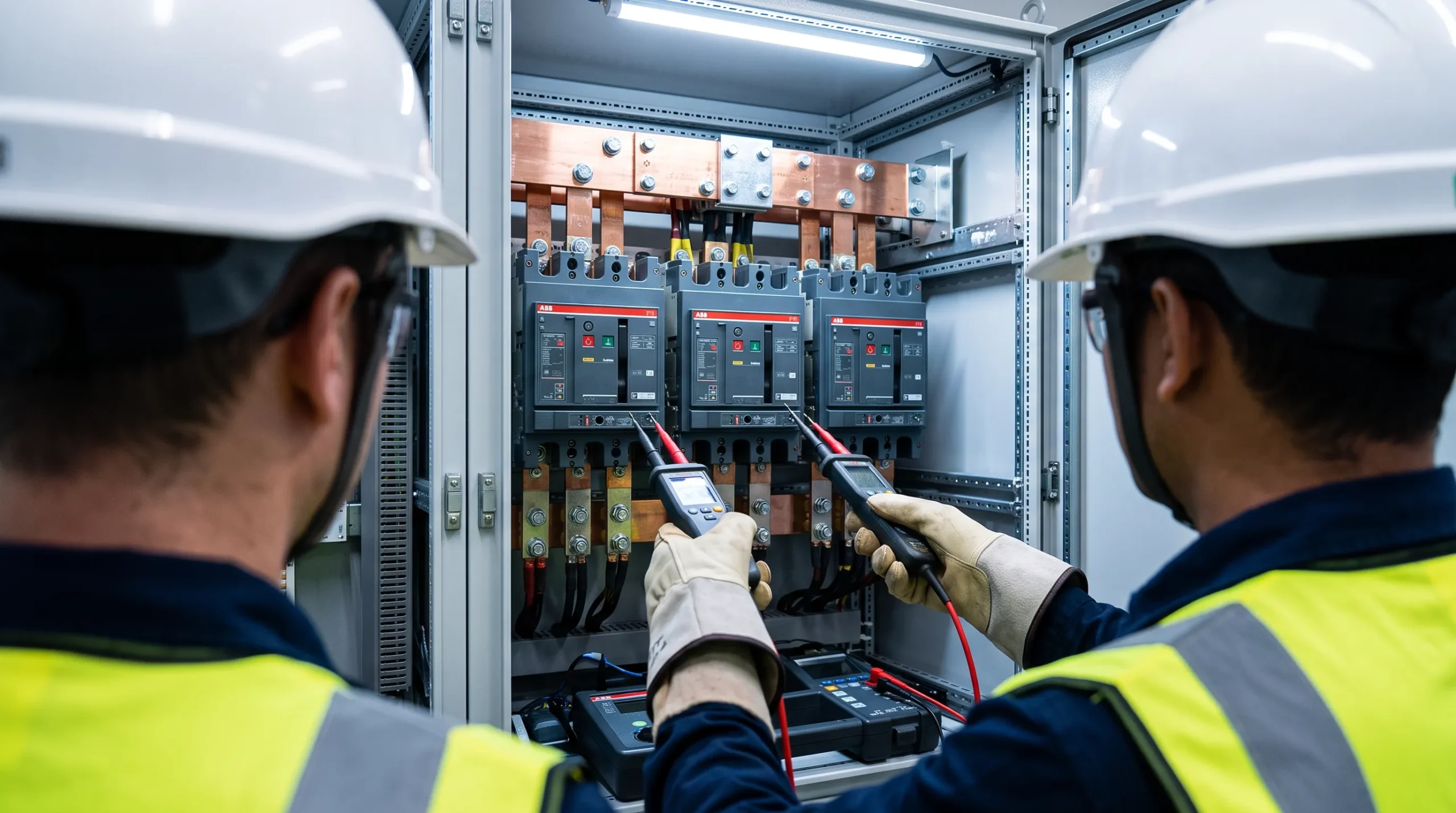
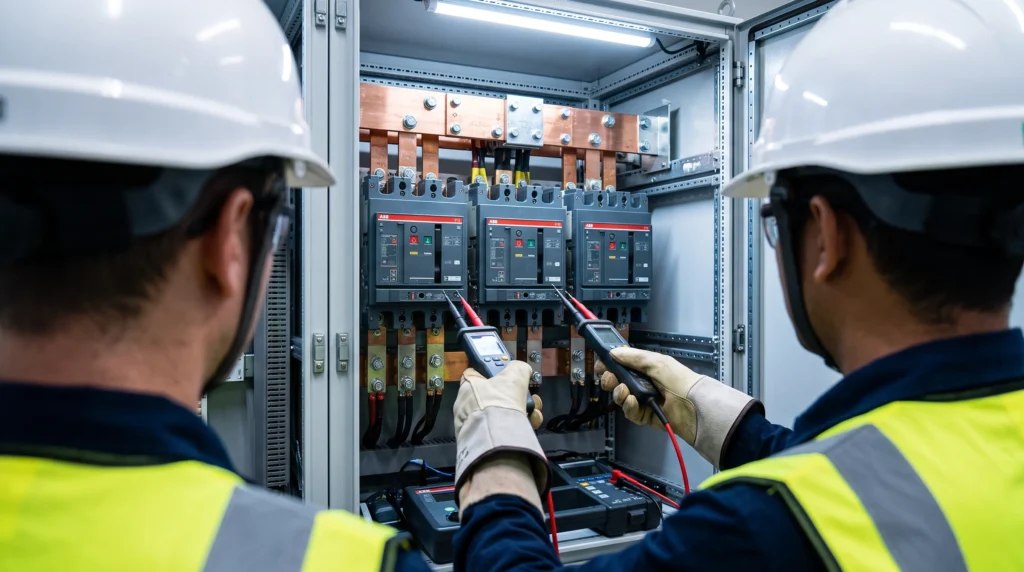
Most switchgear problems blamed on the equipment were planted the day it was energized. One busbar joint left under-torqued, a relay setting copied from the wrong drawing, and an insulation reading that nobody wrote down. Each one looks small on site and costs real money six months later.
This guide covers switchgear testing and commissioning Egypt project teams can actually plan around what happens at the factory, what happens on site, and what paperwork you should be holding at handover. It is written for project managers, EPC contractors and maintenance heads who want the work done properly and want to know what “properly” looks like before the first test set arrives.
What does switchgear testing and commissioning actually involve?
Switchgear testing and commissioning is the structured series of inspections, electrical tests and functional checks that prove a panel is built correctly, protected correctly and safe to energize. It starts at the factory, continues on site before power-up, and ends with documented results that the owner formally accepts at handover.
Think of it in three layers:
- Inspection comes first. Does the panel match the approved drawings, do the breaker, busbar and instrument transformer ratings match the specification, and is everything mechanically sound?
- Electrical testing proves insulation, continuity, transformer ratios and protection behavior.
- Functional proof means operating the board the way your operators will, including interlocks, control schemes, alarms and the link to SCADA or the building management system.
Skip a layer and the risk travels with the panel. A board can pass every electrical test and still trip the wrong feeder because an interlock was wired to the wrong auxiliary contact. The reverse happens too: a flawless control scheme sitting on degraded insulation.
What is the difference between FAT and SAT?
FAT (factory acceptance testing) takes place at the panel builder’s workshop before shipping and checks the panel against the agreed specification and approved documentation. SAT (site acceptance testing) takes place at your facility after installation and proves the panel survived transport, was connected correctly, and works with your real cables, loads, and supply.
FAT | SAT | |
Where and when | Builder’s workshop, before shipping | Your site, after installation |
Main question | Was the panel built to the specification? | Does it work with your real cables, loads, and supply? |
Typical findings | Wrong breaker rating, missing label, wiring error, relay not responding as specified | Transport damage, loose terminations, another contractor’s cable connections, site earthing, a supply that differs from the drawing |
A proper FAT test electrical panel procedure is your chance to find problems while fixing them is cheap. At the factory, the panel is open on the floor, the builder’s technicians are standing next to it, and nobody is waiting on a crane. Find the same mistake on site, and you get delays, call-outs, and an argument about who pays.
Witnessed FAT is worth the trip. Send someone from your side, ideally the person who will operate or maintain the board, carrying the approved drawings and the agreed test plan. ARC builds low voltage assemblies as an official ABB partner and official ABB panel manufacturer, with testing integrated into the build process. This approach connects Panel Building with the testing and verification required before the equipment reaches site.
SAT is also where the electrical, mechanical, and controls teams finally meet, so it often exposes interface problems that no single party had tested. On many jobs, the switchgear testing and commissioning Egypt schedule gets squeezed into the last weeks before energization, so a clean FAT is what keeps SAT short.
Which tests are done before the switchgear is energized?
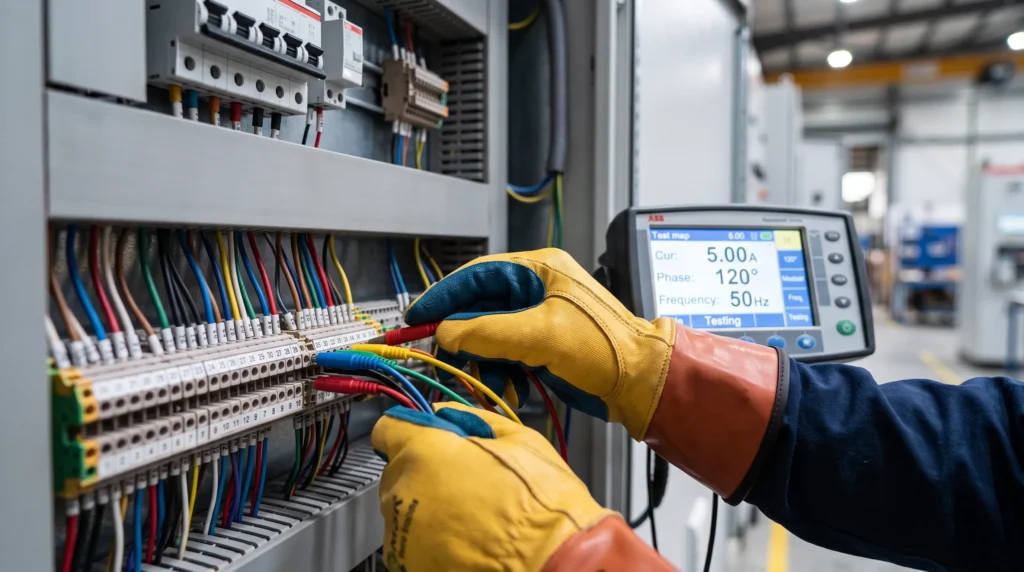
Before energization, the test scope typically includes insulation resistance, protective earth continuity, contact resistance, protection relay testing and functional checks. A broader electrical panel testing and inspection approach can also help facilities establish a baseline for ongoing maintenance.
Three groups of work appear on almost every job, and each is covered below. Alongside them, you will also see the basics:
- Torque checks on power connections.
- Protective earth continuity.
- Contact resistance on main circuits.
- Nameplate and rating verification.
- A full visual inspection against the drawings.
Insulation resistance testing
Insulation resistance testing is usually the first electrical test and the one most often rushed. A megohmmeter applies a DC voltage between live parts and earth, and between phases, to confirm the insulation has not been damaged or contaminated by dust, moisture or a stray strand of conductor.
For low voltage assemblies under IEC 61439-1, routine verification allows an insulation resistance check in place of the power-frequency dielectric test, provided:
- The incoming protective device is rated up to 250 A.
- The test voltage is at least 500 V DC.
- The result exceeds 1,000 ohms per volt for each circuit.
ABB publishes a routine verification checklist that shows how these readings are recorded. Larger assemblies are normally proven with the dielectric withstand test instead.
Two practical points:
- Isolate or disconnect electronics, surge protection, and meters before applying the test voltage, or you will damage the devices you are trying to protect.
- Log the ambient temperature and humidity next to every reading, because the same panel can measure differently on a humid afternoon and a dry morning.
Protection relay and injection testing
Protection relays are the brain of the switchgear, and the brain gets tested separately from the body. Primary injection pushes real current through the main circuit to prove the current transformers, wiring, and tripping chain work end to end. Secondary injection feeds simulated signals straight into the relay to confirm pickup values, time delays, and trip curves match the settings from the protection study.
ARC’s Diagnostics & Testing Services cover relay testing along with binary and analog I/O validation, short-circuit studies, and protection coordination, so the settings and the proof that they work can come from the same team. A coordination study on paper means little if the relay at the plant incomer is still on factory defaults. That gap between study and site is very easy to create on a rushed project.
Functional and interlock checks
Operate everything, and tick off each item as you go:
- Rack breakers in and out.
- Test mechanical and key interlocks.
- Trip each breaker from its relay and from the local push button.
- Check undervoltage releases and the closing and tripping circuits.
- Confirm remote status in the control room.
- Try the emergency stop.
For LV switchgear commissioning, automatic transfer and bus-coupler schemes deserve the most patience, because they only misbehave when a source fails, which is exactly when nobody wants a surprise. Simulate the failure on purpose, with the owner’s agreement and the load managed, and watch what the scheme really does.
How long does LV switchgear commissioning take?
There is no single number for switchgear testing and commissioning Egypt projects. Duration depends on panel count, how complex the protection and control schemes are, and how ready the site is. A simple distribution board can be proven quickly, while a main LV room with transfer schemes needs sequenced work over several days and an agreed shutdown window.
The honest planning rule is to work backward from the energization date, not forward from the delivery date. Civil works, cable pulling and late equipment arrivals all eat into the time at the end, and testing is the activity that gets cut first. Ask for three things in writing at the start of the project:
- the commissioning sequence.
- the hold points where your representative must be present.
- the shutdown windows the plan depends on.
Who should carry out testing on site?
The panel builder, the installing contractor, and an independent third party can each do the job, and the right choice depends on risk and contract structure. The builder knows the equipment best, the contractor owns the installation, and an independent engineer gives the owner an impartial view. Many projects combine two of the three.
If you are comparing providers of electrical testing services Egypt offers, three questions separate the serious ones quickly:
Who will physically hold the test equipment, and can you see current calibration records for it?
Do they test protection relays and settings, or only insulation and continuity?
Will they sign a report that names the instruments, the readings and the engineer who took them?
Brand knowledge also matters. ARC is an official ABB partner, so ABB breakers, drives and protection devices, and the manufacturer documentation that comes with them, are familiar ground. For owners who want one party accountable from the workshop through to the site, switchgear testing and commissioning Egypt wide is easier to manage when the panel builder and the test team share the same drawings. Choosing an experienced ABB Panel Builder can help keep the equipment documentation, panel build, and testing requirements aligned from the factory through commissioning.
What documents should you receive at handover?
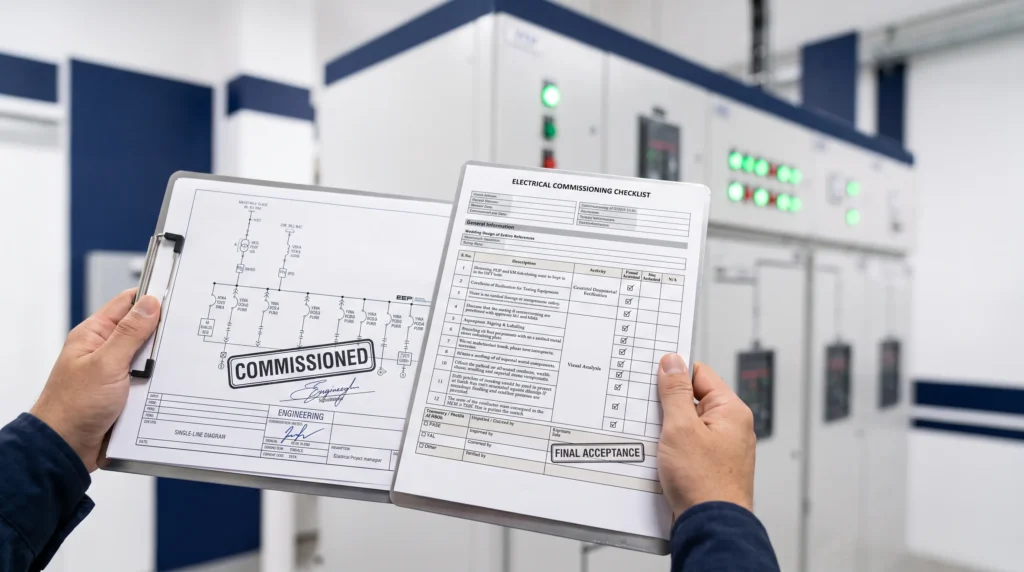
You should receive a signed record of everything that was inspected and tested, plus the information your maintenance team needs to keep the panel healthy. If a result is not written down and signed, for practical purposes it did not happen.
A reasonable handover pack contains:
- As-built drawings and the single line diagram, matching what is physically installed.
- The FAT report, signed by both the builder and the owner’s representative.
- SAT results, including insulation readings with the conditions they were taken in.
- Relay setting sheets and the injection test reports behind them.
- Torque records for power connections.
- Calibration certificates for the instruments used.
- A punch list showing every open item, who owns it and when it was closed.
- O&M manuals and a recommended spares list.
Keep this pack in a place your maintenance team can actually reach. Years later, when a breaker trips and someone needs to know whether the setting was changed, the commissioning record is the only reliable starting point.
What do commissioning tests usually uncover?
They usually uncover ordinary mistakes rather than dramatic defects: wrong protection settings, miswired control circuits, damaged cable insulation, loose connections, and missing interlocks. Each takes minutes to correct before power-up and far longer to diagnose after energization, which is why findings at this stage are cheap compared with failures in service.
Three examples:
- A food plant adds a new MCC to an existing LV room, and the new incomer is set to trip slower than the device upstream, so a single motor fault would drop the whole room.
- A contractor lands control cables on a spare terminal rather than the one marked, and a breaker reports “open” while it is closed.
- A cable is nicked during pulling, and the damage shows up as a low insulation reading before energization instead of as a fault afterward.
Does testing stop at handover?
No. On any switchgear testing and commissioning Egypt job, the readings become your baseline, and later maintenance only means something when it can be compared against them. Without that baseline, a thermal scan or insulation reading on its own says little about whether the panel is drifting.
The checks that depend on it:
- thermal scans.
- periodic insulation checks.
- breaker operation tests.
- relay verification Standards such as NFPA 70B treat electrical maintenance as an ongoing program rather than a repair activity, and IEC 60364-6 covers periodic verification of low voltage installations.
If you do not have a maintenance team with the right instruments, an electrical maintenance company Egypt operators can call on should be able to take over from the commissioning team using the same records. ARC’s Maintenance Services are built around that continuity.
Plan your commissioning with ARC engineers
Switchgear that is tested well at the factory, proven again on site and documented properly rarely gives anyone a bad night later. If you are planning a new installation, an extension or a retrofit and want a clear switchgear testing and commissioning scope that your Egypt facility can review and approve with confidence. Talk to the engineers at ARC Technologies. To get started, send us:
- your single line diagram.
- the specification.
- your target energization date.
We will come back with a test plan and a technical quote. Contact ARC to request yours.

Leave a comment