

 العربية

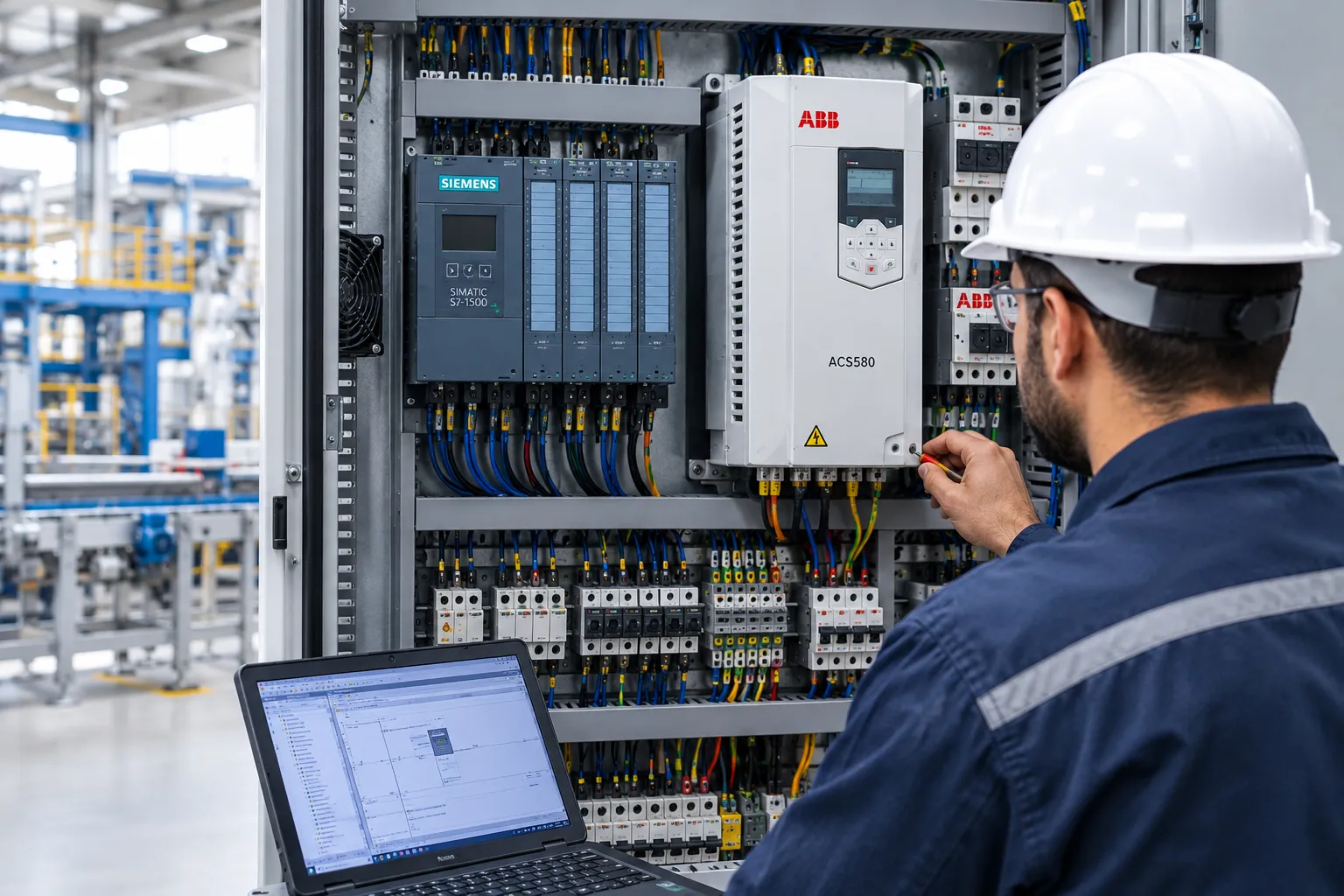
If you run a plant in Egypt, sooner or later someone on your team will raise the ABB vs Siemens PLC question for the next line. It sounds like a brand preference, but the real decision covers spare parts, programming skills, drive compatibility, and who picks up the phone at 2 a.m. when a conveyor stops.
ARC Technologies is an official ABB partner and official ABB panel manufacturer, so we have a stake in this conversation, and we will say so plainly. We will also be fair to Siemens, because many Egyptian plants end up running both. Here is how we would think it through if we were sitting in your office.
What is the real difference between ABB and Siemens automation?
Siemens is strongest where the controller sits at the center of the design, with the PLC, HMI, and engineering software built around one platform. ABB is strongest where motors, drives, breakers, and power distribution carry the load, and it also offers its own AC500 PLC range. In practice, most plants need both sides working together.
When people say “Siemens vs ABB,” they are often comparing two different things. Siemens built its reputation on the programmable logic controller and the engineering environment around it. ABB built its reputation on what happens after the controller makes a decision: the drive that spins the motor, the breaker that protects the feeder, and the panel that holds it all together.
So the sensible question is rarely “which brand?” Ask instead which brand should own the control logic, which should own the power and motor side, and how the two will talk to each other cleanly. That integration question sits at the heart of our Industrial Automation Solutions work.
Why do so many plants start with a Siemens PLC?
Because the ecosystem is familiar. Siemens PLCs are widely used among Egyptian integrators, so programmers are not hard to find and training material is easy to get. That matters more than people admit when a night-shift technician needs to trace a fault.
For small machines, packaging lines, simple pump stations, and utilities, it is a sound, low-risk starting point. Our guide to the Siemens S7-1200 PLC covers the specifications and typical applications in detail, so we will not repeat them here. Larger or more demanding applications usually move up to the S7-1500 family.
The weak spot sits outside the controller. Trouble starts when the PLC is treated as the whole automation system and the drives, protection, and panel design are left as an afterthought.
Where does ABB come out ahead of Siemens?
On drives, motor control, and electrical protection. If your plant is full of pumps, fans, compressors, and conveyors, the drive choice affects energy bills and downtime far more than the PLC brand does.
ABB drives such as the ACS580 for general-purpose duty and the ACS880 for heavier industrial work are common in water, HVAC, cement, and food processing. They come with application-focused macros and solid built-in features. Add ABB low-voltage breakers, contactors, and motor protection, and you get a power side where the components are designed to work together instead of being matched after the fact.
You can browse the full ABB drives range to see which families suit your motor sizes.
Then there is ABB Ability, the company’s digital layer for monitoring drives, motors, and electrical assets. For a plant manager, the appeal is simple: you see a drive overheating or a motor drawing odd current before the line stops, not after.
ABB also sells its own PLC range, the AC500, programmed in Automation Builder. It is a capable controller, particularly when you want drive, motion, and PLC logic inside one vendor’s tools. In Egypt, though, availability of programmers is usually the deciding factor, and we will come back to that.
This is also where panel quality matters. A good drive in a badly ventilated panel on a hot Egyptian summer afternoon will derate or trip, no matter whose logo is on it. ARC Technologies builds drive and control panels with thermal design, busbar layout, and cable routing handled as engineering questions, not cosmetic ones. See our Panel Building page for what that includes.
Still weighing starter options for fixed-speed motors? Our comparison of variable frequency drive vs soft starter explains where each one fits.
Can you run ABB drives with a Siemens PLC?
Yes. ABB drives accept optional fieldbus adapter modules for PROFINET and other common protocols, so a Siemens controller can start, stop, set speed, and read status from them over standard industrial Ethernet. Mixed installations are normal, and they work well when the integration is planned properly.
Picture a water booster station with four pumps. The PLC handles the sequencing, pressure control, and alarms. Each pump runs on an ABB drive, connected to the controller over PROFINET, with a hardwired safe torque-off circuit as a backup that does not depend on the network. The operator sees one HMI. The maintenance team gets drive diagnostics without opening a panel door.
The protocol is rarely what goes wrong. The small stuff is:
- Importing the correct device description file into the engineering software and picking the right telegram type for the drive
- Deciding in the drive parameters which source has control, so the PLC and the local keypad do not fight each other
- Hardwired emergency stop and safe torque off, instead of trusting the network for safety
- A documented IP address for every device before commissioning day, not during it
- A deliberate test of what the drive does when communication with the PLC is lost
That last item gets skipped more than any other, and it tells you whether the plant fails safely. Our Diagnostics & Testing Services team can build that check into commissioning.
When should you choose Siemens, and when should you choose ABB?
Choose a Siemens-led design when the machine logic is complex, your team already knows TIA Portal, or your existing plant runs Siemens. Choose an ABB-led design when motors and drives dominate the load, energy savings matter, or you want one supplier responsible for the power side.
Situation | Better fit | Why |
Complex machine logic, team trained on TIA Portal | Siemens-led | Familiar engineering tools and easier staffing |
Existing plant already runs Siemens | Siemens-led | No second engineering environment to maintain |
Machines shipped to several countries | Siemens-led | Customers abroad expect it, and spares follow the machine |
Hundreds of motors, pumps, and fans | ABB-led | Drive efficiency, harmonics, and breaker coordination |
Energy savings are a priority | ABB-led | Drive-level efficiency and monitoring through ABB Ability |
One supplier for the power side | ABB-led | Components designed to work together |
A machine builder shipping packaging equipment to several countries will lean toward a Siemens platform, since spare parts follow the machine anywhere. A cement or water plant with hundreds of motors will care much more about drive efficiency, harmonics, and breaker coordination, and an ABB-led design usually makes more sense there.
A brownfield site with twenty years of S7 history should think hard before introducing a second PLC brand. The real cost sits in retraining people and maintaining two engineering environments, far more than in the hardware.
The staffing question deserves its own paragraph. A controller nobody on your team or in your integrator’s team can program is a liability, however good the datasheet looks. Check who will actually write, modify, and troubleshoot the code over the next ten years. If the answer is a Siemens-trained team, that is worth more than a small feature advantage on the other side. In the ABB vs Siemens PLC debate, this single factor settles more projects than any specification table.
What does a good industrial automation system look like in Egypt?
It looks boring in the best way: clean panels, labeled wiring, drives sized with margin for heat, a controller with documented code, and a maintenance team that knows where everything is, ideally backed by scheduled Maintenance Services. Brand matters less than discipline.
Take a food processing plant in one of the industrial zones outside Cairo. Dust, washdown, high ambient temperatures, and unstable supply voltage are daily realities there, not edge cases.
A well-designed industrial automation Egypt project will specify panel ventilation or air conditioning for the drive section, input protection against voltage swings, shielded cable for drive outputs, and clear separation between power and signal wiring. Whether the controller is Siemens or ABB comes second to whether those basics were respected, and the same goes for choosing the right electrical panel in the first place.
This is where having a single integrator accountable for the whole system pays off. When the PLC, drives, protection, and panel are designed together, there is nobody to point at when a fault appears. ARC Technologies handles this end-to-end, from specification through panel build to commissioning.
What should you check before committing to either platform?
Whichever way the ABB vs Siemens PLC decision goes, check local stock and lead times, the software versions and licenses you will need, who can support the system after commissioning, the training available for your technicians, and whether the design follows recognized standards such as IEC 61131-3 for programming and IEC 61800 for adjustable speed drives.
Put those into a short checklist you can hand to every bidder:
- Which spare PLC and drive models will sit in local stock, and who holds them
- Who owns the source code and the engineering software licenses when the project ends
- How quickly an engineer can reach your site, and from which city
- What training the vendor or integrator includes for your operators and maintenance staff
- Whether network and device documentation are delivered in an editable form
The IEC website is a reasonable place to confirm what the standards you are specifying actually cover, before they end up in a tender document as a vague phrase.
Is it worth replacing an older PLC or drive?
Often, yes, once spare parts become hard to find, or failures turn into regular events. A planned retrofit, done during a scheduled shutdown, costs less than repeated emergency stops, and it is the cheapest moment to settle the ABB vs Siemens PLC question for the next decade.
Some plants in Egypt still run controllers and drives that are decades old. They work until the day a card fails, and nobody can find a replacement. A phased migration lets you replace the controller or the drives first, keep the field wiring where it is, and move the rest over time. If you are not sure whether to replace or upgrade the panels around them, settle that in the same shutdown window.
For a site with older S7-300 hardware, moving to a current Siemens range is usually the least disruptive path. For a site with aging DC or early AC drives, ABB drives with modern communication can often be dropped into the existing motor circuits with limited rework.
Our Modernization & Retrofit Services team scopes these projects around your outage windows, so production loss stays as small as the site allows.
ABB vs Siemens PLC: Which Should You Choose for Your Plant?
There is no universal winner in the ABB vs Siemens PLC question. Siemens is a safe, familiar choice for control logic, and ABB is hard to beat on drives, protection, and electrical integration. The strongest plants we see pick each vendor for what it does best, then invest in the integration work that makes them behave as one system.
If you are still undecided, start with three questions. Who will maintain this plant in five years? Where does most of your energy go, and is it in the motors? And do you want one accountable party for the panel, the drives, and the controller, or three separate ones who will each blame the other two?
Talk to ARC Technologies engineers
Planning a new line, a retrofit, or a drive upgrade and not sure which PLC and drive combination fits? Our engineers can review your single-line diagrams, motor list, and site conditions, then recommend an approach with a clear scope. Contact ARC Technologies to speak with an engineer or to request a technical quote.

Leave a comment